|
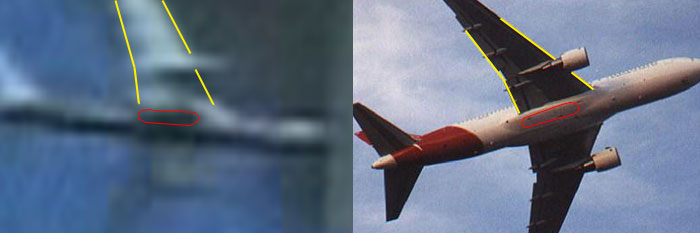
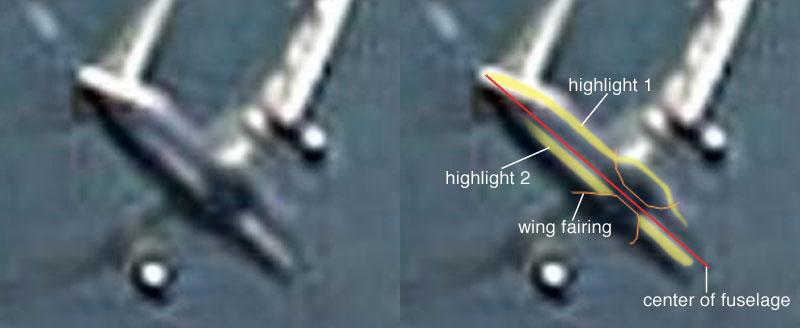
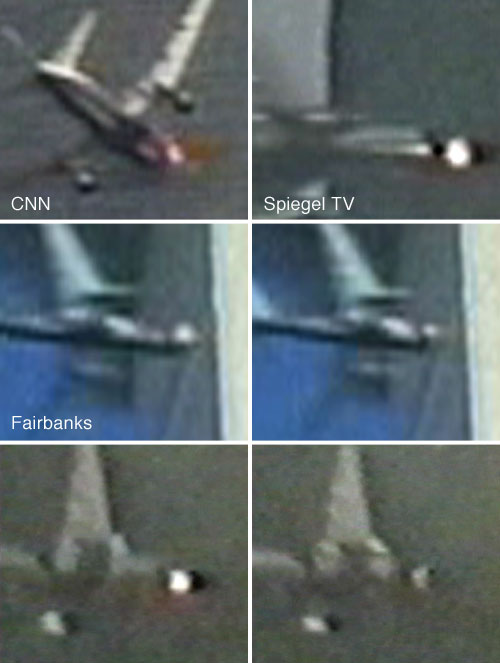
Letsroll911.org, run by Phil Jayhan, and others claim that there was a pod on the underside of Flight 175 that fired a missile as the plane entered World Trade Center 2. I have to admit that initially looking at the images of Flight 175, I was open minded about this claim. It certainly seems at first glance like there's a pod, and it doesn't suprise me that someone would come up with such a conjecture. But with further research, I have grown increasingly skeptical and believe there is a simpler explanation for these images. The 767 wing fairing vs. the "pod" The
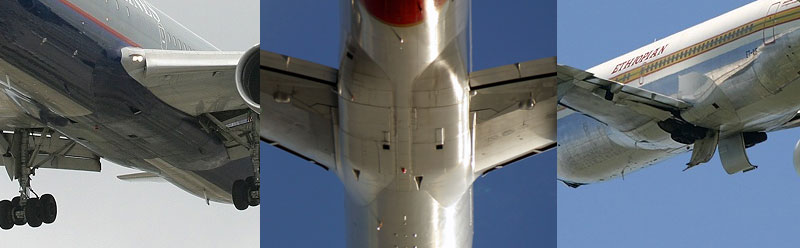
fuselage bulges out where the wings join it. This is called the wing fairing.
The landing gear assembly folds into this area when it is retracted, which
is seems to be a problem if the alleged pod is a missile launcher: The
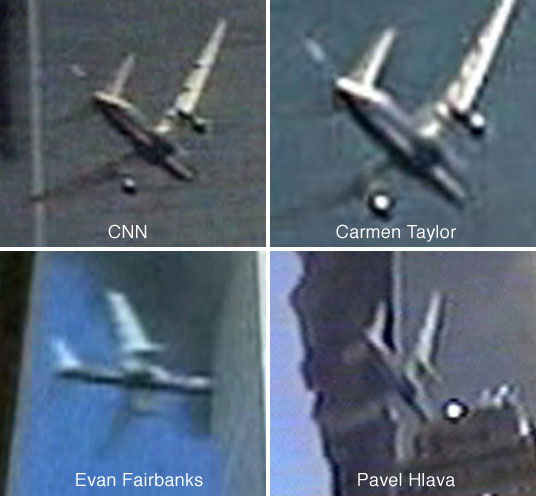
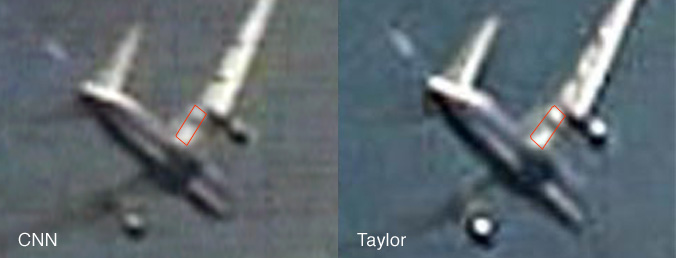
alleged pod appears in video footage from
CNN,
Evan Fairbanks, and
Pavel Hlava, and in Carmen Taylor's digital photo. In
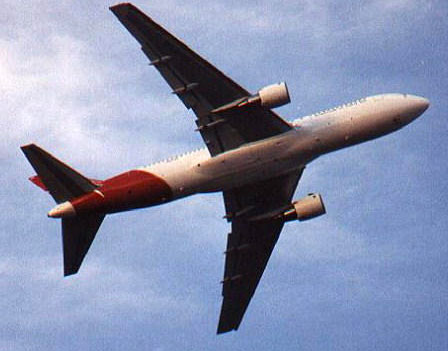
the following photo, the sunlight is weaker and more diffused than on the
morning of 9/11 so the contrast between highlight and shadow is not as
deliniated, but there are similarities to the Fairbanks footage. The entire
right side of the fuselage is illuminated while the fairing on the right
side of the plane is still dark. But the sunlight here appears to be shining
from slightly behind the plane, instead of from slightly in front. There is
one key difference: the right wing is dark here, and illuminated on Flight
175. So the question is, could the underside of the fairing remain in shadow
while the wing is illuminated?. Looking at pictures of 767s on the ground,
the angle of the wings appears to be roughly parallel to the undersides of
the fairings and that would seem to make this impossible. However the angle
of the wings, the wing dihedral, increases somewhat when the plane is
airborne. And because the 767 was making a high speed turn, the wings would
have bent up even further then is normal than in level flight. This might
allow the underside of the wing to be illuminated while the underside of the
fairing remains dark. In
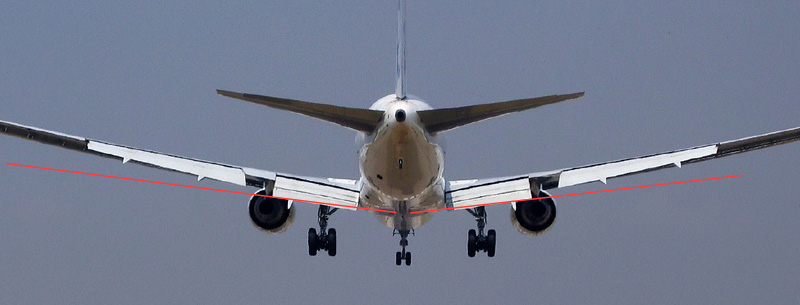
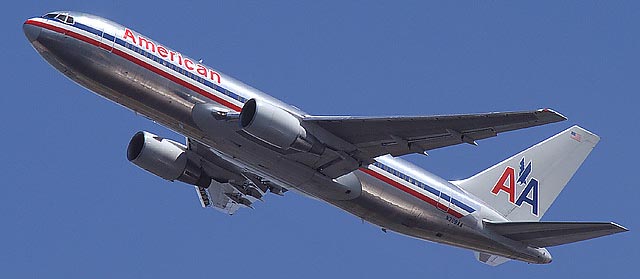
the following photo of a 767 there is a difference in the angles of the
wings and that of the innermost part of the wing fairings. However, the
measurement of the angle of the fairing surfaces was made by looking at
horizontal linear reflections on the fairings, so it should be considered a
rough measurement. That said, I can't see any reason to argue against the
assumption that, at a certain angle, it is possible for the wing to be
illuminated while the fairing remains relatively shaded, especially if the
wings were bent upwards even further than normal because of the high speed
turn Flight 175 was making at the time. Additionally, the size and location of the "pod" in the Fairbanks footage corresponds almost precisely with the flat bottom of the wing fairing, the part that could stay in shadow even if the rest of the fairing is illuminated. Notice that the front end of the fairing has a more gradual blending into the fuselage, which causes the flat area to end a distance back from the front of the wing. Another thing: if the shadow in the Fairbanks footage was caused by a raised, rounded pod, then the shadow should be half the width that we see. One side of the pod would be illuminated by sunlight, and the other would be in shadow. Instead, we see an area of shadow which is the full width of the fairing, indicating that the dark area seen in the Fairbanks video can be identified as the wing fairing, and not a pod, with a high degree of certainty.
The source for the Hlava footage analyzed in this article is an MPEG4 found on the web, so I'm not sure what the quality of the original video is. In that MPEG4 movie, there is a video artifact called "ringing" affecting the image. This was present in the video before it was compressed for the web. It is a result of signal degradation through dubbing or broadcasting, although it may also be present to some extent in the original footage. Notice how on the vertical edges between light and dark areas, such as the right wing or the edge of the building, there is a sort of ghosting effect that adds a black halo. This is ringing. Also notice where the ringing happens, such as the edge of the smoke cloud, it appears to be somewhat rounded or raised. Ringing would be created by the transition from the shaded fairing to the illuminated wing, and may be causing the fairing area to take on the more of the raised appearance of a pod. One more note about the Hlava "pod": it looks thinner and straighter than the "pod" in the CNN or Taylor images, in which it appears more rounded. I don't think foreshortening due to perspective could cause this difference, because the angles of view of the plane are not that different. This should be factored in as supporting the optical illusion hypothesis.
Looking at the CNN and Taylor images, there are a couple things that might
help create the illusion of a pod. The stripe-like reflection that runs down
the left side of the fuselage is interrupted by the fairing on the left side.
This might appear to some to be a shadow cast by the pod. Remember this
reflection is caused by light coming up from below and could not be
interrupted by any shadow from the pod. The second observation I would make
about the CNN and Taylor images is that the innermost flap on the right wing
is brightly illuminated. This may be helping to create what looks like the
bright right edge of the pod. In each image there is a small portion of the
bright area next to the fuselage which does not seem to be part of the flap.
This could be part of the wing fairing catching the light. But there may be
another explanation. The CCDs in video or digital still cameras react poorly
to very bright highlights. Notice in the Taylor photo how bright highlights
on the engines have flared out into round blobs. The highlight is
"blooming", expanding beyond it's size in real life due to the nature of
video technology. The highlight on the flap may also be blooming, causing it
to overlap onto the fuselage.
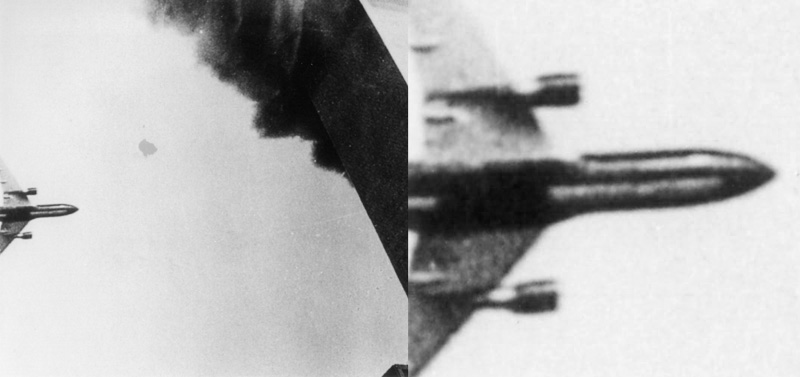
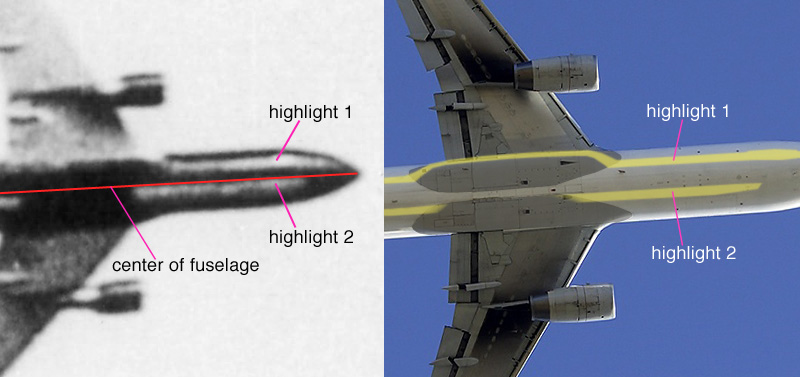
Linear reflections on the fuselage are clearly visible in the CNN and Taylor
images. These reflections could contribute to the pod, but before analyzing
these images, there is another photograph which more clearly demonstrates
how these reflections could be responsible for the appearance of a pod.
Recently, Letsroll911 has posted a newly acquired black and white photograph
of Flight 175: Like
the black and white photo, the asymmetry of the shapes of the left and right
wing fairing areas in the CNN footage and Carmen Taylor's photo is also
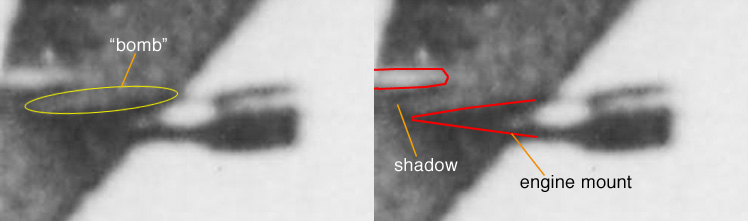
probably caused by the differing positions of the reflections: The "bomb" One
more note on the black and white photo. Jayhan
claims that there is a bomb fixed to the left engine of the 767. This is
an illusion created by the engine mount, the ridge-like part that goes over
the flap (I don't know it's name) and a dark area of shadow between those
two parts. Also, there is no sign of a bomb in the
CNN footage. Head-on angle shows no evidence of the pod
Another problem with the pod theory is that there isn't a pod visible in
this piece of footage from CNN's DVD of 9/11: A "missile"
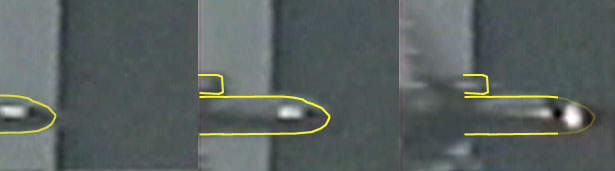
Letsroll911.org identifies a cylindrical white shape on the side of flight
175 as a missile. The source for this analysis is a
movie taped off Spiegel TV of Germany. Overlaying the outline of the
plane on the footage, it's clear that this shape is not making forward
progress in relation to the plane, and in fact is remaining in the exact
same position. It is a reflection of sunlight on the plane's fuselage. One difference between professional file photos of 767s and the images of flight 175 are the reflections on the underside of the fuselage. Airport runways are a mostly a wide field of the same brightness, whereas flight 175 was reflecting a high contrast image from the city below, a mixture of light and shadows from the buildings in the morning sun. One of the reasons the underside of flight 175 seemed metallic instead of blue was because of the contrast of light and dark in these specular highlights, something that our mind normally associates with metallic surfaces. With a higher contrast in the reflections, there is more of a chance for the creation of an illusion of a protruding object on the plane. Letsroll and others have misidentified reflections as pipes or other cylindrical objects on the plane's surface. Here
are some examples of how reflective cylindrical objects reflect light: Spanish cylinders A
newspaper in Spain
published a
article that concluded that there were cylindrical objects on the
underside of the fuselage, in addition to the pod. It referenced an
image
analysis done at a Spanish university. Although the analysis uses a lot
of fancy terms, it doesn't stand up to scrutiny. They identified images in
which "cylindrical objects" are visible on the plane and applied filtering: The "flash" A
flash appears in 4 videos-the
CNN,
Spiegel TV, and
Evan Fairbanks footage and an
unidentified source from the In Plane Site DVD: There
have been some claims that the flashes occured just before the impacts. I
think these are erroneous; the South Tower flash is clearly timed with the
contact of the nose with the building, which can be verified by carefully
following the movement of the nose of the plane leading up to impact. In the
case of the North Tower flash, which is visible in the Naudet brothers'
footage, the plane's shadow (extending down diagonally to the right) meets
up solidly nose to nose with the plane immediately before the flash.
Therefore, this flash also occured at the moment of contact, at least to the
degree that one can be certain based on the low resolution of the footage: In the case of the south tower, In Plane Site and others have claimed that there is a gap between the fuselage and the flash, using the Spiegel TV footage to support this. But keep in mind that the building casts a very slender shadow over the front part of the plane as it enters. The shadow can be seen over the front part of the nose when the flash occurs in the Fairbanks and Spiegel footage, and can also be seen on the wings and engines in the CNN footage. Notice in the CNN footage how the left engine loses it's highlight just before entering the building. The appearance of a gap was probably caused by the shadow of the building on the fuselage. As part of their analysis, In Plane Site argues that the reflection of the flash can be seen on the fuselage, but this may be the tail end of the reflection of sunlight seen in earlier frames (it's shape slightly changed from flexing in the skin of the airplane due to the impact.) Or it may be a combination of both, with the reflection of the flash (which would be less intense than sunlight) on the shaded part of the fuselage obscured by the intense ringing effect from the highlight (the ringing is the dark blob in between the highlight and the flash). There have been some accusations made that the flashes have been added to the footage via digital manipulation. I do not agree with these accusations of forgery. The flashes show up in various versions of the footage from different sources, including mainstream commercial releases. The only versions of the footage that I have seen which do not have the flashes are conversions to digital files, in which the flashes can disappear due to de-interlacing (a normal part of the conversion process) in the case of footage where they only persist for one field (half of a frame). Keep in mind also that certain types of slow-motion and image enlargement processing can make it appear that the flashes have been enlarged or lengthened. The site oilempire.us, making an implied accusation of forgery, claims that there is no flash in the video "The Great Deception" released by Barrie Zwicker back in 2002, but I looked at the video and it was indeed there.
Letsroll identifies the flash as the exhaust of the missile entering the
building. The problem is we don't see a missile and there is no smoke trail
visible. If I had to speculate on what weaponry could cause this, I would be
more inclined to propose some kind of energy weapon. JackBlood.com has an
analysis by Mario Andrade that speculates that the flash is light and flame
emitted by a general purpose bomb with a nose tip fuzing system equipped
with a delayed timer: In Plane Site claims that the flash represents use of an explosive device which was required to act as like a match to ignite the fuel into the subsequent fireball — without offering any further explanation. The first question that came to my mind after hearing this was, since when do crashing airplanes need such assistance to cause their fuel to ignite?!! I suppose, then, that every other fiery airplane crash in history must also have featured the use of one of these secret devices.
Beyond this, many more speculations could be offered. Perhaps some explosive
weapon was triggered from inside the cockpit, or was hidden in the nose
cone. Perhaps, although this might be a stretch, the flash could be a result
of a massive static discharge as the aircraft hits the conductive surface of
the tower (metal-skinned airplanes of all types can build up very large
electrical charges during flight; normally, these are dissipated gradually
through special external attachments known as static wicks, but under the
right circumstances, a sudden uncontrolled discharge can be as powerful as a
small lightning bolt, and occurences of this kind are on record).
Alternately, some people argue that the flash was just a shower of sparks as
the plane collided, metal on metal, with the building. Neither of these
hypotheses would seem to account for the especially bright North Tower
flash, however. Eric Bart speculates that the North Tower flash might
indicate the use of 'shaped charge' explosives: Ultimately, there are only speculations at this point concerning the flashes, and I definitely do not claim to have the answer. Undoubtedly, any attempt to explain things further must be backed up with expert testimony from people with the right expertise in explosives, engineering, etc. Regardless, in the case of both flashes, the visual record is so limited that I seriously doubt that any definitive explanation will ever be found, so one must weigh the risks and benefits of delving into a potentially irresolvable are of speculation which may not be guaranteed to help break the overall case of 9/11. Still, the flashes could be a reason to be open minded about the potential that there was more going on with these two planes and the impacts than the official story admits. A cargo plane?
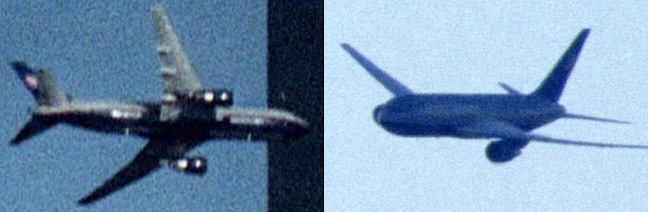
Letsroll and In Plane Site claim that the 767 has no windows and is
therefore might be a prototype KC767 fuel tanker. This is not a credible
claim, being based on photos in which the windows are as small or smaller in
size than the noise or grain in the image. The windows shouldn't be visible
to begin with at this level of detail. Notice in the second photograph that
the cockpit windows, which are twice the size of the passenger windows, are
themselves barely visible. Also note that in the first photo on this page at
the top left, the windows are not very visible despite the fact that it is a
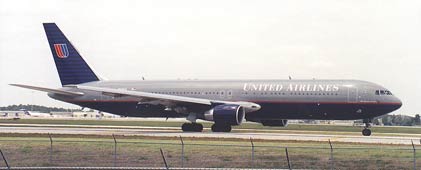
much sharper photo. Seeming to back up the claim of no windows, In Plane Site features an apparent interview (audio only) with a Fox News reporter who claims that the airliner looked like a windowless cargo 767. He also claimes that it had markings clearly different than United Airlines, including an unfamiliar round symbol on the nose. This immediately presents a problem, because it is clear enough in the left photo above that the airliner is indeed painted in the UA color scheme -- even the narrow red stripe down the side of the fuselage can faintly be discerned. No errant large logos are visible, certainly not in either of the above two photos, nor in any other photos or footage I have seen. On top of this, this witness also happens to mention that he was in Brooklyn! This would put him at least a mile away from the WTC. This leaves something to be desired concerning the reliability of this one-of-a-kind report, to put it mildly. 767 with United Airlines paint scheme:
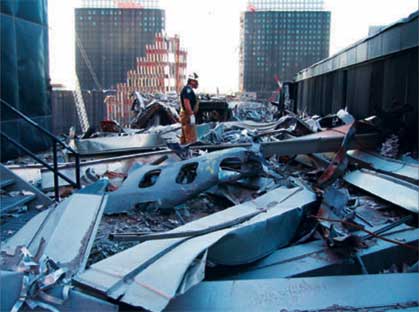
A piece of fuselage wreckage at the WTC, with windows:
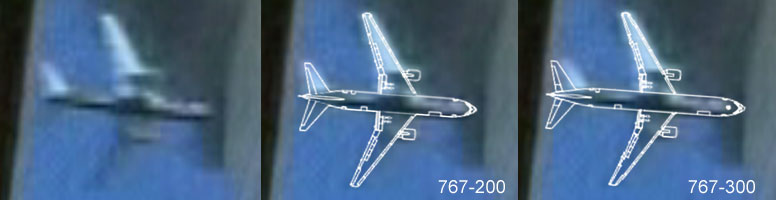
The
authors of the following claim that the size of the plane that hit the WTC
is not the size of a 200 series 767, which flight 175 was, and instead is
closer to a 300 series 767, which has a longer fuselage: This simply isn't true as the following graphic illustrates. I've overlaid the 767 schematics they provided on the Fairbanks footage. It is clear that the 200 series is a near perfect fit and the 300 series fuselage is too long.
So why did they get it wrong? Notice in the graphic that they used, that the midline of their line diagram is on the side of the fuselage and not the center, allowing it to be scaled down smaller than it should be and still match up with the clearly visible right wingtip. I should take a moment to note that some researchers have found other non-visual forms of evidence which might suggest that a plane "substitution" could have taken place in the 9/11 plot, such as discrepancies in official flight records, anomalies in the FAA and military response to the alleged hijackings, suspicious military war games occurring on the same morning, and so forth. I am not implying any opposition to these areas of inquiry; in fact, I believe they are quite worthy areas for continued investigation (and, for the record, the fact that I have been mentioning "flight 175" does not imply that I have ruled out these substitution possibilities). For now, I am just analyzing the visual record to determine what it can or cannot tell us reliably. Conclusion As it stands, the presence of a pod cannot be absolutely proven or disproven given the low quality of the visual record. The only evidence presented so far for it's existence is that in several low quality images it looks like there is a pod there. The pod advocates, who overwhelmingly bear the burden of proof, have not systematically proven that it could not have been an optical illusion. There is more than sufficient reason to conclude that the alleged pod is most likely the result of the play of light on the body of the 767 around its normal wing fairing, especially because this hypothesis holds up the best with the better quality images: the CNN footage, the Taylor photo and the new black and white photo of the underside of flight 175. So the question is, even if one still graciously allows for the remote theoretical possbility of a "pod" given the limitations of the visual record, should this be something that the 9/11 community embraces and presents to the public? Absolutely not, in my opinion, given the evidence we've seen so far. I'm not ideologically opposed to radical arguments like this, but if they're to be promoted they should be proven beyond the shadow of a doubt. The pod advocates haven't come anywhere close to that. Beyond the physical evidence, there is much about the pod theory which seems illogical. Was it really necessary to augment the impact of the plane with weaponry? The thin outer walls of the WTC would not have created any serious resistance that needed to be overcome. And if the WTC was demolished with explosives, as many believe, there was no need to maximize the internal damage caused by the impact. If more damage needed to be done to the building or the plane, why not put powerful explosives safely inside the plane that would be totally hidden and not prone to any mechanical failures that can befall missiles or any hatches that needed to open on a pod? If there happened to be a better quality image of the impact, which theoretically could easily have happened, a pod or a missile fired from that pod could have been clearly visible, exposing the fraudulent nature of the attacks. Would the perpetrators have risked this? Even if weaponry was needed, and if it was a missile launcher, putting it at the juncture of the wing and fuselage would be a bizarre choice from an engineering perspective. The retracted landing gear would be sitting pretty much in the middle of the pod, which doesn't seem to me to leave much room for a missile! At this point we have neither definitive proof of the pod's existence nor any logical reason for the perpetrators to resort to its use. The way I see it, the only responsible thing to do is to put the pod issue on the back burner until there is a more compelling argument presented. Otherwise, it will only serve as a distraction from other evidence for a 9/11 "inside job" that is genuinely credible and substantive, and worthy to be presented to the public. More skeptical analysis on the pod can be found here, in an article by Mark Hungerford. He has very similar conclusions about the pod, although I'm not in complete agreement with all of his technical analyses. What he has to report about how skeptics are treated at the Letsroll911 forums is disturbing.
Sources for the 767 images used in this article: |

VOLTAR