
"Heaven's light is Our Guide"

Rajshahi University of Engineering and Technology
(Unofficial website)
1. Admission Notice of 2005-2006 session
2. Admission Date for 2005-2006 session
3. Notice for Admission for 2005-2006 session
4. Merit List for Admission Test for 2005-2006 session
5. Tribal List for Admission Test for 2005-2006 session
6. Waiting List for Admission Test for 2005-2006 session
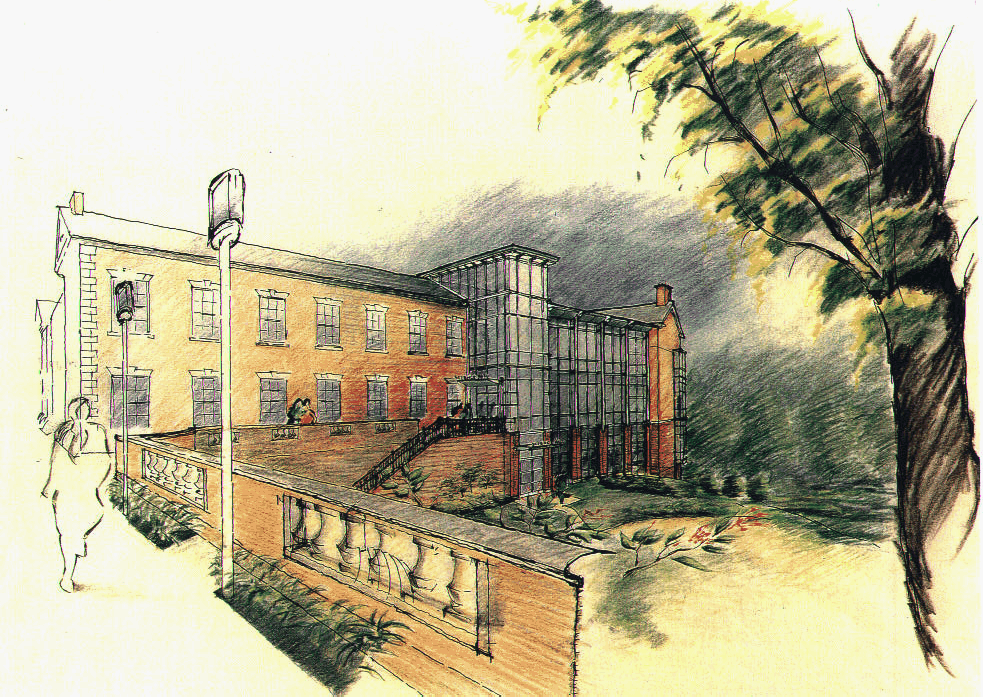
RUET is located on the North side of Rajshahi-Natore-Dhaka road at Kazla, 5 kilometers east of Rajshahi city, on 150 acres of land. Known as green campus with so many varieties of trees, the campus is laid out with a picturesque landscape by the side of famous Padma River and Rajshahi University.
The Campus presents a spectacular harmony of architecture and natural beauty. The campus area has been divided into different functional zones: (i) Residence for students, (ii) Residential zones of faculty and other supporting staff, (iii) Academic zone for academic buildings and laboratories/workshops, and (iv) Cultural cum social and recreational zones for students. A branch of Rupali Bank, a post office, an auditorium and a medical center are located on the campus. For the education of the children of the University employees, there is one school cum college.
dormitories located in the dormitory area. There are adequate number of
quarters inside the campus for providing residential facilities to the teachers and the employees of the Institute. It is an ideal campus with exquisite natural sceneries and free from the hustle and bustle of the busy town. The Institute provides transport facilities to the students, teachers and employees for corporate and restricted individual uses. There is a secondary school inside the campus for providing elementary and secondary school education, primarily, to the children of RUET faculty members and staffs. At present, the Institute has ten teaching departments. The Institute has the following Degree awarding departments; The institute offers courses leading to the award of following degrees: The Academic council is preparing proposals for Doctor of Philosophy programs and will be implemented in the
near future subjected to the approval of the board of governors(BOG ). The B. Sc. Engg. courses extend over a period of four academic years, each of a normal duration of one calendar year, which is divided into two semesters. Hence, in terms of semesters, the total length of B. Sc Engg. courses is 8 semisters.
The normal duration of M. Sc. Engg. course is three semesters.
Teaching for the courses is reckoned in credits and the credits allotted to
various courses are determined by the committee of courses using the following
credit conversion guidelines;
The total number of credits in four years that the students have to complete succesfully for the award of B. Sc. Engg. degree is at least 360. The excerpt of the letter grade system used to assess the performance of the students is given below;
A student who has a grade point average (GPA) of 2.0 or higher and no F grade in the theory courses an not less than C grades in the sessional courses of the two semesters comprising an academic year is promoted to the next higher class.
The minimum CGPA for getting B. Sc Engineering Degree is 2.0. A detail
description of the letter grading system presented above can be obtained from
the VC's Office. The university maintains outstanding laboratory facilities to provide adequate practical training to the students both in the basic and advanced levels. The inventory of the equipments is being updated continuously to meet the growing technological demands for both in the local and global perspectives. The Institute emphasizes both theoretical and practical aspects of computing and has a central computer center contains more than 40 IBM PC XT/AT compatible computers. The authorities of the computer center is considering to buy work-stations to provide better computing facilities, LAN and INTERNET
connections. A microprocessor training System in installed in this laboratory to develop
prototype microprocessor based controllers and systems. The central library is the main source for the text and reference books and
periodicals. The contents of the central library are being continuously updated with newly available books and periodicals. The Institute is supported by donor organizations, namely; the Asia Foundation and the British Council to develop adequate library facilities regularly. Mosque is the monument of an Islamic society. To do regular prayers, a mosque was built at the central position of Institute campus. The mosque is led by a
full-time imam. The Institute has three dormitories for the male students and one temporary
residence for the female students. Nearly 90% of the students live in the
dormitories. BOG is the topmost authority of BITs. The chairman of BOG is nominated by the government of the People's Republic of Bangladesh. BOG members are selected in accordence with the procedure described in the Institute Statute.
The VC's Office
Vice-chancellor
, Rajshahi University
of Engineering and Technology
Kajla, RAJSHAHI 6204
BANGLADESH +880-(0)721-750798
 +880-721-76254
RUET starts its journey
The Rajshahi University of Engineering and Technology started its journey on September 1 with a daylong programme on the campus.
The lone institution for engineering education in the north-west was elevated from an institute of technology to a full-fledged university along with three such institutions in Dhaka, Chittagong and Khulna, pushing the tally of public universities to 21.
On the occasion, a discussion was organised at the university auditorium in the morning, with Mayor of the Rajshahi City Corporation Mizanur Rahman Minu MP, as chief guest.
Presided over by founder vice-chancellor of the university Professor Keramat Ali Molla, the meeting was addressed, among others, by Professor A.M. Rezaul Karim Talukder of Electrical and Electronics Department.
Earlier, the Rajshahi mayor opened the university and planted three saplings of forest, fruit and herbal trees on the campus.
Students, teachers, officials, employees, local political leaders and other persons concerned were present.
Speaking on the occasion, Minu praised Prime Minister Khaleda Zia for turning the Bangladesh Institute of Technology (BIT), Rajshahi, into a full-fledged engineering and technological university along with three other BITs in the country.
He laid emphasis on maintaining congenial and academic atmosphere on the campus in the greater interest of acquiring knowledge to reach the country to its cherished goal.
The mayor said the government had allocated Tk. 88 crore in the first stage of the university's development and more money would be sanctioned in the next phase.
The university sources said an engineering college was established on about 150 acres of land at the outskirts of Rajshahi city in 1962. The college was converted to a BIT in 1986. Some 13,000 students have so far obtained degrees on civil, mechanical, and electrical and electronics engineering, and computer science.
The institution also launched post-graduate courses on these disciplines about two years back.
A colourful procession of teachers, students, officials and employees earlier paraded the main campus of the university. Also, a tree plantation programme was launched.
The daylong programme ended with a football friendly.
.

Table of
Contents
Introducing Rajshahi University of Engineering and Technology is one of the most prominent autonomous technological institutions providing engineering education in Bangladesh.
Rajshahi University of Engineering & Technology is one of the prestigious Universities in the Northern part of Bangladesh offering Engineering and Technological education effectively. It was founded in 1964 as a faculty of Engineering under the University of Rajshahi providing four years Bachelor degree in Civil, Electrical and Electronic and Mechanical Engineering. However, the institution could not achieve its goal because of the complicated management system: The administration was controlled by the Ministry of Education; academic curriculum by the University of Rajshahi and the infrastructural development and maintenance by the Public Works Department. To circumvent the aforesaid problems several committees and commissions were formed since 1973. On the recommendation of these committees/commissions and having considered the practical aspects, Shahid President Ziaur Rahman had taken a historical step to give autonomy to the four Engineering Colleges to make them centers of excellence of technology. To implement his idea President Zia had formed a 15 member high-powered committee headed by Professor Dr. Wahid Uddin Ahmed, the then Vice Chancellor of BUET. The consistent effort of this committee ultimately led to the establishment of 4 Engineering colleges to Bangladesh Institute of Technology (BIT) in July 1986. But due to limited autonomy and some constitutional inadequacies of the BIT ordinance, the expected progress of the Institutions could not be achieved. This ultimately necessitates reframing the Institutes as full-fledged universities. Due to her keen interest on the development of Engineering Education it is the Honorable Primeminister Begum Khaleda Zia who took the appropriate steps to convert the 4 BITs to Engineering and Technological Universities. Under her dynamic leadership the present parliament passed the university bill and that ultimately paved the way to commence the activities of university from Septmenber1 2002. The name of our BIT became Rajshahi University of Engineering & Technology (RUET).
 Back to the Contents
Mailing Address
(
VC's Office)
Prof. Dr. A.K.M. Anwarul Haque
VC, Rajshahi University of Engineering and Technology
Rajshahi-6204
Bangladesh
Tel/Fax:
+880-(0)721-750798
Teaching Departments
Back to the Contents
Degree awarding Departments
Degrees Offered
Back to the Contents
Duration of Courses
Nature of course
Contact hour
Number of credits
Theory Lecture
1 hour/week
1
Tutorial
1 hour/week
1
Lab/Sessional
3/2 hours/week
1
2-3 hours/week
2
Project/Thesis
6 hours/week
4
Field Work
2 weeks of field work 1
Back to the Contents
Grading System
.
Numerical Grade
Letter Grade
Grade Point(GP)
Class Based on Cumulative Grade point average(CGPA)
GT80% or above
A
4.0
Honors
GE70% but LT 80%
B+
3.5
Honors
GE60% but LT70%
B
3.0
First Class
GE50% but LT60%
C+
2.5
Second Class
GE45% but LT50%
C
2.0
Second Class
GE40% but LT45%
D+
1.5
GE36% but LT40%
D
1.0
LT35%
F
0.0
Minimum Grade-Points for the
Graduation
Back to the Content
Academic and Extra-Curricular
Facilities
Academic Facilities:
Laboratory Facilities:
Computer Center:
Back to the Content
Microprocessor Training Laboratory:
Central Library Complex:
Departmental Rental Library: Besides the central library, each teaching
department has its own library contains the reference books for the respective
fields. The students are allowed to rent books from the rental library for one
academic year.
Extra-Curricular Facilities
Physical Training
Complex: A sound mind in a sound body,
keeping this philosophy in mind, the Institute authority has established the
physical training complex with ample facilities which include:
The Institute Central Mosque:
Dormitories
Board of
Governors
Back to the Content