Story telling is an art. Certainly, not everyone can or has the gift for telling stories which capture the audiences attention and imagination. Fortunately, many railroad workers have cultivated this skill; probably as a result of a lot of time on the road with which to practice. And those of us who enjoy hearing the stories are grateful. However, one of the finest story tellers was not a railroad man. This vocal artists work is featured every year around this time.
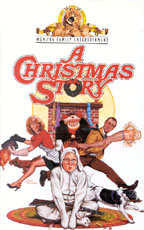
So, what's the Nickel Plate connection with the 1983 MGM/UA film A Christmas Story? It is the setting for one. The film, starring Peter Billingsley, Melinda Dillon, and Darren McGavin is based upon the novel "In God We Trust, All Others Pay Cash" by Jean Shepherd. Shep also narrates the film. His superb story telling skills and wonderful, exhuberant voice adds tremendously to the films ambiance and believability.
The movie is set in the 1940s Hohman [read Hammond], Indiana, where nine-year-old Ralphie Parker (Billingsley) seeks a "Genuine Red Ryder Carbine Action Two-Hundred Shot Lightning Loader Range Model Air Rifle" for Christmas. But he constantly runs into the grown-up rebuttal: "You'll shoot your eye out."
Jean Shepherd was originally from Hammond, Indiana. Later, Shepherd had his own radio program out of New York where he often told stories of growing up.
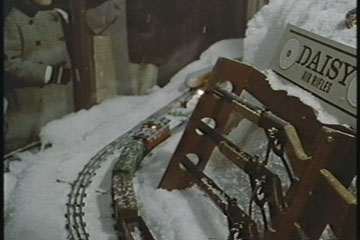
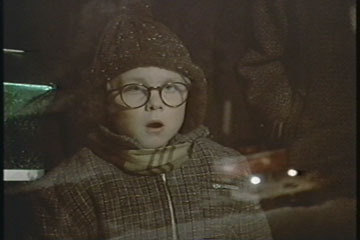
The Nickel Plate passed through Hammond enroute to Chicago. While this is a small correlation, there does appear to be instances of the old NKP popping up in the film. In the window scene of the department store is a model railroad layout. There appear to be several instances of berkshires showing up and what is clearly a Nickel Plate Road 1000-series caboose.
CLICK the images at left to see larger pictures. You decide! Furthermore, "Ralphie" lived on Cleveland Street in Hammond, Indiana. Cleveland Street was bounded on the north and south by railroads headed towards Chicago. Unfortunately, I do not know if either of these were the Nickel Plate. Perhaps someone in the know will email TRKneller with the appropriate information.
I must say that I am thoroughly amazed that a film research department would care enough to include appropriate railroads in miniature for the historical time and place covered. I am even more amazed that the Nickel Plate appears to have been selected as one. Since this minor disovery, I often imagine the steam whistles frequently heard in the film as those of the Nickel Plate. I wonder, though, if Mr. Shepherd had any input on the selection of railroads? Perhaps Shep was a fan of the line of High Speed Service. With those beautiful, red cabooses and graceful berkshires, who could resist anyway? I may never know for sure, but I think that in my book I'll keep Jean Shepherd as a Nickel Plate fan.
TRKneller
 Contents