
|
|
Home
|
|
News Wire
|
|
LIVE Trains
|
|
Photographs
|
|
Railroads of Whitley Co., IN
|
|
Allen County Public Library
|
|
Links
|
|
Past Issues
|
|
Contact
|

|
|
Quick News
Opinion piece
United States troops begin liberation of Iraq's oppressed. In complete opposition to the cries of the anti-war movement, Iraq's citizens eagerly look forward to freedom. Cities freed by US troops see the populous explode in celebration when they realize that the current US President means what he says. While some still attempt to debunk the mission since few, if any, WMDs have been found, the liberation of the populous should be viewed as the real goal. It is now clear that Saddam Hussein needed to go and that the populous of Iraq was more than ready for him to go.
...more war news
|
|
Editorial
Where's the Future Headed?
Isn't is amazing that it took more than forty years for the most powerful diesels to match the horsepower of the most powerful steam engines. Sure, BigBoy was an articulated engine and essentially, then, two engines under a single boiler, but most would view it as a single locomotive. Some claim that BigBoy could produce far more than 6000 horse power (hp) at the drawbar. It was onlw within the last decade that diesel units began to hit the 6000-hp per unit mark.
The realization of a 6000-hp unit is a real achievement. While revisiting an old issue of TRAINS magazine [August 2001], it was noted that many railroads had not yet found many uses for such powerful units. In fact, most railroads complained that the units were far too complicated to troubleshoot and maintain. The truth is that each unit has at least six microprocessors to maintain the systems of the locomotive. Specialized software has to control everything on the locomotive or knuckle breakage will become very common. They have reached a point where even the finest hand on the throttle isn't enough finese. While the locomotive may only show 8 notches on the throttle, the sub-systems are providing an infinitly variable throttle setting based on data from all aspects of the locomotives current state of condition and work.
Still, some out there ponder the question of what steam would be like today had it been allowed to progress. I would guess that railroading would still not be as glamorous as it had been prior to the late 1950s. Steam was even then going through a metamophasis with exploration in steam turbine technology. Rationally, it is safe to say that steam had it's day.
So where does the future lead? With steam surely out of the question and railroads struggling to find uses for the newest generations of power, what lies ahead for railroading? Will diesel go the way of steam? A victim of too much technology for an archaic mode of transportation? Perhaps, all railroads will be museums. Perhaps growth will stop and rest assured that loco manufacturers won't stay around when railroads aren't purchasing. Stagnation would kill them all. So where will it all go?
Nearly 180 years ago railroading took off in this country. So long as bulk, heavy commodities need to be moved railroads will be required to do the work. There is still no better way to move that kind of freight across the land. Railroads will figure out how to use the more powerful tools and the builders will figure out how to make them stronger, safer, and more reliable and simple. While many questions were raised, the future of railroading is far from its end. And who says steam can't come back? After all, steam turns the turbines of a nuclear powered submarine!
|
|
Feature
FWRHS Progress
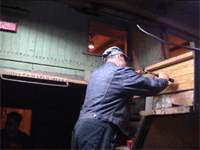
Work begins inside NKP (LE&W) caboose 141.
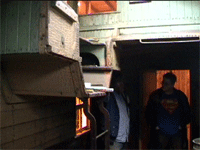
Note the simple iron ladder up to the cupola. 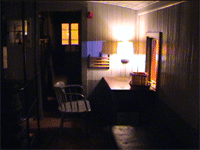
Inside the Wabash caboose.
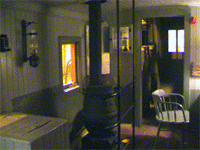
Someday soon the NKP cab will look as good as this Wabash unit.
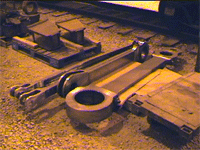
Some of the "smaller" rods.
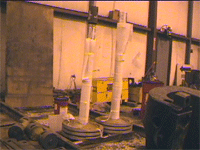
The pistons have been turned and honed. They're waiting to be reinstalled.
|
News this month comes from a recent visit to the Fort Wayne Railroad Historical Society; TrainTown. Probably the biggest surprise was that the outside of Nickel Plate Road caboose 141 has been completely resided. Work has now begun on the inside. NKP cab 141 began its life more than 105 years ago as a four-wheeled "bobber" on the Lake Erie and Western (LE&W).
Well on her way to a renewed life, she has now existed through three centuries. She began life in the late 1800s as a shorter four wheeler. Later, as laws changed, she was cut on one side of the cupola, stretched, and placed on two pair of two axel trucks. She was acquired by the NKP when the railroad was folded into the NKP. There she served throughout the twentieth century until retirement. As a wooden caboose, she was lucky to have survived. In fact, thanks to the foresight of the late John Keller of Lima, OH, it was saved in the 1960s and donated to the Society in 1975. 141 is the only LE&W caboose to survive.
With the kindness and openness of the FWRHS, we were invited inside the caboose for the first time. She is surprisingly plain and utilitarian in design. She has simple bunks and simple formed iron ladders the rise to the cupola. In the cupola are not the standard bench type seats on either side as are found in the Wabash caboose. Rather, is a strange looking "U" shaped seat that starts on the left side, wraps around the wall and winds up on the right side. I assume this facilitated an easy "slide" around to view forwards and backwards. Whatever the reason, it was plainly obvious that this caboose was from an older time than most I have seen.
Naturally, work is progressing steadily on the 765. As I watched, staybolts were being installed. Unfortunately, I did not get the name of a very kind gentleman and former railroad man, but he provided us with a thorough walk through of the work that had been preformed and that which still had to be done. Additionally, he walked us around the shop and explained each appliance we came across. Thanks a million!
While good for the 765, a few unforeseen issues have been found during the restoration. Although these new issues mean she'll not see steam as soon, it does mean that she'll be even more sound when finished. Remember, she has not seen this kind of attention for more than forty years. In light of the additional work, some still predict a steam date of later this year; perhaps September. Only time will tell.
The Society is living their mission goal. They are saying what they do and doing what they say. They are spreading out into areas that they have never touched before. They are also looking and planning for the future. No more will they be a "one locomotive" group. They are making plans to be a fully functioning railroad museum. Kudos to them.
If you have missed past reports on the future of the society, check out the Past Issues page to find the news.
|
|



