 Contents
 |
| |
 |
EDITORIAL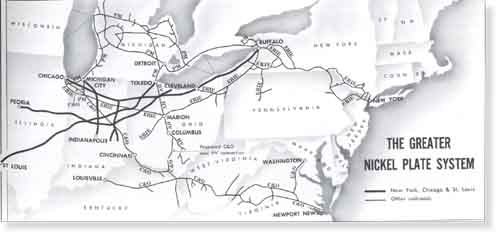
During the 1920s, the Nickel Plate was controlled by two brothers named Mantis James and Oris Paxton Van Sweringen. Together, they appointed John J. Bernet as president, Charles E. Denney as vice-president, and Augustine R. Ayers as motive power superintendent and later general manager. Along with some outside guidance, this was the nucleus of a blossoming, prominent railroad. The Vans were responsible for the Nickel Plates aquisition of the Toledo, St. Louis & Western Railroad (The Clover Leaf) and Lake Erie & Western as well as construction of the Cleveland Union Terminal. These aquisitions, along with a new Interstate Commerce Commission consolidation plan, seemed to have fueled a notion of manifest destiny. The Vans set out to test the boundries of their financial wizardry and the limits of the I.C.C. plan. On February 28, 1920, Congress passed a Transportation Act that, among other things, forced the I.C.C. to prepare a tenative railroad plan of consolidation. The idea was to reduce the number of rail systems to just a few of roughly equal size and strength. The Van Sweringen brothers effectively brought the first plan of consolidation to the I.C.C. and had so easily passed through the proceedings that they took it upon themselves to formulate a new system based around the Nickel Plate. The two brothers found complimentary lines that offered access to southern coal fields and also to major emerging automotive centers. Quickly, the Vans began to purchase stock in the railroads of interest in the name of the Vaness Holding Company. Furthermore, the Van Sweringens created a unification plan in which the Nickel Plate, New York Central, Pennsylvania, and Baltimore and Ohio would collectively absorb and distribute all other lines. These four mega-systems would control nearly all of eastern railroading operating nearly identical mileage with similar net incomes and coal tonnage hauled. The I.C.C. seemed to accept the plan and personal initiative well. The three major lines said little. On May 8, 1924, the first meeting of the four railroads in the plan met to discuss the idea. The Van's and their Nickel Plate walked out with a tenative plan to absorb the Chesapeke & Ohio, Hocking Valley, Pere Marquette, and the Erie. However, the Vans later decided to press the others for even more. They pushed for the Nickel Plate to also aquire the Lackawanna, Bessemer & Lake Erie, Wheeling & Lake Erie, Virginian, Pittsburgh & Shawmut, and Pittsburgh, Shawmut & Northern and joint ownership of the Chicago & Eastern Illinois with the New York Central. All told, the B&O was to get the Reading, Central of New Jersey, Monon, and a few others while the New York Central's major slices of the pie were to be the Lehigh Valley and New York, Ontario & Western. The Pennsylvania was assigned the Norfolk & Western, the eastern lines of the Chicago & Alton, and the Grand Trunk Western. Initially, the systems would have looked similar to this:
However balanced it looked, Samuel Rea, president of the Pennsylvania Railroad, felt his road deserved more. Rea sued for hal interest in the Virginian, Detroit & Toledo Shore Line, and the Reading with an interest in the Lehigh Valley. The Pennsylvania brass was also against the Lackawanna going to the Nickel Plate. After several meetings that left the Penn unsatisfied, the other three roads went ahead and submitted the plan to the I.C.C. on January 26, 1925. Based on the prior successes with the I.C.C., the Van Sweringens sat poised to take a marginally sized railroad into a new era of size, power, and profit potential. During this time of I.C.C. review, the Vans made many financial and stock manuevers to secure control of some of the roads in it's consolidation fold. The stock market and trade magazines around the country were watching as the Nickel Plate seemed assured of government approval and the stock climbed. Unfortunately for the Vans, a few C&O stockholders were not so willing to be bowled over. Colonel Anderson, the leader of the C&O holdouts, learned of a shady stock trust agreement between the four stockholders of the Vaness Company. In short, this agreement would allow the last surviving stockholder to divest interest in Vaness, yet still hold voting control of the Greater Nickel Plate System. This did not sit well with the I.C.C. On March 28, 1926, the proposal was flattly rejected. In fact, nearly anything tied to the proposal was abruptly cut short. The Van Sweringen brothers sat at the pinnacle of a major railroad restructuring, from which they would emerge as major players. But financial wizardry toppled the tower before it was ever built. But the Vans did leave a great legacy. They brought on fantastic leaders and created a lean, well-running railroad that was recognized on the national scene. While power or greed may have cut short the growth of the Nickel Plate, one must ponder, "What if?" SPECULATION What if the Greater Nickel Plate System had actually seen the light of day? Of course, this would require that one also considers the fate of the B&O, Pennsylvania, and the New York Central along these same lines. Gone, then, would be the Penn-NYC merger, the NKP-N&W-WAB merger, the C&O-B&O consolidation, and the entire face of railroading today. Even if the four had compressed into two systems, two of these four great names would probably still exist. Or, would this have hastened the collapse of eastern railroading? Strangely enough, many of the lines that the NKP would have grabbed are now gone (at least through Indiana). But would this have been the fate if the lines had merged? Certainly some of these lines would have been shed, assuming that Congress would have went on to allow it. Yet, some lines may have stayed by assuming newer, more important roles in a consolidated system. Unfortunately, I don't have a map that shows what the other consolidated lines might have looked like for comparison. Naturally, this kind of speculation only produces more questions. But, for those model railroaders, these questions may be answered by thier own imaginations. Sure, some may cry, "Foul!" Those purists who model the way it is or was. But many fine model railroads have been created from pure fiction or loose coupling of real roads and environments. I have often lemented the fact that the Nickel Plate, my favorite railroad, missed out on many beautiful deisels. Sure, they had great steam. But what could this Greater Nickel Plate System have afforded us. A wider variety of steam and deisel? Surely, in the mountainous C&O regions power would have been greatly different from that of the flat-lands of Indiana. Perhaps Tony Koester's Alleghany Midland would have been more real than fiction. Well, there's no turning back time. All these great roads are gone. I guess the point of all this is just a mental exercise. Perhaps, when I have time to build my own model railroad (NKP naturally), I'll consider a Greater Nickel Plate System. Or, maybe, someone else will take on this exercise. Nah, I'll just go with my plan to build the Chicago Division. But what if...?
Source: The Nickel Plate Story, John Rehor - Kalmbach Publishing
|
||||||||||||||||||||||||||||||
| Copyright � TRKneller 2002 Contact: TRKneller | ||||||||||||||||||||||||||||||
| Any comments, corrections, or additions should be directed to: TRKneller | ||||||||||||||||||||||||||||||