 Contents
 |
| |
 |
Fort Wayne Railroad Historical Society |
|
Equipment Type |
Description |
765 Nickel Plate Railroad 2-8-4 Berkshire fast-freight steam locomotive 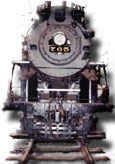 |
This locomotive was built by the Lima Locomotive Works (Lima, Ohio) in 1944 and is one of 80 nearly identical engines. A few, including the 765, were set up for use as back-up passenger locomotives in addition to their use as freight locomotives. The 765 operated out of Fort Wayne for much of her career, pulling trains between Chicago and Bellevue, Ohio. She was in use until June, 1958. All steam operation on the Nickel Plate Railroad ceased a month later. The 765 was stored in Fort Wayne at the East Wayne roundhouse. This building still stands and today houses the Norfolk Southern Lake Division offices and dispatch center. Exhibited in Fort Wayne's Lawton Park from 1963 until 1974, her deterioration outdoors led to the formation of the Society for her protection and restoration. In 1979 the 765 was steamed up for the first time since retirement and pulled excursion trains until 1993. She was operated far from her home Nickel Plate rails, traveling to at least 14 states. In her career with the Society, she has pulled up to 33 passenger cars in one train and raced at 79 miles per hour more than once. Ready to roll, the locomotive weighs over 400 tons and carries 22 tons of coal and 22,000 gallons of water. A major overhaul is now required and will take place over the next few years. The locomotive will be lifted and the driving wheels, bearings, frame, and side rods will receive much needed attention. During this time the boiler will be cleaned, ultrasound tested, and reassembled with new flues and superheater units. We'll also renew some worn areas in the firebox. Decades of rust till be sandblasted inside the tender, steel sheets replaced and the interior painted. There are other smaller projects that will complete the overhaul including servicing all of the appliances such as the air and water pumps. At the conclusion, the 765 will look and perform as it did in 1944 and will be an operating museum bringing living history to thousands of people. |
Nickel Plate Road caboose #141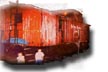 |
This wooden bodied car was built for the Nickel Plate predecessor Lake Erie & Western as a four-wheel (two axel) caboose. Later it was lengthened and given two four-wheel trucks. John Keller, of Lima, Ohio, who donated it to the Society in 1975, saved it in the 1960s. Of all the Nickel Plate cabooses saved, this is the only one of the LE&W models to survive. Currently, this car is being restored with new sheeting, roofing, and other woodwork as needed. This caboose is typical of those that would have been at the end of freight trains pulled by the 765 through Fort Wayne in the height of its railroad days. |
| Nickel Plate box car #X-50448 | The Haskell & Barker Company of Michigan City, Indiana, built this wooden car for the Lake Erie & Western in 1902 as their #43074. After the 1922 merger with the Nickel Plate, it became the #83074. It survived in work train service until after the Norfolk & Western merger of 1964 when it was sold to Dick Yager of Fort Wayne who donated it to the Society. This car will be restored although its deteriorated condition will require substantial work. |
Norfolk & Western #540019 200-ton crane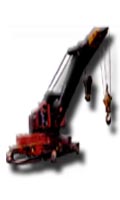 |
This crane was built by the Industrial Works Bay City, Michigan, in 1922 for the Virginian Railroad. It was transferred to the Norfolk & Western after the 1959 acquisition of the Virginian. It last saw service in Fort Wayne around 1986. This crane (wrecker, derrick, or big-hook), originally built as steam-powered, was converted to diesel power in 1959. Its lifting capacity is rated for 90 tons at a radius of 28 feet or 200 tons at 17 feet. It weighs approximately 356,000 pounds, or as much as a modern diesel locomotive. The long boom and lifted load is counterbalanced by a massive counter weight on the rear of the cab. Prior to the crane's use, large beams must be run out of their storage pockets and cribbed (braced) to prevent the crane from tipping over when the boom is swung; especially when lifting a heavy load. It is used from time to time by the Society to assist in restoration work on other equipment. Accompanying the crane is an Illinois Terminal flat car (#341100453) to act as an idler car, accomodate the boom, and store rail. This 55-ton capacity flat car was built in 1945. |
Diesel locomotive #1231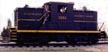 |
This locomotive was built in 1953 by the Davenport Besler Corp. for the U.S. Army. The 1231 spent most of her career at the former Casad Military Depot south of the shop. It was donated to the Society around 1985. It weighs 44-tons and has two V-8 Caterpillar diesel engines that develop approximately 400 horsepower. The locomotive is operational and as the serves the shop switcher and as a rolling classroom for the "Engineer for an Hour*" program. You can learn about railroading and operate this locomotive by enrolling in this program. This also a great gift idea for anyone interested in railroading. * Participants receive instruction in general railroad operations, locomotive and rail braking systems and diesel locomotive inspection and operation. The program takes about 1 � hours with one hour devoted to actual operation. $99 for non-members $89 for members Sessions are available on select Saturdays in March through October. To get further information or reserve your session: Fort Wayne Railroad Historical Society P.O. Box 11017 Fort Wayne, IN 46855 or Call: 219-485-2829 (evenings) and talk to Tom Nitza. |
Wabash caboose #2543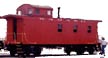 |
This caboose dates to the turn of the 20th century (circa 1905). The exact date of construction is unknown, but the car was retired in 1957 and displayed in Swinney Park with the #1 steam switching locomotive (see below). Both were donated to the Society in 1984. This car is carried on unusual, obsolete Huntoon patented trucks and has an original triple-valve, K-type air brake system which still functions as George Westinghouse intended over 100 years ago. The air brake systems on trains today still utilize the same basic principles of this early system, although improved and modernized. The interior of the car has many benches and storage cabinets including an icebox. The stove, cast at a Fort Wayne foundry, would not have been easy to cook on and the car did not contain rest room facilities. A sink and water tank, apparently scavenged from a passenger car, were added later. |
#1, Lake Erie and Fort Wayne Railroad 0-6-0 steam switching locomotive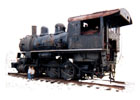 |
This locomotive was built as No. 534 for the Wabash Railroad. The Rhode Island Works of the American Locomotive Company constructed it in 1906; builder's serial number 41174. This Wabash class B-7 was leased to its LE&FtW subsidiary in 1954, after all other Wabash steam locomotives had been retired. It switched the steel mill on Taylor Street and other west end industries until 1957 when it was placed on exhibit in Fort Wayne's Swinney Park. In 1984 it was donated to the Society. Work is underway to restore this locomotive to operating condition. Currently, work centers on rebuilding the locomotive cab and tender. |
| Hygrade mechanical refrigeration car #HFPX 193 | This car was built in 1961. Cars of this type were developed to replace iced reefers (refrigeration cars) that had to be periodically re-iced. This car was used as a shop during the first rebuild of the 765 which was performed outdoors even in winter. Currently it is used for storage. |
| Tool-crew car #701 |
This car was built for the U.S. Army in 1953 as USAX #89665 by the St. Louis Car Co. It was built as an Army kitchen car but never saw the service for which it was intended. After 20 years of storage, it was aquired by the Kentucky Railway Museum and was used as a concession car on their diesel-powered excursions. In 1979 it came to Fort Wayne and was used on 765's first excursions to Argos, Indiana in July, 1980. Thereafter, it was converted into a tool and crew car for use with the 765. It has its own power plant and contains workbenches, tool cabinets, welder, and includes a sink, toilet, and some crew seating. |
Stored | |
| Southern Railway head-end car | This car was built for the Southern Railway in 1941 by Pullman and is divided into three area. At the front is a small baggage area with sliding doors. In the middle is a dormitory section for a dining car crew of 12. The dining car steward had a private bedroom. The coach section has seating for 22 "colored". It is interesting to note that the 800-900 series coaches built for the Southern at the same time had the exact same furnishings, decor, and space per passenger except that these were designated for "whites". Later, civil rights attorneys were to call this practice "seperate but equal". The car was sold to Atlanta attorney Stanley G. Nylen, who donated it to the Society in 1979. It was used as the crew and tool car for the 765 during 1979 and 1980 seasons and then retired. There are no current plans to restore this car, which has some serious structural defects. |
| Baggage/railway post office #31 | This car was built for Nickel Plate predecessor Lake Erie & Western in 1914 by the Standard Steel Car Company. After the Nickel Plate absorbed the LE&W in 1922, it became #831 on the Nickel Plate roster. The car had U.S. Post Office clerks sorting mail for each town along the train's route; urgent business in its day. It was downgraded to maintenance of way service; probably after World War II. The car was donated by the N&W in 1974. This car is in deteriorated condition. Restoration is a goal, but no work or planning has been started. |
| Ice-activated refrigerator cars Milwaukee Road URTX #37314 and Dubuque Meats URTX #63605 & #63610 |
Built in 1948 and 1954 respectively, these ice-activated reefers (refrigerated cars) are typical of the cars pulled by the 765 during its career. The fast freight trains of eastbound perishables moved at 60 mph earning the Nickel Plate Railroad its reputation for "High-Speed Service". |