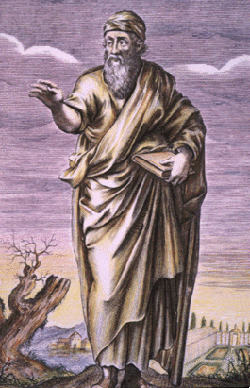
" The profound importance of this discovery was recognized at once by the Greek mathematicians. They had begun by assuming (in accordance, I suppose with the ‘natural’ dictates of ‘common sense’) that all magnitudes of the same kind are commensurable, that any two lengths, for example, are multiples of some common unit, and they had constructed a theory of proportion based on that assumption. Pythagoras’ discovery exposed the unsoundness of this foundation" - A Mathematician's Apology by Hardy, p.101 (speaking of Pythagoras' proof that the square root of two is irrational).
|
|
" But it is a common and general error of the uninitiated to bring the following accusations against philosophers. Some of them think that those who explore the origins and elements of material things are irreligious, and assert that they deny the existence of the gods. Take, for instance, the cases of Anaxagoras, Leucippus, Democritus, and Epicurus, and other natural philosophers. Others call those magicians who bestow unusual care on the investigation of the workings of providence and unusual devotion on their worship of the gods, as though, forsooth, they knew how to perform everything that they know actually to be performed. So Epimenides, Orpheus, Pythagoras, and Ostanes were regarded as magicians, while a similar suspicion attached to the `purifications' of Empedocles, the `demon' of Socrates and the `good' of Plato. I congratulate myself therefore on being admitted to such distinguished company." - "The Defense", by Apuleius.
" If on the contrary each is a principle, then the effective powers become a matter of chance; under what compulsion are they to hold together and act with one mind towards that work of unity, the harmony of the entire heavenly system? Again what can make it necessary that the material bodies of the heavenly system be equal in number to the Intellectual moving principles, and how can these incorporeal Beings be numerically many when there is no Matter to serve as the basis of difference?
For these reasons the ancient philosophers that ranged themselves most closely to the school of Pythagoras and of his later followers and to that of Pherekudes, have insisted upon this Nature, some developing the subject in their writings while others treated of it merely in unwritten discourses, some no doubt ignoring it entirely." - The Six Enneads, by Plotinus. (See the Internet Classics Archive at MIT).
This temporary entry page has been set up on behalf of "pythagorean", because of a few small difficulties his site is having with the Webring system. Click here to enter the site. This page is being hosted on Patricia Cottard's home for wayward Pagans.
|
||||||