Disclaimer: This is clearly insane. Do not attempt this. Rock climbing is a dangerous pursuit, and the hazards will, most likely, lead to your death or severe maiming. Death, broken bones, internal injuries, loss of conciousness for very long periods, personality disorders, loss of Significant Others, and many other bad things will happen to you if you follow any of my notes. Do not do these things. I am not responsible for your conduct or actions. If you fall and die, you do it on your own time. My suggestions here are for my own records, and are not suggested for anyone else. If you follow them, you could die, or hurt yourself or your friends severely. I have left out details that would make this a safe activity to pursue (like, the anti-grav belt from Buck Rogers). I know of the omissions, but have chosen to leave them in; those ready to pursue a death-wish sport are welcome to come up with their own notes, like mine, for themselves. Do not attempt anything in these pages - it is nuts and I cannot take responsibility for your following these instructions, no more than I can urge you to start shooting people you meet on the street. If you feel so inclined, there are many other sites more suited to your personality type. Stop reading this page now, unless you are me.
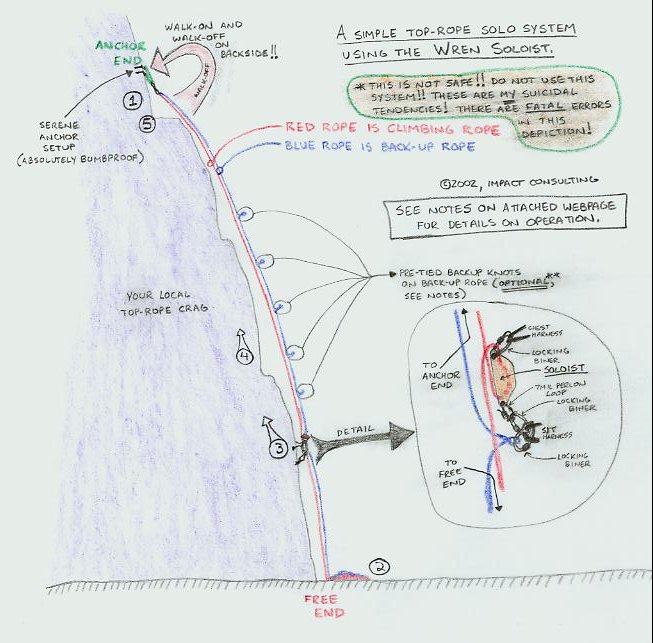
Introduction: This page will attempt to introduce a system for top-rope soloing with the Wren Soloist mechanical solo belay device. It is not complete, and will contain errors that may cause death or severe bodily injury to any who attempt to follow them. The page is the first online graphical representation of a Soloist TR system that I have been able to find on the 'net; there may be others that are more or less sage or safe than this depiction. Please read the disclaimer above again, and then do not follow my technique.
The instructions online and in the Wren operations manual are textual and scant, and for a reason. If one does not have the necessary self-rescue, ropes management, lead, belay, aid, first aid, and other climbing skills necessary to pursue solo climbing, one should not attempt it at all. I do not posess sufficient skills in any of these skills, but choose to put my body at risk of severe damage or death anyway. If one chooses to do so as well, these graphics and the notes about them may make the operation more clear. Please, before you follow these instructions, also read thoroughly, and re-read, and re-read, and understand, and practice at home, the ideas presented in the LINKS at the bottom of this page. These diagrams are not enough in any way or manner to indicate a complete (or even cursory) view of the subjects involved.
Operation: You must have the requisite gear. This will include a Soloist device, ascenders, extra slings and 7mm accessory cord, locking carabiners, a 10.5mm dynamic climbing rope, and adequate other climbing gear to set up a safe, SERENE (see pages 51-60 of this USDOI document for some decent descriptions and diagrams) anchor. This list is not nearly inclusive - it leaves out items that will be obvious to the advanced climber that will be attempting this. You must already have knowledge of the principles and operation of the Soloist device, and of many knots, self-rescue techniques, and rope management that are not in the purview of this page.
1. At a suitable top-rope crag well within your abilities to lead blindfolded, with both hands tied behind your back, and with dozens of sober, alert rescue-trained friends watching, ascend the non-technical approach to an anchor position above your climb. Build a safe, SERENE anchor (resources such as this book by Long may be helpful). If the climb is less than half a rope-length (and you are positive of such), use one rope and tie a figure-8 on a bight in the middle. Attach the bight of the loop to your anchors. If you are on a climb that is of greater length than half your rope, attach two ropes together with an appropriate joining knot, tie a figure-8 on a bight with the joining knot in (but not at the midpoint of) the bight. If you are so inclined, it is optional at this point to tie backup knots at reasonable intervals on the backup rope; these may be, for example, figure-8s-on-a-bight at locations where you will have hands-free rests at which to swap out the backup knots. Toss the rope ends to the ground, in any case. Either walk-off to the base, or rappel to the base.
2. At the base, backfeed the rope ends neatly. Nothing is more annoying than dragging up tangles behind you to get you stuck. Attach yourself to the climbing rope, anchored at the top, per the instructions in the Soloist manual. Ensure that there is a back-up knot in the system close to the base, or some other manner of stopping a ground fall on the stretchy dynamic rope.
3. Begin to climb, per the instructions in the Soloist manual. Shortly off the ground, and at frequent intervals until you get to a point where a fall with rope stretch would not deck you, clip into the backup knots. One option is to use either pre-tied knots in your back-up rope, and another is to tie these knots as you reach them. In any case, always have a backup knot in your system, securely tied between you and the anchor (on top). When passing the knots, always put the new (upper) one in the system before removing the old (lower) one, so you always have a back-up. Untying the older knots, as you pass, will make your descents easier in many cases.
4. Continue to climb, backing up your system as necessary and prudent. If you're doing this solo thing anyway, you'll know what I mean. Take advantage of ledges and rests to back-up your system and to keep yourself from falling too far in the event of a mechanical failure of the Soloist.
5. When you reach the anchors, clip to them, take yourself out of the solo system, and either: 1) clean the system from the top and walk off, 2) re-rig the system through fixed protection at the anchor, rappel to the base, and pull your rope(s), or 3) rappel on the existing system for another toprope ascent in the same manner.
Here are a few links to other Top-Rope Solo references around the net:
WEB: mtncommunity.org discussions on the setup
USENET: rec.climbing discussions on the setup
Tradgirl's Advanced Topics FAQ on TR-Solo
Himmelsleiter - The Art of Solo Climbing, by Arthur Vyn Boennighausen
 Since 21 October 2002