KayLand
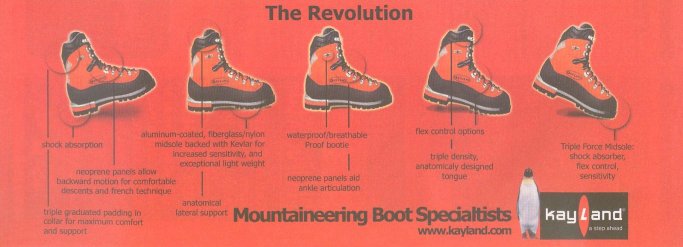
Revolution
 Technical Ice Climbing and Mountaineering Boot – Product Review
First Impressions,
I love winter. I love summer too, but in winter I have so many more
choices of what to go and climb (or ski), and where I do it. Shelf Road and
KayLand
has a killer technical boot out that will get you through the ‘other’ season –
the Revolution. It’s in the same technical league as
the LaSportiva® Nepal Extreme, well-suited for most
cold-season alpine mountaineering exploits. This beefy weather-proof leather
boot boasts all manner of performance tweaks, and for
ice climbing in particular, it’s primary purpose, I can’t imagine more
comfortable foot enhancement.
I received a
demo pair from a North American distributor, Igloovikski,
and set out as soon as possible to give them a good run-through. They
unfortunately weren’t available in the early season here for some excellent
mixed climbing in RMNP and on some killer climbs in avalanche central (Summit
county’s 10 Mile Canyon), but oh boy. Happy days those first ones were, walking
around the house in big bright orange-red boots.  It's been miserably cold and other things
have interfered with starting to test them, like (ugh) work, but I finally got
them out today for a few pitches of WI2/3 solo.
It's been miserably cold and other things
have interfered with starting to test them, like (ugh) work, but I finally got
them out today for a few pitches of WI2/3 solo.
What do I
like about 'em, so far? They fit right outta
the box. They're of about medium
volume. I have narrow feet (AA?) and
especially heels, but green SuperFeet liners pushed
my heels into the right place nicely. The
toebox is still very roomy, even with big socks (the
really big SmartWool ones, red and grey), but it
didn't cause a problem; in fact, I think that it's helping the warmth more 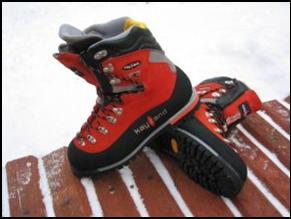 than snuggier boots would (my LS Karakorams
are a half size small and painful - but that's what ice is all about, right?).
than snuggier boots would (my LS Karakorams
are a half size small and painful - but that's what ice is all about, right?).
They're
nice and flexy in the ankles, warm, and so far seem
like they're going to be comfortable for general mountaineering (and
approaches) as well. The only knock I
have so far is that the asymmetric soles (the whole boot
points inward at the toe) doesn't fit very well onto rigid cramps -
More as I
figure things out. I like them about 10x more than my Raichle & Koflach doubles or
LS Karakorams so far, though. The approach marches will tell a lot. More as
I come by it.
If you're shopping, use your combat boot size (generally, your
street size or generic Nike running shoe size) for ordering (or downhill ski
boot cm size). They seem to be pretty
equivalent. And the boots seem pretty
forgiving to fit, unless you have a hugely wide foot. Narrow isn't bad with an insert - only sloppy
right at the toes.
Climbing WI2-3 at Silver Cascade, solo,
 Same
impressions. Probably because of the
rigidity of the shank plate, I found it difficult to walk uphill on hard
snow/ice without kicking in a little for purchase. The Vibram soles
are still slicker than snot on ice without using crampons, but this is common
to all of the Vibram boots I’ve ever worn. Wearing a slightly less-thick sock that won’t
bunch on my heel might make things more comfortable for local, warm ice
conditions.
Same
impressions. Probably because of the
rigidity of the shank plate, I found it difficult to walk uphill on hard
snow/ice without kicking in a little for purchase. The Vibram soles
are still slicker than snot on ice without using crampons, but this is common
to all of the Vibram boots I’ve ever worn. Wearing a slightly less-thick sock that won’t
bunch on my heel might make things more comfortable for local, warm ice
conditions.
I love that these boots are not too tall on the ankle to drive
in. The ankle flex
just works, even in a small car.
Climbing WI3+/4 at
They stayed warm and dry all day in cold, snowy, windy
conditions with 8 inches of new powder on the ground. A mile approach hike was pleasant, although
icy patches on the road still caused slipping unless I consciously set my
weight directly above the boots.
Climbing a snow-covered boulderfield was
actually nice for a change; no stressing around the ankles when the boots 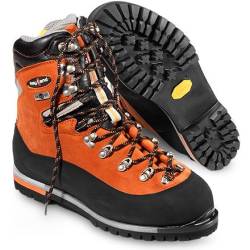 turned unexpectedly
on the rocks, and they gripped the snowy/icy rock edges exceptionally
well. I would expect this kind of
comfort and reaction from my backpacking (midweight
hiker) boots, but never from ice boots. Moving my foot in one direction and my ankle in another felt a lot
safer on the descent as well; less stress on the knee when unexpected twists
happened.
turned unexpectedly
on the rocks, and they gripped the snowy/icy rock edges exceptionally
well. I would expect this kind of
comfort and reaction from my backpacking (midweight
hiker) boots, but never from ice boots. Moving my foot in one direction and my ankle in another felt a lot
safer on the descent as well; less stress on the knee when unexpected twists
happened.
We climbed 8 pitches of WI3+/4 in wet conditions; my climbing
pants and thermal underwear were soaked and coated in ice, my gloves were iced
over except at flex points – but the boots stayed dry, completely. I am used to sweating profusely in my boots
as well, but they were dry and comfortable enough at the end of the day to
drive home 2 hours in without changing.
I have to think that the PROOF membrane works to keep them dry from the
inside as well. I liked that the boots
didn’t pick up wet, bally snow on the hike out – the crampons had 2” of snow
and ice built up even with frequent bashing.
Backpacker’s March 2003 Gear
Guide rates the KayLand Revolution Women’s boot as
the best mountain boot for women, but fails to test the Revolution in mens (they did rate the Contact 1700s as the best all-purpose
boot, the Multi-Tractions as excellent midweights,
and the Zeus as a ‘best buy’ for mountaineering boots – see the Zeus review in
the 8/00 issue). Some of Backpacker’s notes on the Revolution
Women’s follow, and match my impressions:
“…snug fit around the leg, ankle, and instep, which provide stability on
icy terrain… …suitable for winter trips,
light mountaineering, and rugged backpacking treks, the Revolutions offer
excellent support and waterproofing…
…the tops aren’t stiff enough for skiing, though.”
Climbing WI2/3 at Silver Cascade,
I’ve done a bit more research for this review now, closer to
publication. I wanted to see what others
had said about it as well as think about how 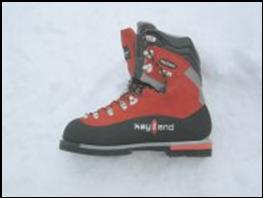 they perceived
it. I have included a review from
SummitPost.com at the end of this, as a comparison – the review is interesting
and talks about some of the aspects I haven’t tried out or had problems with,
with these boots.
they perceived
it. I have included a review from
SummitPost.com at the end of this, as a comparison – the review is interesting
and talks about some of the aspects I haven’t tried out or had problems with,
with these boots.
For my feet and ankles, I like some of the ‘fancy’ additions
that KayLand put into these boots. The contoured tongues actually do wrap nicely
outside of the main lacing, and don’t give me any problems with tongue-shifting
on long days, pinching, or drooping back into the boot. As they get less stiff with more use, we’ll
see how the tongues hold up – but they seem to be well supported, and I like
how this design feature works with narrow ankles and large calves.
Others have knocked the lace-up system and lace hooks as being
too complicated and too difficult to work.
With 20+ pitches and several days out now, I haven’t found a single
reason to complain – my ankles haven’t been bruised or beaten at the end of any
day, I haven’t ever had to re-tie or tighten after leaving the car, even after
approaches, and the laces haven’t ever loosened that I would have to futz with
them in the cold or wet. There is a
trick to this – and it’s important.
Getting the lowers set up to the proper tension for comfort can be done
walking around indoors. After that, the
flexible cuff anchor loops keep the lower tension perfectly in place – fabric
loops instead of frictionless ones – and you can just adjust the uppers.
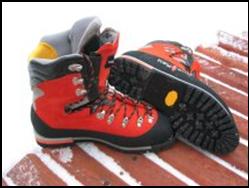 The lower two lace
hooks on each upper are fixed, but the topmost one is spring-loaded. Gimmicky? Maybe. But it works.
Time will tell how durable the spring hooks are – they may be the first
thing to fail on this boot. When they
are engaged, like the flex cuff loops, the laces don’t go anywhere. This dramatically reduces the sliding of the
laces, so there aren’t any untying problems while you’re climbing and flexing
your ankles around (which can be so inconvenient). They are positioned just right that the lace
knots don’t have to wrap around the ankles to get support, and the knots just
don’t come undone (I use a double granny).
If these things keep working, I’m sold and will look for them in
backpacking boots next go ‘round.
Releasing the knot and getting out of the boots is a little more
challenging because of these features; you have to pull a little slack down
through the top lace hooks to release the springs, and then a bit more below
the ankles to release ankle cuff tension.
Hard to do with gloves? Probably. But you won’t need to – you can climb all
day, hike back out, drive home with these on, and take them off when you’re
nice and warm, ready to get into the hot tub.
Big bonus points all around.
The lower two lace
hooks on each upper are fixed, but the topmost one is spring-loaded. Gimmicky? Maybe. But it works.
Time will tell how durable the spring hooks are – they may be the first
thing to fail on this boot. When they
are engaged, like the flex cuff loops, the laces don’t go anywhere. This dramatically reduces the sliding of the
laces, so there aren’t any untying problems while you’re climbing and flexing
your ankles around (which can be so inconvenient). They are positioned just right that the lace
knots don’t have to wrap around the ankles to get support, and the knots just
don’t come undone (I use a double granny).
If these things keep working, I’m sold and will look for them in
backpacking boots next go ‘round.
Releasing the knot and getting out of the boots is a little more
challenging because of these features; you have to pull a little slack down
through the top lace hooks to release the springs, and then a bit more below
the ankles to release ankle cuff tension.
Hard to do with gloves? Probably. But you won’t need to – you can climb all
day, hike back out, drive home with these on, and take them off when you’re
nice and warm, ready to get into the hot tub.
Big bonus points all around.
These are great boots.
One thing I’ll agree with the SummitPost
reviewer on – if they fit, you’ll be in hog heaven.
Details:
KayLand products come with a two year guarantee on
its products against faults in materials and manufacturing
Thinsulate (www.3m.com/thinsulate) Thermal microfiber insulation is used in the boot’s construction,
trapping more air than larger fibre and spaced
insulation, works when wet, quick drying., superior active-breathing
performance, less bulky than traditional insulation materials.
H2O
PROOF layering in the boot construction – a PROOF membrane is sandwiched in
between the inner and outer layers to keep your feet dry and insulated from
weather. It is impervious to wind, snow,
and rain, but breathable to allow water vapour
perspiration to escape. PROOF is
guaranteed fully for one year; it works on an osmosis system rather than just
as a barrier; inner and outer layer boot materials are specially treated and
built to assist and complement the function of the membrane as a ‘second skin’
layer.
|
|
|
SummitPost.com
Gear Review: Reviewed by Glencoe on |
|


|
These are
really nice boots, but I couldn't get excited enough about them to part with money.
I should stress that I haven't field tested these boots but I gave 'em a pretty thorough analysis over a couple of days of
indoor testing. |