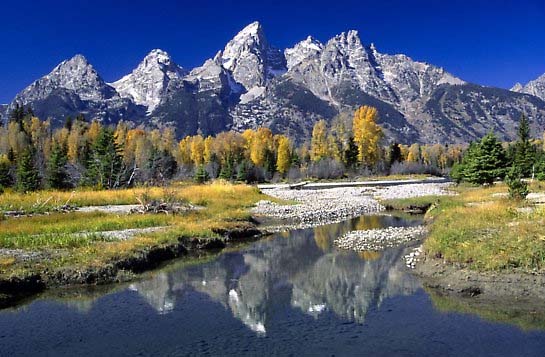
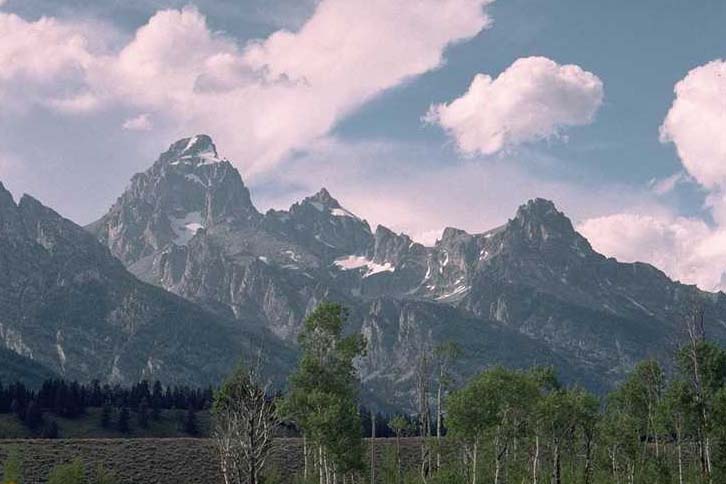
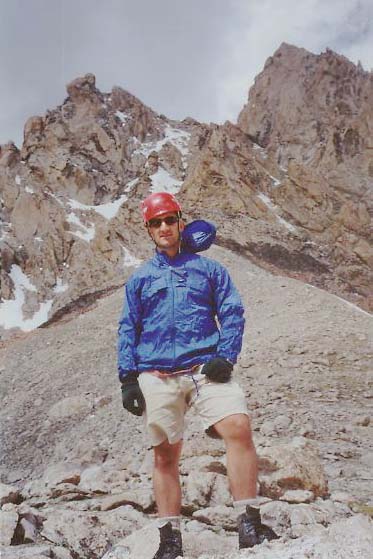
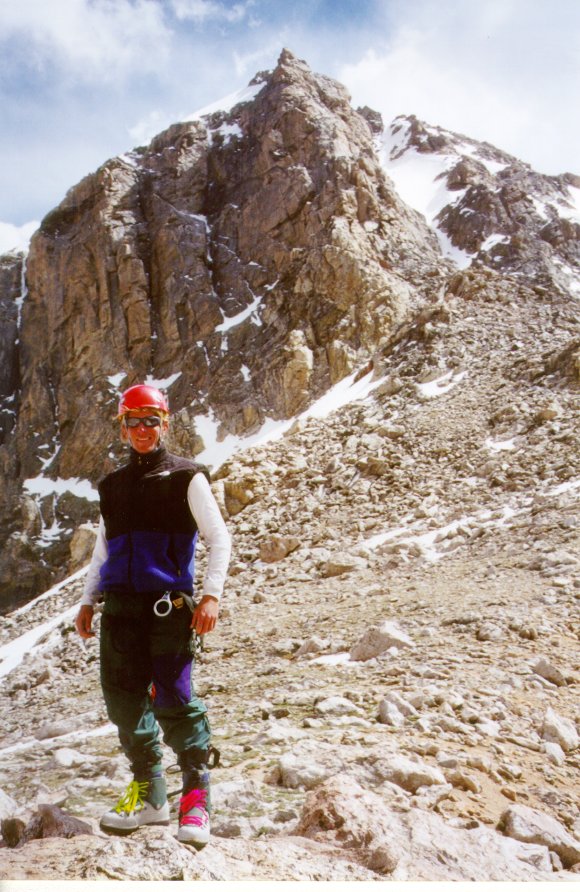
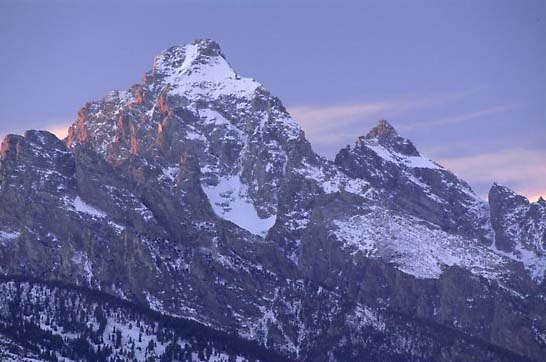
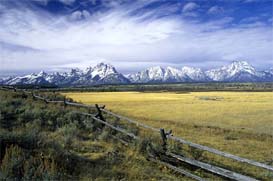
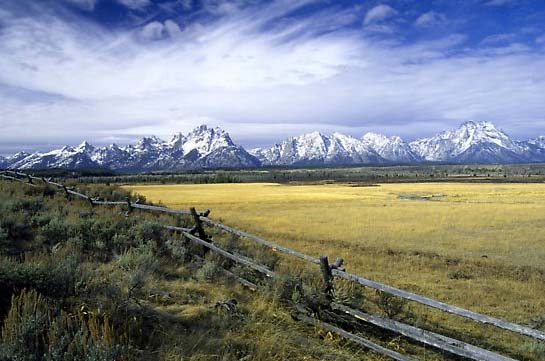
 In early June 2000, and my old roommate, army buddy, and college drinking pal Pete called me up. "I have an idea to climb ze Grand," he said, in a bad French accent. A bad French accent is about all it takes to get me to go climbing (or a good one, or someone just letting the word 'climbing' slip into their conversation), and I was hooked as soon as I figured out who was calling and what the heck he was talking about. I can tell how long ago it was that I did this, as I go through it for clarity in mid-2003, by my descriptions of 5.6 and 5.7 rock as 'featureless' and 'difficult.' I'm really most amused with myself.
With my company and boss being really cool, and having upwards of 200 hours of off-time saved up, anything worked for me. I drove to DIA to snatch Pete on Saturday afternoon prior to the July 4th celebrations, and we had to spend a couple of hours drinking waiting for his gear to show up; the airline employees, wanted to deliver the luggage to us in case it didn't show quickly, couldn't seem to grasp the idea that 11,000' in the mountains 8 hours away was no place they wanted to carry a 50 pound climbing pack to. It eventually showed, and we were off towards the bleak eastern plains of Wyoming.
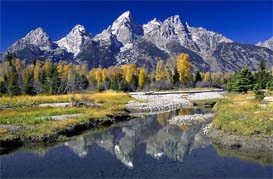 Wyoming. Now this is a strange place, and I say that having lived in 28 states and having travelled fairly well around the world. I just don't get this place that's only a few hours from home. Strange people and habits, if ya ask me. Interesting things ensued here, like bars closing at 9pm ("We close at 9 on weekends") and getting stopped for having NY plates on my car. Can't trust those outta-staters here in cowboy country, I suppose. It's been wacky on all of my climbing trips here. Or, maybe I'm just being too sensitive, expecting the normalcy I'd find in, say, some third world desert country.
We drove as far as we could keep our eyes open, deep into the night, and finally pulled off on an unmarked highway exit to spend a breezy, warm night under a beautiful clear sky near Casper (you can apparently pull off at any exit and not worry about anyone being around - WY has next to no residents of the 2-legged variety that wander about after dark). The next morning we continued through the Shoshoni reservation and over Togwotee pass, looking for moose and enjoying the lushness of the flora along the lightly-travelled road. As soon as we reached the Snake valley, we made a beeline for the park and quickly pulled into the AAC climber's ranch in the Teton park, parking next to a well-used VW camper with a 'sport climbing is neither' bumper sticker. For $6 a night, I couldn't complain about the plywood bunks, showers, bouldering wall, and a place to stay where there are other interesting people around.
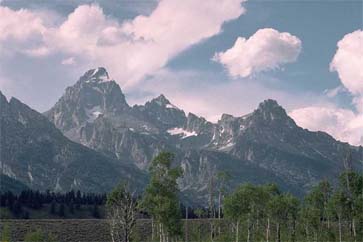 As per my usual routine, and aggravated with the rather firm bedding, I woke up at 0600, and decided there was no time like the present to start climbing. We obtained a wilderness camping permit for the Lower Saddle at 11,600' between the Grand and Middle Tetons from the rangers at Jenny Lake, and off we went. The trek up the initially flat, but quickly steepening switchbacky trail to Garnet Canyon took about 3 hours (slow, but we had large packs and weren't in any hurry). My camera's battery died after 2 pictures in Garnet Canyon, as is the norm for me on fun climbs I'd like pictures of (see the Aconcagua story on my website). At the Platforms, the NPS trail leads a couple of hundred feet over a boulder field on the north side of the creek to prevent further damage to the Platforms' tundra; another 45 minutes of hiking and we were just about at the Meadows, where we broke for a few to inspect possible rock climbs on Disappointment Peak.
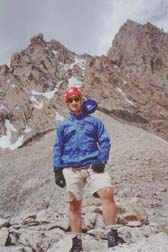 We hiked on through the Meadows, following other climbers up the Middle Teton Glacier moraine and rockfall, completely missing the steeper but less scree-filled NPS trail to the Caves; by the time we'd reached the top of the initial headwall and were on the north-side moraine proper, we'd had about enough of hiking with big packs. The final headwall to the Lower Saddle looked too steep to climb and descend safely with the loads we were hauling, so we figured, heck, there's no one here in the moraine anyway, let's modify our camping permit a little. We went just beyond the creek and rise to the Jackson guides' hut, and found a nice walled camp site. After setting up camp and snacking (and lounging in the sun for an hour) we decided to go out on a recon of the upper south face from the lower reaches of Middle Teton, above the Lower Saddle.
A wonderful 2" laid fixed rope, probably older than sin, secured to older climbing ropes ascends the right upper headwall, where water constantly runs down the rocks. Other parties had put in an ascending left traverse of the glacier snowfield, but the fixed rope over the rock turned out to be much more elegant of a line. The wind always blows (a little chill-illy) up at the saddle, and there were several tents already set up, with more parties coming up. Both the rangers' and Exum guides' quonsets were locked up tight, so we took a couple of pictures and ascended a few hundred feet on the north ridge of the Middle for a look at our route. Pictures don't do this mountain any justice at all. It looks completely unclimbable, scary, invincible even, until you're actually on the ridges you're going to climb. Probably something about the scale and distance it's viewed from. Wall Street is almost invisible except as a thin line ascending right from above the Needle and WS couloir. Still, it's well worth an hour to scope the route out and get a perspective on what you're really doing. The recon hike has been one of my most enjoyable, time-honored traditions in the mountains; I always seem to get the best (or worst, depending on your point of view) weather and pictures from them, and today's trip was no exception. There never seems to be enough time to do a proper job of documenting a climb when you're actually engaged on it, and these are valuable bits of time well spent for me.
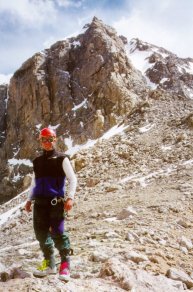 Because the various guide books rate the climb time from the Lower Saddle at 5 to 6 hours for competent climbers, we were in no hurry the next day, a lovely blue sky morning. We talked about climbing the Middle's NE ice couloir or some rock stuff on Disappointment after we got down, so we took our crampons with us to the Lower Saddle. Being such a nice day, Pete left his winter gear (including wind pants) in our hang-bag at the saddle, and off we went north past the Black Dike and Needle. Before leaving, I made what turned out to be the most prophetic statement of the climb: While packing, I decided to leave my headlamp at the camp. You know, 'cause it's so freakin' heavy. Pete pulled his out and put it in his pack, and I said, "Hey, if we end up needing that, then we'll know we're @#%#ed." Pete, always not-so-impressed with my gypsy-packing style, said that it was his one little thing he always wanted to carry. Since I usually always carry extra cold gear (hat and mittens, at the minimum), I let it go.
It's basically pointless, in my experience, to search out or try to find the Eye of the Needle in pictures before you get there; just climb left of the needle and then go up to the second little saddle. The first saddle (so you'll know it if you come to it) has a nice drop-off to the east face of the needle, but the second leads directly to the Wall Street entrance slab, a wide angling ramp that leads around and into the middle of the Exum route face.. The second saddle, the correct one, has a small cairn on top, but you most likely won't see it until you are right on top of it anyway. A couple of downclimbing moves from the saddle, and then a jump down onto the frozen surface of the col proper: The snow across WS couloir was ice-hard and a pain to cross, kicking in sidesteps, even with a tech ax and double plastic boots. At the beginning of Wall Street the clouds came over and it got chilly, and we changed from hiking/climbing boots into rock shoes. Probably the only place where slightly larger rock shoes have any utility is here, in alpine rock climbing - you can wear thin (army-issue) wool socks in them and stay warm. We roped at the exit boulder from Wall Street to the ridge, and I got to lead out on the semi-technical beginning pitch.
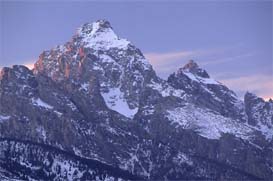 The boulder problem itself is a bit overwhelming for a first piece of climbing there; the foot ledge is small, the flat finger ledge even smaller, and it's rather dizzying to look straight down. Fortunately, it is only about 5 feet around, and after that 'exposure' means very little. The first pitch included this boulder (we're still wondering about the picture of Exum leaping and
clinging to the far wall; we guess he scaled the boulder and jumped instead of edging around it) and the Golden Stair. Quite a fun pitch, really, and pretty short. Based on Pete's flat-lander status and lack of recent technical rock time, we decided to remain roped and swing leads all the way up, even on the 'scramble' ground. At my next lead, I was faced with the chimney and icey boulders entering and half-ascending the Wind Tunnel pitch.
The boulder problem itself is a bit overwhelming for a first piece of climbing there; the foot ledge is small, the flat finger ledge even smaller, and it's rather dizzying to look straight down. Fortunately, it is only about 5 feet around, and after that 'exposure' means very little. The first pitch included this boulder (we're still wondering about the picture of Exum leaping and
clinging to the far wall; we guess he scaled the boulder and jumped instead of edging around it) and the Golden Stair. Quite a fun pitch, really, and pretty short. Based on Pete's flat-lander status and lack of recent technical rock time, we decided to remain roped and swing leads all the way up, even on the 'scramble' ground. At my next lead, I was faced with the chimney and icey boulders entering and half-ascending the Wind Tunnel pitch.
Although it had been chilly and breezy before, we'd stayed dry. As soon as I started the first pitch lead, it began lightly snowing; sometimes more and sometimes less, sometimes flakes and sometimes graupel, but consistently - but only when I was on lead. Pete, sitting at the belays waiting for me to finish my pitches began to freeze while I was about halfway out every time. When I'd belay, out would come a convenient break in the clouds and some sun - keeping me comfortable, but then broiling Pete as he led, the sweat then freezing while he belayed me next. The weather didn't look especially good, but it didn't look as bad as it could have, either. So, up we went. We've climbed
in far, far worse.
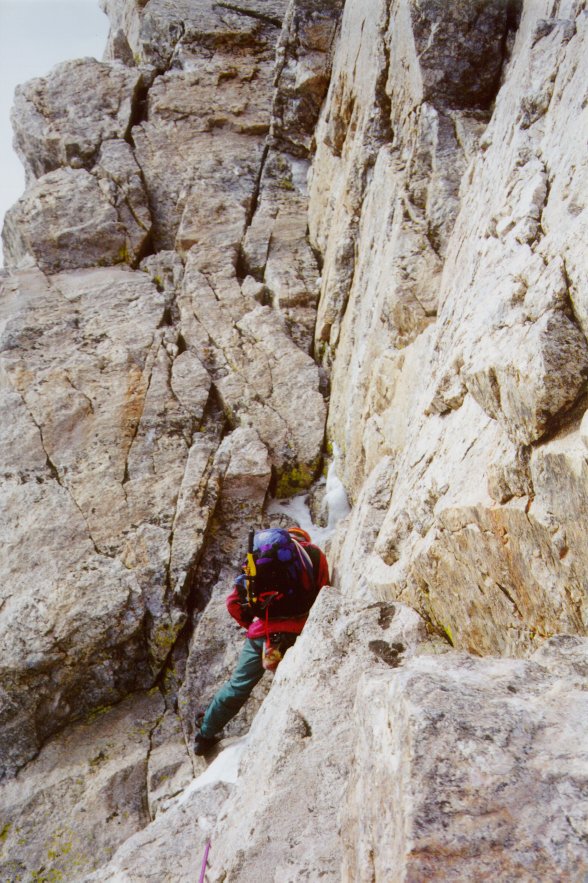
I swung after the second Wind Tunnel pitch and climbed some right-side crack variations to the base of the 'Friction Pitch.' I also had honors on that, but don't be fooled by pictures of that pitch in the guide books. It starts out (Kelly's variation, probably) as a very shallow but vertical dual crack, just enough to stand up into, then goes to slabby face. Twenty feet further on, just as the angle begins to back off, there's a first piton hammered in. The climbing's not hard, just fairly vertical through the beginning, and with little to friction off of or hold on to higher. I threw in a pink tricam in the middle of this section, just where Pete had a horrible time finding a stance to clean it, cursing my choice of pieces. I couldn't find anything friction on the whole pitch (pinching some chicken-head-like bumps instead), but up higher it had a nice lieback left hand crack that leads to an overhanging block (off to the west, that makes a nice photo-op for being way up in the air).
The next two pitches were again fairly easy scrambling, and quickly led to the bottom of the obvious Open Book. This was by far my favorite pitch; not too high-angle, but still fun enough that I felt a couple of pieces of pro were in order. Nice laybacks and cracks on both sides get you up to a long, safe run-out (no sense making short leads). With backpacks, the next obvious crack on the ridge line was an left-hand undercling in an overhanging corner, and I felt it was too hard to be on-route. Plus it was full of ice, I'd already had a long (heavy drag) lead, and I couldn't feel my hands even in my fleece mittens. I instead belayed Pete up and took a traverse line out to the hard left (towards
the cliffs) to a much easier ledge crack, and around back to the right towards the crest. Here I found a second piton, so I suppose that was the route anyway. One more pitch (no longer swinging leads) and I was on the crest with a fantastic view of the summit and the Ford Couloir heading up. I belayed Pete up and we felt we had 2 more 'pitches' of scrambling. And lo and behold, up the Ford come 5 guys in leather boots and crampons, 4 on a rope team and one solo with them, the first people we've seen or heard all day, just in time to meet us on top.
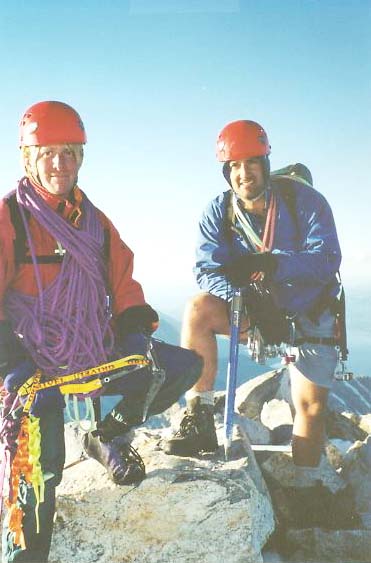
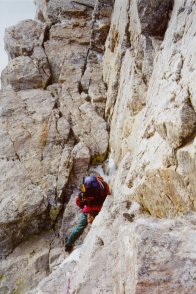 We headed up the end of the ridge and across the snowfields to the last short scramble up a snow & rock field, and there was the summit. 10 pitches, including scramble pitches, and it had taken a full 10 hours from the Saddle. Quite slow, with the last rays of daylight streaming across us, we thought. Over the Snake river valley you could see the shadow of the Grand extending away from us, letting us know the end of the day was coming quickly. The other fellows turned out to be employees from an outdoors shop in Provo and had been up here before - hence, knew the route down. We decided to team up to get off the summit block more quickly and efficiently. They kept on their crampons pretty much the whole time, even on the rock scrambles and rappels down; I kept on my rock shoes. Because of that, I reached the first 70' rap just as their quickest had an 8mm rope tied into it. I had a rope on my shoulders and another in my pack, so I got to go down the single strand and clean the route (they didn't toss very well), and moved quickly over to get the second, 120' free rap set up.
The second (major, to the Upper Saddle) rap was fully free-hanging and isn't someplace you want to be if you don't enjoy rapping or trust the setup; I tied together my two ropes and tossed, offering one of the Provo crew the first rap. He didn't have any problems with my knots, but figures I suppose that if I set it up I should trust it and test it myself. Down I went. I stuck around at the bottom and changed back into double boots while the rest of the party descended, wiating for Pete and the chance to pull my ropes. The third-to-last guy was coming off of the rope, already on the ground, and moving the twenty feet across to my semi-protected shelf when something fell and hit him dead smack on the head. The rope had moved across the edge, 120 feet higher, as another climber got on and knocked off a rock, about the size of a beer can. I got sprayed with shrapnel, but fortunately was facing the other way still. Phil, the unfortunate Utard, had his Ecrin Roc helmet buckle and dent in with the impact, and then loudly rebound into shape, unbroken. Phil hit the ground hard on his tailbone. After a few seconds, we realized what had happened, and moved in to help as Phil started to get back up, staggering. He was conscious, knew his name and where he was, and didn't appear to have a concussion (yet). He sat down to get himself together as the other two descended and I pulled and packed the ropes. The first half of the Utah party was already descending the colouir towards the Lower Saddle, far below us. The sunset was beautiful, but really we shouldn't have been so high when it went down.
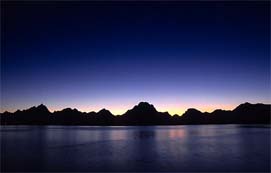
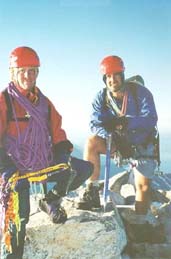 I walked down with Phil and Josh through some nasty, steep, icy snow fields, as it got darker and darker. The sun had never warmed the snow col to the point we could plunge step, and I began to wish I had brought my crampons. About the time it got really dark, I saw Pete waiting for me on a rock ledge below, obviously remembering I didn't have a lamp. As if knowing where I was, the clouds came in, obscuring first the starlight and later the slim moon as well; it was totally black, and I was barely able to make out Pete's outline from 10 feet away when we didn't have the lamp on. The next couple of hours were a real pain, in the dark, on the steep ice, without crampons. At one steeper (50 degree) snow pitch we were reduced to turning into the ice, plunging our axes in at our feet, and walking down like descending a ladder. This took Pete a good half-hour with leather boots and was far harder physically than anything we'd been called upon to do earlier in the day, and Phil and Josh began to make tracks away from us, down in to the darkness.
The other three members of the Utah party had headed on down the route to the Black Dike, obviously in a hurry to get back around to
their camp on the Teton Glacier (all the way around the mountain), leaving behind Phil (who had forgotten his lamp, and now had a nice headache as well) and Josh (who was diabetic and starting to act a little hypoglycemic); we caught up with them again two at a big ledge in the couloir that we'd initially climbed behind the Needle to gain access to Wall Street. Neither Phil nor Josh had made this descent before, and the walls along the side of the col and the Black Dike lower blocked the line of sight to where they were planning to head. Their 'buddies' radioed them to start climbing down, but we were of a mind to pull out the rope and rap down to the trail, a good hundred dangerous feet below us in the dark, since we knew about the scramble that we'd had to make up to this point.
We got the rap set and ran down it to the snow, immediately west of the Needle, and sent Phil and Josh on their way down as we retrieved the ropes again (good nice enough dudes, but their friends seemed to be getting panicky and butt-headed on the radios). I again packed up the ropes and started following Pete down, close in step behind so I could memorize the terrain as he descended and follow him. His batteries completely died about 50 feet below the bottom of the rappel
 Although I didn't have a headlamp with me (I'd even stopped beating myself up about it several hours before), I had a little ziplock baggie of 'useful things' in my pack, and I knew it just happened to contain two extra AAA batteries, somewhat old, but usable in a pinch. After lots of touchy-feely games with the pack and headlamp in the utter dark (even dropping one battery on the snow but fortunately finding it without moving around), we had a small beam of light again, enough to continue our descent. Just a couple of hundred yards further we came around the black dike and onto the talus trail heading down to the Lower Saddle, where Josh and Phil had holed up, not knowing whether to go up or down, and no longer in radio contact with their partners.
I saw three headlamps down
at the saddle, and assumed the first trio had descended and abandoned their plan to
circumnavigate the mountain that night. We were all four out of water, so we had
Phil and Josh follow us down to the saddle where I knew a pipe of potable fed near the guide house. We did indeed find the
other Utah folks down there, in the cold breeze, getting rehydrated, and also
(happily) found our ditty bag with the crampons and extra clothes. After
drinking a couple of quarts, Pete and I wished them well wandering up and down the
saddle to stay warm all night, and headed down, onwards towards camp. As the clouds broke completely into clear, starry skies, we easily cramponed down the
glacier and quickly turned off the headlamp to conserve whatever battery juice
we had left. In the clear sky the stars and Milky Way were more than enough
to get us safely down to the vicinity of our tent.
When we finally arrived at the tent, it was 0115, and we'd spent more than 17 hours out climbing and returning. We had the last two
bites each of the summer sausage we'd left at camp, the only non-cook food we had thought to bring that hadn't been consumed the day before, and went quickly to sleep. We slept until the sun woke up around 0800, and dazedly packed up our camp, wondering about the others we'd descended with yesterday and how they were getting along. The hike down and out, by the proper NPS trail this time, still took another 4 hours, and we immediately headed straight for the climbers' ranch for showers and to reserve bunk space. Beer never tasted so good as that afternoon.
Postscript: A couple of weeks after I wrote and posted this initially, I received an email from a rec.climber (Michael Riches, aka the Rockrat) who read my TR on r.c. He was one of the group of three from Utah that left Phil and Josh behind, and he explained, strangely enough making his point quite clear and understandable, their reasons. I still have some problems with their conduct and lack of teamwork, but can't say too much considering how much Pete and I poked the pooch on this climb too.
Some photos on this page (noted by their ALT text) were taken by and belong to Quang-Tuan Luong/terragalleria.com, all rights reserved.
 In early June 2000, and my old roommate, army buddy, and college drinking pal Pete called me up. "I have an idea to climb ze Grand," he said, in a bad French accent. A bad French accent is about all it takes to get me to go climbing (or a good one, or someone just letting the word 'climbing' slip into their conversation), and I was hooked as soon as I figured out who was calling and what the heck he was talking about. I can tell how long ago it was that I did this, as I go through it for clarity in mid-2003, by my descriptions of 5.6 and 5.7 rock as 'featureless' and 'difficult.' I'm really most amused with myself.