Then and Now; A Story of Growth Between Climbs
The Crestone Traverse, Needle to Peak
I first climbed both the Crestone Needle and Peak in summer 1996, as my approximately 20th & 21st-ish 14ers in Colorado. I'd come a long ways from my start on Pikes the year prior, but felt in no way confident to tackle something rated 'advanced' in the guide books without someone who felt comfortable on rock along with me. I was still in the army, finishing my tenure as a company executive officer for a mechanized infantry company, and had many contacts throughout the division who knew people that could meet my requests. My friend and roommate Pete, then attached to a support unit (now playing Special Forces and having fun every day, I'm sure), hooked me up with a chemical officer named Pat. Pat had apparently had a decent amount of experience on 5th class rock (of which I had none, and no desire), and readily agreed to an adventure in the mountains.
I first met him when I drove to his house and we packed up his 4x4 for the trip. He seemed confident and ready to go, although I had much more 14er experience than he. We got along well, and decided at that point that we could be decent climbing partners; we could at least share our diverse talents and hopefully take advantage of each others' strengths. Our plan and goal was a traverse between 2 14ers in the Sangre de Cristos, Crestone Needle and Crestone Peak, one of the four classic rock traverses in Colorado, and a harder climb than I'd yet put myself on. I'd already been to the area on a winter solo of Humboldt, and spent much time studying the pictures from my trip and the guide book in an attempt to ready myself.
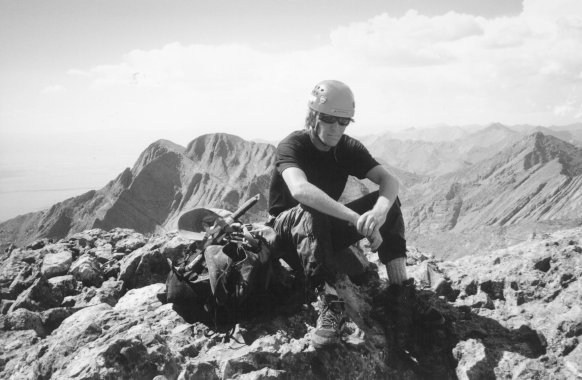 I'll tell the brief version of that tale in a bit, but let's bring you up to speed on me now. I resigned from the army as a Captain, Infantry, in 1997, and have since been working odd jobs and as a project engineer at Peterson AFB to pay for skiing and climbing. I've climbed just about everything I could find, and started in late '99 to get into vertical tech rock climbing as well (at the behest of one of my 14er 'slog' buddies who'd grown tired of it and wanted a challenge); five years after I started, I'm now leading mid-range trad tech climbs and guiding new and less-experienced parties up mountains they want to climb. I've been all over Colorado, climbed the wild side of Aconcagua, and led some interesting routes in Wyoming. I can't imagine anything better, except perhaps getting paid enough to make a living guiding and yet maintain the engineer-pay lifestyle (it's not much, and less than I was making when I got out of the army 3 years ago, but I still get to have fun in the mountains).
My friend Scott, another former army officer and also a friend of Pete from the unit where he met Pat, gave me a buzz from his new home in Atlanta (no, he's not happy there) (but if it was supposed to be fun, they wouldn't call it work). His job was taking him to Denver for a few days, and he had a weekend to kill. He was at 48 in his CO 14ers tick list, and wanted a couple of more. I've climbed with him for oh, 3 years, and had some fine (and some scary) adventures to boot; he wanted to add two more to his list, and said he wanted the Crestone Traverse as well. I initially thought, 'great, my chance on Ellingwood Ledges!,' but Scott doesn't have any rock experience, despite being in good enough shape to do it. I decided well out that it wouldn't be a good idea to get him up on the ar�te, and settled for repeating the route I'd done 4 years previous. It got me out of the house, in any case.
We decided to plan for a Friday night-Saturday-Sunday trip, with him returning to DIA on late Sunday. I told him not to bring anything but the clothes on his back, a harness, and a helmet. He took it to heart, and I made sure I had two sets of gear ready for his arrival. He was supposed to arrive at my place at 5 Friday so we could get down and set a camp, but he got stuck in meetings (and then lost in his old hometown, but my place isn't the easiest to find so we forgive him). He showed a little after 10, and I'd pretty much given up on him; I had had dinner and a few beers, and with the packing that we still needed to do we decided to hang, relax, and get an 'early' start the next morning. The large number of beers I drank that evening almost did us in. I left the alarm on at 0430, figuring that if he was in better shape he'd get up; he didn't, and I went back to my extremely pleasant dream for an hour. At 0530, he walked in and told me such. It took me a full 20 minutes to motivate, get up, and get in his dad's Durango. Bleagh. One should never drink more than a 6-pack before a big climbing day.
After stopping at the store for some lunch munchies, donuts, and caffeine (for me), we cruised the 89 miles to the beginning of the 4x4 road up to South Colony lakes. In the canyon between Wetmore and Silver Cliff I spied some fantastic pinnacles and cliffs I'll have to go back and work routes for; I've always been so busy driving I've never noticed them before. The 4x4 road up to the trailhead has deteriorated severely in the past 5 years; I doubt in another five that anything short of my CJ-5 or a dirt bike will make it up undamaged. We arrived at the trailhead around 0900, several hours later than our planned start.
As I'd done the route before, Scotty elected me pathfinder (one of those thingies I'd supposedly been qualified for in the army); we went up to Broken Hand pass, with Scott only lagging from the 12000' altitude difference. With a bite of summer sausage and cheese in us, I led on up the couloir systems (eventually dragging two other climbers, who were new to the peak also, behind us) and landed us on top of the Needle around 1310. Another group had just finished the Ledges (ar�te) route, and yet another had just summitted from the Peak-Needle traverse; they were all kind of affected when we stated our intention to do the traverse the hard way, at the late time of the afternoon. The other group had just taken 3-1/2 hours to do it, which had we taken that long, would have placed us in nightfall and severe storm times for the area. There were nothing but little puffy clouds on the western horizon (better weather than I've ever seen for those mountains at that time), so we went ahead. As I descended the ridge to rig the rappel point, another team of (much) older climbers were finishing the traverse; they were wonderful to talk with as they ascended the final block for their trip back to camp. You meet the best people climbing.
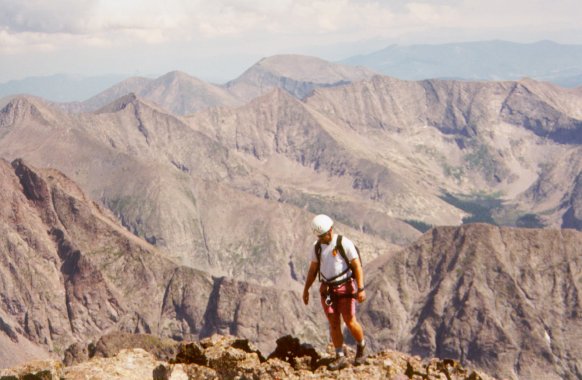 I won't go into too much detail on the traverse (although I think Dawson's got it all wrong in the guide book - which I didn't use at all this time); drop well below the Black Gendarme, then climb to near the ridge crest, with two east-leaning pinnacles, then cross these to the main saddle; traverse N and W to a loose, dangerous col (stay off and below the obvious trav ledge, as it ends in air) and use handholds on the right face to work to the top; from the top, work directly towards Red Saddle (it's straight up the slabby conglom face), and walk 20' west to the saddle. This is the most efficient route for summer climbers; I wouldn't want to do the winter route the same, owing to a severe dropoff below the loose col and its aspect. We summitted Crestone Peak in 2:20, well faster than either other party that day (65% and 80% faster, respectively). Somehow muscle and rock memory kicked in and guided me well, even with having to help Scott over some of the first few obstacles (he picked it up really quickly and then just followed wherever I led). This variation has a couple of 5.2-5.3 moves on it, but it's not too exposed (maybe 20' max) and saves easily 30 minutes of up-down travel. One who's bored can easily find some nice 5.5-5.6 moves to keep busy while others climb.
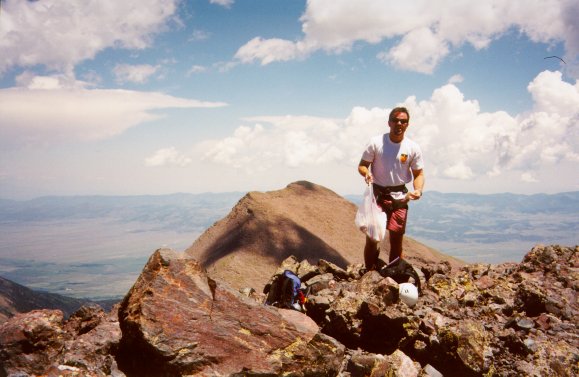 We descended North Col on the Peak, and a couple of hundred feet in a storm started to brew in the valley to the east. This made us nervous, as we'd been exposed in storms before, and had no mind to be so again; we redoubled our efforts, and though the Col, over the N ridge to the descent chute, and down the nasty ground to the valley floor the storm stayed 5 miles east of us. And it was sunny and hot the whole way, with nothing above us or to the east. Strange that mountains can affect the weather so greatly. When we finally got to the valley floor above the Upper South Colony lake, the threat had completely blown past. It would've been ugly, but we'd packed (and not used) enough gear to get down in any storm I've been in (we'd have left gear and rapped if we had to).
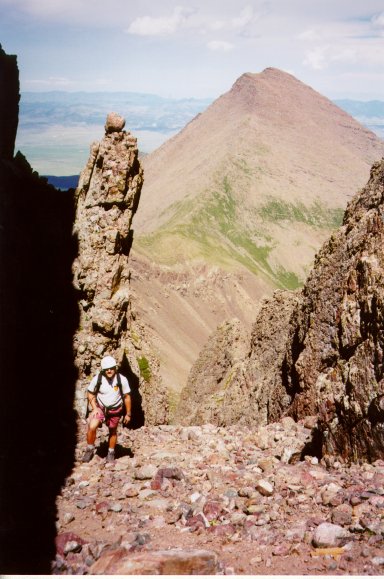 Well, a beautiful afternoon turned to evening as we returned to the car 10 hours after we'd left it (yep, a long descent); I got to massage the truck all the way down the 4x4 road and it was quite night when we go back to the hardball.
The point of this tale is the difference that experience and the confidence that comes with it makes. 4th class? Hah! Whatever. Yeah, I'll free that. I remember being absolutely scared out of my mind 4 years ago on this same (almost route-exact) climb; even my memory has made hyperbole of some of the moves involved. I remember the second east-leaning pinnacle as hanging over the north wall to the S Col lakes (which would make a couple of thousand foot drop); in fact, it drops about 400' to a shelf that comes off of the N Peak subpeak, and it's not overhanging the chasm at all. It's a good 3 feet in from the edge, and the fall potential is maybe 12 feet. I remember being completely out of adrenaline at that point 4 years ago, from scaring it all out of me; now, I look at the climb as having been oh, on maybe 45deg knobby slabs and 35-45deg knobby faces, with a few small vertical steps and a couple of slightly steeper face pitches. The whole thing is completely doable without a rope if you don't mind some exposure; I'd still carry it, but probably wouldn't use it at all (even for the 4th class downclimb/rap off the Needle, the only place it's really of any utility).
I can't believe that this little piece of rock scared me so badly; and now I'm guiding it. (In case you missed it, the brief version of the previous climb was stated in the above paragraph. We succeeded, it took us a little longer, and I felt like it nearly killed me.) If you haven't yet gotten some 5th class experience, both in a gym and out, but want to have fun on mountain routes that are rated harder than 'novice,' I highly recommend some vertical exposure time (preferably on lead). Every skill you pick up in the mountains seems to lend itself in some way to your other mountaineering pursuits, and I'm constantly surprised how.
Since those two climbs I've had the opportunity to go back up to South Colony. I went in August 2002 with Bryan to see what we could do of the rock climbing routes in the area.
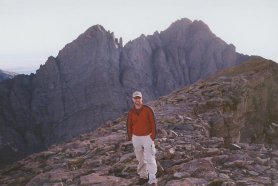 He had had a bad experience up there the previous summer with his wife, brother, and his girlfriend in considering climbing Ellingwood Ledges, the sharp arete that forms the most obvious feature on the Needle. There was a lot of snow still lingering when they approached for the climb, and a party descending had told Lisa that it was wet, icey, and not a good idea. Bryan was very annoyed when they had made the trip down and the rock-crawl up, and then everyone backed out at the base of the climb. We talked about the climb over the winter, and planned to make a trip down to finish it off, just the two of us, the next summer.
The weather was perfect for our entire weekend. Cold and windy perhaps, but none of the storms that the area is famous for forcing bivouacs on the mountain came anywhere close. We wanted to get an acclimatizing climb in on Humboldt the afternoon we arrived, and after marching right up to the base of the climb and setting up camp we did so. Reaching the summit in the very late afternoon, and tired from a week of work and the short but steep hiking, we returned to camp for dinner. We reconnoitered the base of the climb for our approach route, and decided that since we were so close and had all weekend, to try for the direct start that would add a couple or three moderate (5.6) pitches to the climb's start.
The wind came up over the evening, but we both slept soundly, our gear waiting for us in the tent's vestibule. We woke to the sound of a party passing near our tent, on the way up the route. We weren't quite ready to crawl out of the sleeping bags, and so took another half hour of napping before waking. The first thing that we noticed were the disarray in the vestibule from our carefully ordered setup the night before. The pikas, small mouse-like rodents that live up in marmot-land, had gone quite through all of our gear, getting into cooking gear, food packages, and actually eating the backs of Bryan's hiking boots clean off. Hunh. Salty feet, I guess. Without anything else to be done, we piled the gear that we would leave behind in the tent and sealed it, hoping they wouldn't eat through the tent walls during the day and do more damage. And, with that, we headed up the couple of hundred yards to the base of the route.
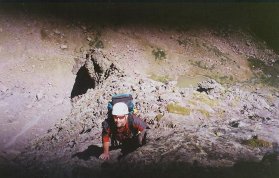 Another group, the one we had heard earlier passing our camp, was on the route. They had just cleared the base when we had our rock gear on and were ready to climb, just at dawn, leaving us a clean path up. The direct start route wasn't what we had hoped it would be; going around on the grassy ledges would have been much easier and quicker. Many of the rocks were loose, and pro was scarce; after a long and short pitch we bailed onto the ledges and took the more traditional climb up the steeply inclined meadows, several parties now ahead and a couple behind us. This was Bryan's first adventure onto alpine rock, and even at 3rd and easy 4th class, a couple of thousand feet of air down to the lake below looked pretty big. We roped and I left Bryan lead a simul-climb up to the red pillar, the first 5th class difficulty, and a bottleneck on the route. Two other parties were there when we arrived.
Instead of waiting, I took a 5.7ish route up a loose cliffband about a half-ropelength out and finally got to something that wouldn't break off for an anchor. Bryan really didn't like the route I'd chosen, but I was already up and we'd moved around the other parties, not beating them up but not losing any time either. Another thousand feet of 4th class with Bryan protecting the moves took awhile before we reached the first technical difficulties around 13,600'. The party just ahead of us, a group of 3, had soloed up to this point and were in line ahead of us. This time, we just took a break and waited in line, recalling that the next pitches were 5.5, 5.5, and then the 5.7 headwall.
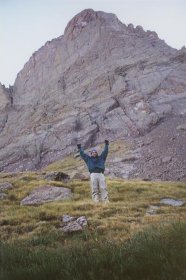 The first pitch was ridiculously easy, except for the pullover onto a grassy ledge with no real belay; I didn't let Bryan know about this as I brought him up. The second turned out to be about 3rd class, to the steep final pitch. The party ahead of us had moved around to the left side and the more traditional, and first ascended, Head Crack. I looked up and saw a pretty crack straight on the arete, and knew I wanted it. The 5.7 vertical crack took more gear than the guides had suggested, including a #3 camalot - but it was exceptionally fun. This was one of the best 5.7 pitches I've ever climbed, and the thousands of feet of approach didn't affect it at all. I'd do this pitch again in a heartbeat. Afterwards, there was only a long talus gully leading to the summit. Bryan had tired rapidly during the 4th class approach, most likely due to not being fully acclimatized to working at this altitude, and we rested at the summit for a long while. Our plans had included doing the traverse again and descending over Bear's Playground to the Humboldt trail, but the hour was late (more time than planned protecting and resting on the approach) and Bryan was obviously lagging in power. The only alternative was the horrible hikers trail down to Broken Hand Pass and back to camp.
The descent off the 3rd and 4th class south face seem interminable, particularly to Bryan, getting more perturbed and tired as we went down. I could see the energy just leaving him as the trail came, went, came again, and went again. The pass itself, steep slidey dirt and treacherous footing, was just awful. To try and save some time instead of descending all the way to the lake and climbing back up to camp, we turned left and attempted to traverse below the hanging meadows, finding ourselves picking across rockfall talus fields for another hour and a half; and then, still having to hike up the small tarn to our camp. It was near sunset when we arrived back, beat and bedraggled, but successful and happy. The plans to complete the traverse and attempt the Prow on nearby Kit Carson were discussed, ever so briefly, and discarded for another trip after more altitude conditioning for my stalwart partner. We hiked back out the following morning and are looking forward to completing our missions down there sometime in the near future.
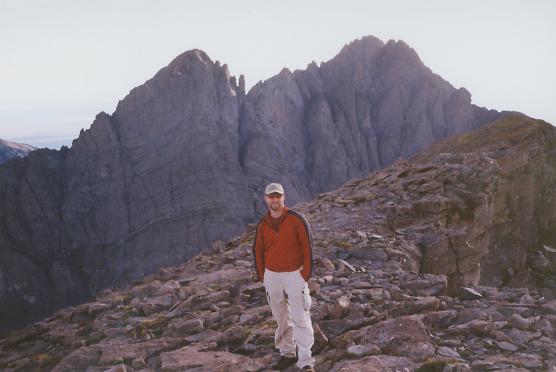 He had had a bad experience up there the previous summer with his wife, brother, and his girlfriend in considering climbing Ellingwood Ledges, the sharp arete that forms the most obvious feature on the Needle. There was a lot of snow still lingering when they approached for the climb, and a party descending had told Lisa that it was wet, icey, and not a good idea. Bryan was very annoyed when they had made the trip down and the rock-crawl up, and then everyone backed out at the base of the climb. We talked about the climb over the winter, and planned to make a trip down to finish it off, just the two of us, the next summer.
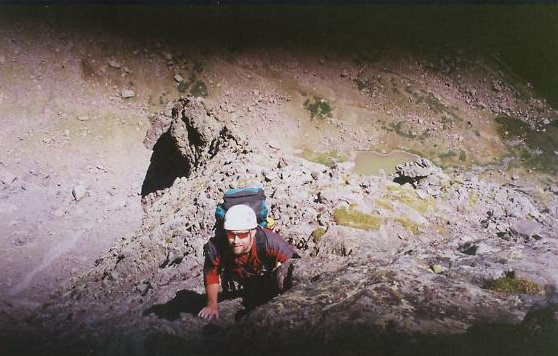 Another group, the one we had heard earlier passing our camp, was on the route. They had just cleared the base when we had our rock gear on and were ready to climb, just at dawn, leaving us a clean path up. The direct start route wasn't what we had hoped it would be; going around on the grassy ledges would have been much easier and quicker. Many of the rocks were loose, and pro was scarce; after a long and short pitch we bailed onto the ledges and took the more traditional climb up the steeply inclined meadows, several parties now ahead and a couple behind us. This was Bryan's first adventure onto alpine rock, and even at 3rd and easy 4th class, a couple of thousand feet of air down to the lake below looked pretty big. We roped and I left Bryan lead a simul-climb up to the red pillar, the first 5th class difficulty, and a bottleneck on the route. Two other parties were there when we arrived.
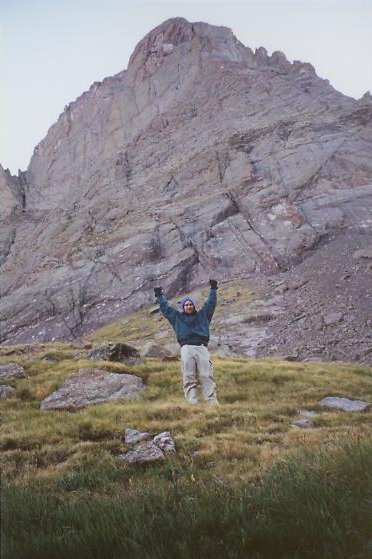 The first pitch was ridiculously easy, except for the pullover onto a grassy ledge with no real belay; I didn't let Bryan know about this as I brought him up. The second turned out to be about 3rd class, to the steep final pitch. The party ahead of us had moved around to the left side and the more traditional, and first ascended, Head Crack. I looked up and saw a pretty crack straight on the arete, and knew I wanted it. The 5.7 vertical crack took more gear than the guides had suggested, including a #3 camalot - but it was exceptionally fun. This was one of the best 5.7 pitches I've ever climbed, and the thousands of feet of approach didn't affect it at all. I'd do this pitch again in a heartbeat. Afterwards, there was only a long talus gully leading to the summit. Bryan had tired rapidly during the 4th class approach, most likely due to not being fully acclimatized to working at this altitude, and we rested at the summit for a long while. Our plans had included doing the traverse again and descending over Bear's Playground to the Humboldt trail, but the hour was late (more time than planned protecting and resting on the approach) and Bryan was obviously lagging in power. The only alternative was the horrible hikers trail down to Broken Hand Pass and back to camp.