
Muang Thong Thani

 |
|
|
|
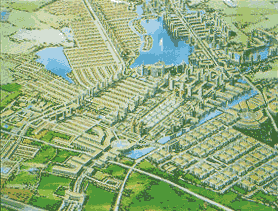
| Artist's impression of the
Muang Thong Thani. The city with condominium units, industrial space, exclusive apartments and facilities. The city is designed to support a population of 150,000. |
|
|
|
 |
|
|
|
| R esidential complex on one edge of the city, comprises 24 identical storey towers, 30 stories tall anchored along a 5 storey podium containing carparking, street level shops, recreation facilities and garden apartments. | |
|
|
| Muang
Thong Thani at a glance Location: Chaeng Wattana Rd, Rangsit, Bangkok Status: completed 1994 Gross Construction Value: $US1Bn Developer: Bangkok Land Co. Plc Ltd Consultants: NFA Architects (architecture, urban planning); M&E consultants, MAA Consultants (structural engineering); W&Associate Consultants; Sindhu Pike Bodell Transport Planning Consultants (Traffic Engineering); Tract Consultants (landscape architecture). Contractors: Bouygues-Thai, Seum Intergroup, BKK General Contractors, K&B Construction. SOURCE: ARCHITECTURE AUSTRAILA MAGAZINE, JULY / AUGUST 1993, JANUARY 1994 |
|
Muang Thong Thani (MTT)
a new town located 40km north of Bangkok's CBD provides an interesting
case study of highrises on the outskirt. Approaching
the new town from the second stage expressway, one could appreciate the
gigantic scale of the odd condominium towers which rises from an obviously
barren landscape surrounding it. There
is a 'Gotham City' - larger than life feel about this place: a certain
twisted megalomaniac vision of the architect.
The architect envisage a city for 150,000 people. Muang Thong Thani which the name translated as 'Golden Town' was to be Bangkok's first hi-tech city of the 21st century. The city is structured into zones: residential, light industrial, commercial and public recreation zones. The streets are organized into modified grid pattern consisting of linear open spaces, boulevards, flanking along side a large man-made.
The City is cut accross by a major arterial road. Along side this 1km main throughfare are 24 condominium towers, 30 storeys high - anchored along a 5 storey podium consisting of carparking and retail shops. Sophisticated 'villa office' fronting the opposite side of the road. The design of these mix used units were influenced by traditional Thai shop-house which you see in many Thai town (those with small shops below and residential quarters above). Each of these units contain parking underneath a street-level shop, above which are five floors of office or light industrial space and two storey penthouse on top.
The developer attempted to create a mixture of accommodation types to cater for people of different socio-economic groups and needs. Most notably are the low rise condominium buildings at the east end of town. These are targeted at lower paid public servants, the units are sold as housing co-operatives and provide only minimal, affordable by-law housing (each flat also has a small shop ong round floor like many government flats in Bangkok). In all, there are 27,000 of these housed within 27 buildings to form the Popular Condominium Community / Precinct.
For the first time in Thailand, the architect has also introduced the concept of 'flatted factories'. Arranged in a grid pattern, each building is 120m long, 45m wide and 10 storeys high. There are eight floors of flexible space for clean high-tech industry, one floor for carparking and a ground floor for container unloading, shops and restaurant included, tennis courts and gravel gardens are surmounted at the top.
A regional shopping centre is proposed to sit between two condominiums and the eastern gateway to the street. Two twin crystalline office towers juxtaposed over a linear shopping centre and a major road artery will mark an impressive 'gateway' to the east of the city. The 120,000 sqm facility would have included offices, shopping, restaurants, theatres, ten-pin bowling and a children's amusement park. This project is currently on hold.
COMMERCIAL REALITY
Financial
crisis hits Thailand in '97, not long after MTT units were released into
the market. The project sold less than 50 percent of the total units and
much of what has been sold was bought up by speculators and those units
remains mostly unoccupied.
At one stage, the developer looks to go bankcrupt. They ttried desparately to woo the government to (indirectly) bail out the project, the developer offered government free land for public agencies to set up their head offices there. The developer promised low rental cost for government employees etc. The idea was well received by some beaurocratas at first but was immediately exposed in the media and killed off in heated parliamentary debates.
Bangkok Land Co, a company once pride itself as Thailand's largest property and land developer has to fight hard to survive after the Baht collapse. There were talks of massive debts in the property sector (one source estimated that there is about $20Billion of non-performing loan in the property sector alone). Also interesting to note is BLC's sister company Tanayong, the developer of the Skytrain system in Bangkok, the irony is that this project is having some financial problem of its own having lose the majority share ownership of the Bangkok Transit System Project.
A NEW LIFELINE
The 1998 Asian Games event which was staged in Bangkok saw a minor revival of the MTT project. The public's focus were on the impressive sporting facilities at Bangkok Land sporting complex, several unoccupied condominiums were outfitted into an 'Athelete village' for the Game's participants, officials and media reps. The BKK Asian Games proved successful and hence public profile was booted.
The facilities at MTT continue to be Major drawcards for major events including trade exhibitions, sporting event such as the Kings Cup boxing, World Amateur Thai Boxing, indoor soccer, concerts and other events.
A recent proposal to refurbish vacant condominiums at Muang Thong Thani into retirement village for Japanese retirees may save the project from going under..


.
