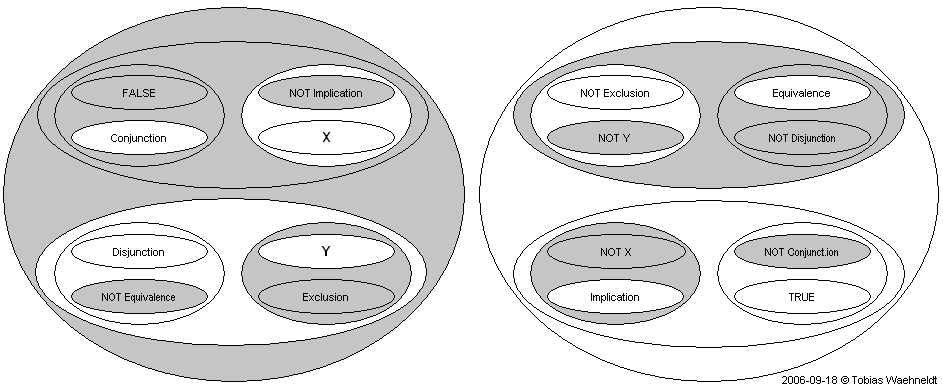
A room of all
n-digital logical relations becomes transformed into the resulting room
of logical evidence with  two-gradated dimensions in order to portray the texture of all
including possible logical relations symmetrically.
two-gradated dimensions in order to portray the texture of all
including possible logical relations symmetrically.
|
X Þ Y |
The hypothesis, on X follows Y, tested on
falsification, is |
||
|
X ≠> Y |
The hypothesis, Y doesn’t follow X, tested
on verification, is |
||
|
REMARK: The exclusion-operator is implemented by the author and is not
commonly accepted in sciences! |
|||
|
|
|||
|
Totality |
Conditionality |
||
|
T T T T |
TRUE |
T F T T |
Implication |
|
F F F F |
FALSE |
F T F F |
NOT Implication |
|
T F F T |
Equivalent |
T T F T |
NOT Exclusion |
|
F T T F |
NOT Equivalent |
F F T F |
Exclusion |
|
Connectivity |
Variety |
||
|
F T T T |
NOT Conjunction |
F F T T |
NOT X |
|
T F F F |
Conjunction |
T T F F |
X |
|
F F F T |
NOT Disjunction |
F T F T |
NOT Y |
|
T T T F |
Disjunction |
T F
T F |
Y |
|
REMARK: the categories are
implemented by the author! |
|||
|
Hypothesises |
Tests |
Variety |
Relation |
|||
|
T |
T |
F |
F |
X |
||
|
T |
F |
T |
F |
Y |
||
|
On X follows Y |
Falsification |
|
F |
|
|
Implication |
|
Verification |
V |
|
|
|
Conjunction |
|
|
On X follows NOT Y |
Falsification |
F |
|
|
|
NOT Conjunction |
|
Verification |
|
V |
|
|
NOT Implication |
|
|
On NOT X follows Y |
Falsification |
|
|
|
F |
Disjunction |
|
Verification |
|
|
V |
|
Exclusion |
|
|
On NOT X follows NOT Y |
Falsification |
|
|
F |
|
NOT Exclusion |
|
Verification |
|
|
|
V |
NOT Disjunction |
|
|
On Y follows X |
Falsification |
|
|
F |
|
NOT Exclusion |
|
Verification |
V |
|
|
|
Conjunction |
|
|
On Y follows NOT X |
Falsification |
F |
|
|
|
NOT Conjunction |
|
Verification |
|
|
V |
|
Exclusion |
|
|
On NOT Y follows X |
Falsification |
|
|
|
F |
Disjunction |
|
Verification |
|
V |
|
|
NOT Implication |
|
|
On NOT Y follows NOT X |
Falsification |
|
F |
|
|
Implication |
|
Verification |
|
|
|
V |
NOT Disjunction |
|
Figure of Logical Declination
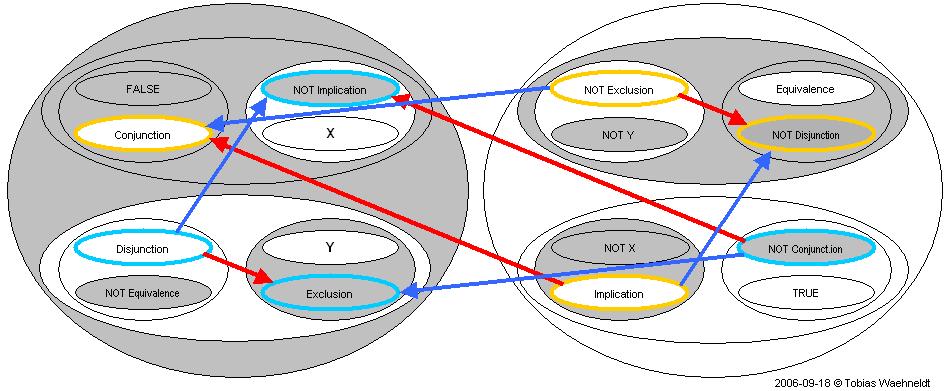
Derivation of Logical Relations
Table of Logical Derivation
|
Hypothesises |
Check |
Matching Relations |
||||
|
Variety |
Tests |
T |
T |
F |
F |
X |
|
T |
F |
T |
F |
Y |
||
|
On X follows Y |
Falsification |
|
F |
|
|
Implication |
|
Verification |
V |
|
|
|
Conjunction |
|
|
On X follows NOT Y |
Falsification |
F |
|
|
|
NOT Conjunction |
|
Verification |
|
V |
|
|
NOT Implication |
|
|
On NOT X follows Y |
Falsification |
|
|
|
F |
Disjunction |
|
Verification |
|
|
V |
|
Exclusion |
|
|
On NOT X follows NOT Y |
Falsification |
|
|
F |
|
NOT Exclusion |
|
Verification |
|
|
|
V |
NOT Disjunction |
|
|
Conditionality |
Tests |
T |
F |
T |
T |
Implication |
|
T |
T |
F |
T |
NOT Exclusion |
||
|
On Implication follows NOT Exclusion |
Falsification |
|
|
F |
|
NOT Exclusion |
|
Verification |
V |
|
|
V |
Equivalence |
|
|
Connectivity |
Tests |
F |
F |
F |
T |
NOT Disjunction |
|
T |
F |
F |
F |
Conjunction |
||
|
On NOT Disjunction follows Conjunction |
Falsification |
|
|
|
F |
Disjunction |
|
Verification |
|
|
|
|
FALSE |
|
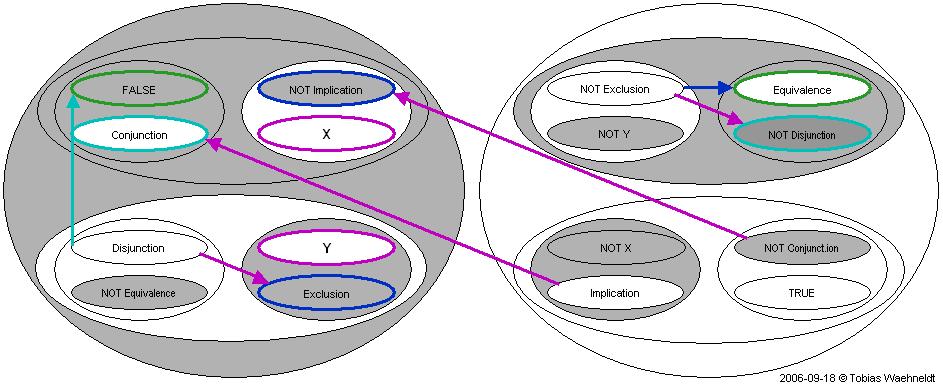
Figure of Logical Derivation
|
||||||||||||||||||||||||||||||||||||||||||||||||||||||||||||||||||||||||||||||||||||||||||||||||||||||||||||||||||||||||||||||||||||||||||||||||||||||||||||||||||||||||
Contemplation
The table shows the derivation of
quantity and quality from the theoretical well of logical evidence, which is derived
from the theory of hypothesises.
Derivation of Quantity
The table shows the n-digital logical relation of logical evidence as
Boolean expressions (False, True),
-
their
transformation into the -dimensional binary-digital expressions (0, 1),
-
their
transformation into the number system with the base of , in this case
the quaternary number system and
-
their
transformation into a singular number system with a base of  , in that each number has its own symbol, in this case the hexadecimal
number system.
, in that each number has its own symbol, in this case the hexadecimal
number system.
Derivation of Quality
-
The
table shows the logical evidence, which is derived from logical declination of
the singular hypothesis and their transformation into preferably simply adapted
and generalized linguistic fragments of expressions of a hierarchical
cause-effect-scheme respectively non-hierarchical interdependencies of influencing
variables like hardly or not distinguishable causes or effects.
-
The
absolute value of dichotomic index describes ranges, each dichotomic scaled
(prefixes) with logical qualities and their logical complements, their
negations.
-
Each
case of the cause-effect-scheme, without the cases of logical variety, without
the causes, the effects and their complements, are linguistic interpreted both
ways, positive and negative and respectively their plausibility more a less
indifferent but commutable.
Generalization
In order to generalize the
qualitative fragments of linguistic expressions, the causes and effects are to
contemplate variously exchangeable, so that the linguistic expression determines
the relation of both and their assignment. In order to supports the
capabilities of categorisation and operating two further table are appended.
|
Table: Operator-Declination of
Logical Evidence 2006-09-29 © Tobias Waehneldt |
|||
|
FIN |
EPC |
ICS |
EQV |
|
AND |
EPC, ICS, ECS, FIN, TIN are implemented by the author! |
NOR |
|
|
OR |
NAND |
||
|
XOR |
ECS |
IMP |
TIN |
The adaptation of qualitative and
quantitative logical concepts is very difficult but very helpful. It increasingly
determines the communication. But doubtlessly the very complex contextual and
associative components of communication transporting more than logical
information. The social context and their necessities is the root of
communication, to show emotions, emphasis, rivalry, identifications, ideals, to
get orientation and much more. Such things don’t simply fit into a room of
discrete logical relations. But the logical evidence can help to develop more
differentiated forms of communication and supports the capabilities to communicate.
2006-09-19
© Tobias Waehneldt – all rights reserved