|
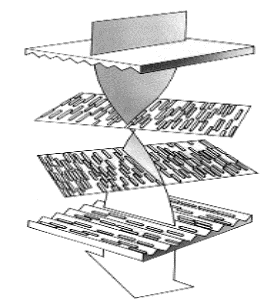
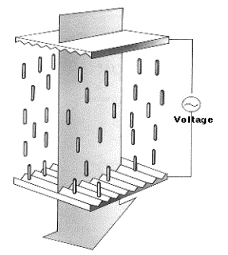
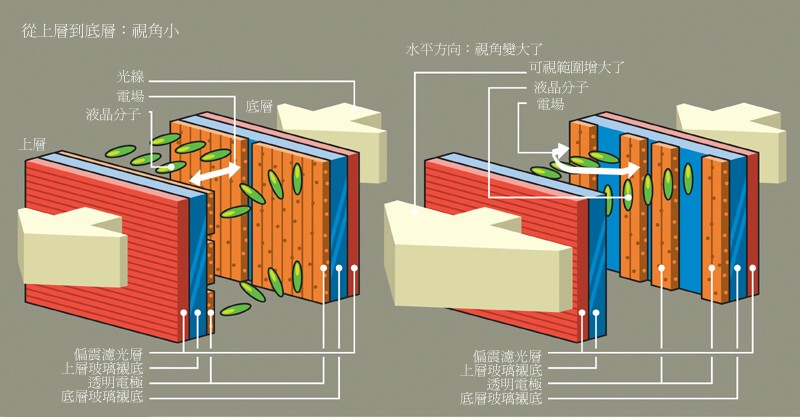
LCD之顯示原理介紹 工作原理:液晶顯示器中最主要的物質就是液晶,當通電時導通,分子排列變的有秩序,使光線容易通過;不通電時分子排列混亂,阻止光線通過。讓液晶分子如閘門般地阻隔或讓光線穿透。因爲液晶材料本身並不發光,所以在顯示幕兩邊都設有作爲光源的燈管,而在液晶顯示幕背面有一塊背光板(或稱勻光板)和反光膜,背光板是由熒光物質組成的可以發射光線,其作用主要是提供均勻的背景光源。背光板發出的光線在穿過第一層偏振過濾層之後進入包含成千上萬液晶液滴的液晶層。對於液晶顯示器來說,亮度往往和他的背板光源有關。背板光源越亮,整個液晶顯示器的亮度也會隨之提高。而在早期的液晶顯示器中,因爲只使用2個冷光源燈管,往往會造成亮度不均勻等現象,同時明亮度也不盡人意。一直到後來使用4個冷光源燈管産品的推出,才有了不小的改善。從上面敍述的LCD原理可以知道,光源的好壞將直接影響到畫面的亮度和質量。這也是爲什麽筆記本的液晶顯示器使用壽命是有限,而且比較短的,就是因爲受燈管影響非常大。 液晶(Liquid Crystal)為一半透明之物質,同時兼具有固體的結晶次序性與液體的流動性,也被稱為中間相(Mesophase)物質,如圖2-1-1。由於液晶具有規則分子排列的特性,當受到電場等外部刺激時,液晶分子排列會產生變化而具有光電效應之特性(Electro Optic Effect),利用此特性可應用在顯示用元件上。 圖1 液晶分子之相轉移示意圖 一般液晶顯示器使用的液晶材料,並非單一的液晶分子,原因是單一液晶材料無法達到LCD在低電壓驅動、高速化之要求,故使用時必需混和10種∼20種不同的液晶材料,才可在熱安定性、光安定性等特性上達到顯示器的要求。此外,LCD面板製造廠商也會考量顯示器種類、用途、使用地區之溫度等因素,選擇適當的配方。 液晶材料是液晶顯示器結構中上下玻璃板間的半透明介電材料,功能類似光閘開關,其原理是利用上下電極通電後,電場產生變化使得液晶分子因介電異方向性與導電異方向性而出現旋光性,示意圖見圖2-1-2,光線因液晶長軸與短軸折射率不同而產生不同之穿透度,再配合配向膜與偏光板之作用,即可產生光線ON-OFF之變化。

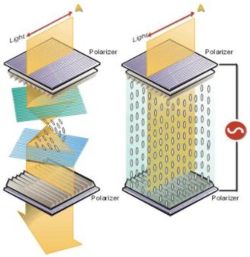
LIQUID CRYSTAL DISPLAYThe Liquid Crystal Display (LCD) was first developed at RCA around 1971. LCDs are optically passive displays (they do not produce light). As a result, LCDs require all most no power to operate. Many LCD calculators can operate from the power of a solar cell, others can operate for years from small button cell batteries. LCDs work from the ability of liquid crystals (LC) to rotate polarized light relative to a pair of crossed polarizers laminated to the outside of the display. There are two main types of LCD displays used for calculators today: Twisted nematic (TN) and supertwisted nematic (STN). TN displays twist polarized light to 90 degrees and have a limited viewing angle. STN displays were developed to twist polarized light between 180 to 260 degrees resulting in better contrast and a wider viewing angle. A LCD consists of two plates of glass, sealed around the perimeter, with a layer of liquid crystal fluid between them. Transparent, conductive electrodes are deposited on the inner surfaces of the glass plates. The electrodes define the segments, pixels, or special symbols of the display. Next a thin polymer layer is applied on top of the electrodes. The polymer is etched with channels in order to align the twist orientation of the LC's helix shaped molecules. Finally, polarizing films are laminated to the outer surfaces of the glass plates at 90 degree angles. Normally, two polarizing films at 90 degrees should be dark, preventing any transmission of light but due to the ability of LC to rotate polarized light the display appears clear. When AC voltage is passed through the LC, the crystals within this field align so that the polarized light is not twisted. This allows the light to be blocked by the crossed polarizers thus making the activated segment or symbol to appear dark. Many other types of LCD displays are being developed for the laptop and CRT replacement market including full color versions. These include double and triple twisted nematic (DSTN and TSTN) displays and the Active-matrix Thin-film Twisted Nematic and Metal-Insulated-Metal Twisted Nematic (TFT-TN and MIM-TN) displays. Unfortunately these advanced display are too expensive for most of the calculator market. TN LCDs almost completely dominate todays calculator market due to their extremely low power requirements, thin size, and low cost.
|
||||||||||||||||||||