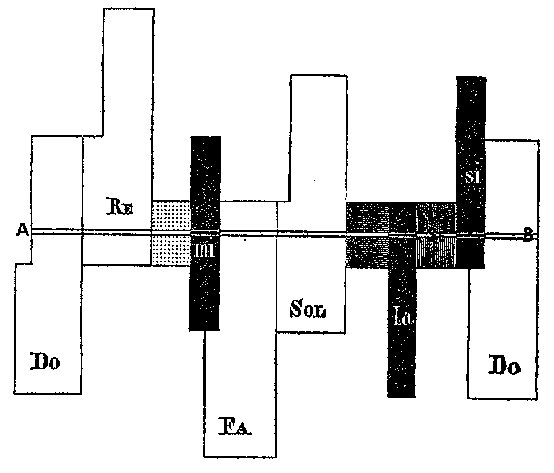
Fig. 2. - A PORTION OF THE ENHARMONIC KEY-BOARD, SHOWING THE RELATIVE POSITION OF THE FINGER-KEYS WHICH GIVE THE TRIPLE AND DOUBLE DIATONIC SCALES IN EVERY KEY OR SIGNATURE, OR TAKING DO ON ANY WHITE KEY. - Scale of one half.
The white and black keys are represented in their natural colors; the red keys - perfect sevenths - by vertical lines; the blue keys - dominant thirds in the minor mode - by horizontal lines; the yellow keys - dominant sevenths in the minor mode - by white stippled with black.
Fig. 3 - SECTION THROUGH A B, OR THROUGH THE THIRD QUARTER OF ANY KEY-NOTE, EXPOSING ALL THE NOTES OF THAT KEY BOTH IN THE MAJOR AND MINOR MODES.
ENHARMONIC TABLE,
COMPRISING THE NOTES GIVEN BY THE SECTION A B, FIGS. 2, 3, IN THE SIGNATURES FROM 9 FLATS TO 9 SHARPS, AND CONTAINING THEIR DIATONIC SCALES INCLUDING THE MINOR MODE. 100 NOTES TO THE OCTAVE. *
| [sig.] | TRIPLE DIATONIC SCALE | ||||||||||
| DO | RE | mi | FA | SOL | la | si | DO | ||||
| KEY- NOTE. | SECOND. | 3d. | FOURTH | FIFTH. | 6th. | 7th. | OCTAVE. | ||||
| 9# | D# | E# | e#7 | fx | G# | A# | ax | b# | C#7 | cx | D# |
| 8# | G# | A# | a#7 | b# | C# | D# | dx | e# | F#7 | fx | G# |
| 7# | C# | D# | d#7 | e# | F# | G# | gx | a# | B7 | b# | C# |
| 6# | F# | G# | g#7 | a# | B | C# | cx | d# | E7 | e# | F# |
| 5# | B | C# | c#7 | d# | E | F# | fx | g# | A7 | a# | B |
| 4# | E | F# | f#7 | g# | A | B | b# | c# | D7 | d# | E |
| 3# | A | B | b7 | c# | D | E | e# | f# | G7 | g# | A |
| 2# | D | E | e7 | f# | G | A | a# | b | C7 | c# | D |
| 1# | G | A | a7 | b | C | D | d# | e | F7 | f# | G |
| [0] | C | D | d7 | e | F | G | g# | a | Bb7 | b | C |
| 1b | F | G | g7 | a | Bb | C | c# | d | Eb7 | e | F |
| 2b | Bb | C | c7 | d | Eb | F | f# | g | Ab7 | a | Bb |
| 3b | Eb | F | f7 | g | Ab | Bb | b | c | Db7 | d | Eb |
| 4b | Ab | Bb | bb7 | c | Db | Eb | e | f | Gb7 | g | Ab |
| 5b | Db | Eb | eb7 | f | Gb | Ab | a | bb | Cb7 | c | Db |
| 6b | Gb | Ab | ab7 | bb | Cb | Db | d | eb | Fb7 | f | Gb |
| 7b | Cb | Db | db7 | eb | Fb | Gb | g | ab | Bbb7 | bb | Cb |
| 8b | Fb | Gb | gb7 | ab | Bbb | Cb | c | db | Ebb7 | eb | Fb |
| 9b | Bbb | Cb | eb7 | db | Ebb | Fb | f | gb | Abb7 | ab | Bbb |
| FIFTH. | SIXTH. | 7th. | KEY- NOTE. | SECOND. | 3rd. | 4th | FIFTH. | ||||
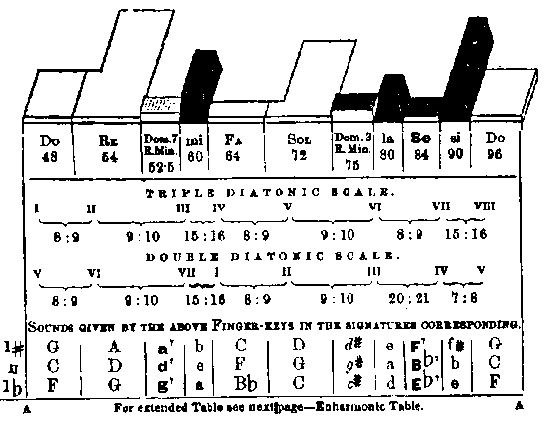
| DO | RE | mi | FA | SOL | la | Se | DO | ||||
| DOUBLE DIATONIC SCALE. | |||||||||||
* In considering the relation of the notes in the enbarmonic system, there is constent reference to the series of fifths, and the following observation of their order may be of use. A descending series of fifths is a succession of the folllowing letters, the first four of which form an English word, viz. bead gcf. Whe n the series is extended down, a flat is added, always on the beginning of this series or on b, which sign continues without change to f, where another flat comes in, remaining also for the seven letters. If the series commences with one or more sharps, the same rule holds good, remembering that a sharped note is flattened by making it natural. If we then commence with B# we shall have
B#, E#, A#, D#, G#, C#, F# - B, E, B, D, G, C, F - Bb, Eb, Ab, Db, Gb, Cb, Fb,
or the key-notes of the keys from twelve sharps to eight flats. Continuing, we should have a succession of hte same letters, with double flats, ending with the key-note of fifteen flats ; next the same with triple flats, leaving us in the unexplored regions of twenty-two flats, where for the present we will stop. The series of thirds, sevenths, etc., follow the same succession.
To the perfect sevenths is added the index 7, not as being essential, for the type alone is sufficient to distinguish them, but in order to make them more conspicuous at the present time.
Examples in Fingering Chords on the Enharmonic Key-Board.
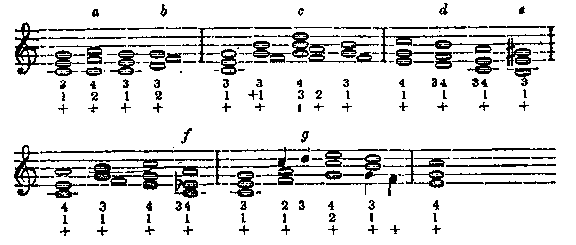
Notes. - a, subdominant chord, f and a; b, dominant with seventh, F7; c, same with ninth, A; d, dominant seventh; e, dominant of relative minor; the seventh, d7 may be added; f, subdominant with seventh; g, grave second d, or sixth of subdominant. The flattened note should be made natural in the next chord.
The double figures indicate that the key is touched with one finger, which is immediately changed for another, as is customary in passing smoothly from one chord to another. The base will be easily supplied by the musician, who will also observe the similarity between this fingering, and that of the common key-board.
25. The chords given belong in part to the triple, and in part to the double diatonic scales, or more properly. speaking, those scales belong to these chords. For melodies originate from harmonies, if either can be said to generate the other, when both spring into existence almost at once. When Haydn, who from poverty could not obtain instruction in the theory of music, was forced to search for himself, he discovered certain rules which he was desired to impart. "Try to find them out," is understood to have been his sensible reply. It was supposed that they referred to the dependence of melody on harmony. However this may be, it is certain by the evidence contained in his compositions, that he had a very complete and delicate knowledge of the laws of harmony and their relation to melody, and that his inspiration came from a higher source then the tempered octave of twelve keys. The student who would follow Haydn's advice will find more aid in an enharmonic key-board with its pipes, strings, or even seraphine reeds, than in the moat thorough primer of thorough-base that has yet been published. A pupil in harmony taught by an instrument tempered with twelve sounds is worse off than a student of mineralogy shut up wihh twelve specimens, or of chemistry with so many elementary substances. The latter might learn much that is true and important, and so might the musical student mould he tune his twelve notes accurately to something. And I would not be understood as thinking that those thus taught harmony are totally ignorant of its true principles. I have met with notable instances where the truth was denied in words and declared in actions. Musicians sometimes learn by intuition, and contrary to what they are taught. So people are found just and amiable in spite of bad political or theological creeds and education.
26. Fig. 3 gives a section through the center of the third quarter of the key-note of fig. 2, and through all the notes, major and minor, of the signature to which it corresponds. The circumstance that a section in this place will cut all these notes and no others, might be considered remarkable and even wonderful, were it not for the fact that this is the first principle on which the system is based. In constructing the board a certain number of parallel spaces are laid down down left to right, and one space is assigned to each signature intended to be provided for. In the natural signature, C, the key-note, has its place of necessity. But C is the fourth of 1# and accordingly is prolonged backward - toward what would be the top of a page or the north point of a map - over the space of 1#. As it is the fifth of 1b, and the second of 2b, it is brought forward to cover the space of these two signatures also, and the whole key now is four times as long as the space originally assigned to each signature- which I have taken at nine�tenths of an inch, but which might have been more or less. So every other note wanted in a signature is placed here, and if wanted in adjoining ones it is protracted into them. Thus the e of the natural key is in all the spaces occupied by its root C, exept in that of 2b, where it is not used. The perfect sevenths and dominant thirds and sevenths of the minors being used each in one signature only, are not extended beyond it. Many simple rules for the relative position of the finger-keys could be given , which quickly fix their location in the mind, like the following:
27. Rules. - l. From the back half of a white key to the adjoining white key, on the right is a major tone, 8:9, e. g., DO to RE, fig. 2, C to D, fig. 1, and vice vers�. 2. From the front half of a white key to the nearest black key, on the right, is a minor tone, 9:10 ; e.g, RE to mi, fig. 2, D to e, fig. 1, and vice vers�. 3. From the forward part of any black key to the adjoining white key into which it is half inserted, on the right, is a diatonic semitone, 15:16; e.g., mi to FA, fig. 2, e to F, fig. 1, and vice vers�. 4. From the back end of any black key to the next black key on the right, is a major tone; e.g., la to si, fig. 2, e to f#, fig. 1, and vice versa. The distance to the right, or left, for whole tones is always the same, viz., the width of the white key or 0.993 in. Other rules will suggest themselves to the student, and these specimens will suffice.
28. The finger-keys supposed to be cut by the secction A B, have their remaining portion in the rear, shown in perspective, and are marked with their names and the relative vibrations of their sounds. Below is indicated their order in the triple and double diatonic scales. Still below is a part of a table of the fixed notes which would be cut were this section made through the key-note of the several signatures indicated in the margin. The complete table should follow below this section, but as the space of the page does not allow, it is given entire on the opposite page and should be referred to this section; even the of the paper on which the sounds are marked corresponds with that of the finger-key in the place it is supposed to have been cut. This enharmonic table contains in its eleven columns all the notes of the major and minor modes, within the limits of nine flats to nine sharps, both inclusive, and comprises one hundred notes to the octave. Owing, however, to the close coincidence of two of the series with two others, twenty-two of these can be dispensed with without an error exceeding the hundredth of a comma in the fifths alone, and nothing elsewhere; which difference may be neglected, and is, practically, through the "sympathy" of accordant sounds, in perfect tune.
29. The last named circumstance is of much importance when the cost of organ-pipes is in question. although there is no such thing in music as a "circle" of keys returning into itself theoretically and mathematically, yet there are certain close approximations which can be taken advantage of for economical reasons. If we ascend eight perfect fifths and a major third, and descend five octaves, we have a note higher than our starting pitch by sornething less than the eleventh of a comma, or in the relation of its vibrations to the starting pitch as 100,111 to 100,000. This supposes absolutely exact tuning, which is very difficult, as the pipes or strings, which near the sound they would give when sounded singly, draw into tune and are perfectly accordant. So that if the tuner should make his fifths one-fiftieth of a comma flat which he might do and have them all sounding in perfect tune - he would end as much below the starting pitch as perfect tuning should, theoretically, bring him above it. From which it is seen that he can, if he choose, flat each fifth one hundredth of comma, and the two series will then coincide. Indeed, this distant note is usefill as a landmark, and as a detective of small errors accumulating among so many fifths. It may be compared to the correction of measured distances by astronomical observations, without, like the latter, being subject to any errors of observation however small.
30. On reference to the table, page 13, two notes thus approximate are C in the natural key and b#, the third of eight sharps, and the key-notes Bbb 9 flats, to G, 1 sharp, are thus available for the thirds, from a, in 1 flat to fx in 9 sharps; in all eleven pipes saved. Also the thirds, db in 9 flats, to b, in one sharp, are equally serviceable for the dominant thirds in the minor mode, c# in 1 flat to ax in 9 sharps, which include eleven more pipes, reducing the hundred of the table to seventy-eight only.
ADDITION TO �30. - The perfect sevenths of the major key, Abb7 to F7, answer for those of the minor key, g7 to e#7; and the total of pipes in the octave will be 67.
31. With the key-board that has been described, all the playing is done with the hands, without aid from the feet, and there is nothing to prevent the use of the feet for pedal bases. But the same key-board is not best for fingers and for feet, especially with the large number of its sounds, many of which are not called for in pedal bases, while others are constantly required. I have therefore devised an enharmonic pedal key-board which is sufficient and convenient for the pedal parts. The notes most needed are the keg�notes. These are arranged 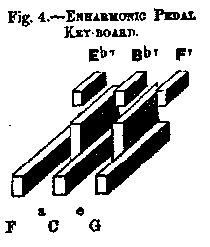 in front in a straight line and in the order of the fifths ascending from left to right. Behind these and in a higher row, and between the key-notes are major thirds of the keys in front and to left of each. Still above the thirds, and directly behind the key-notes, are the perfect sevenths of the latter. The key-notes are white, the thirds black, and the sevenths red, as in the manuals. Each pedal is an inch wide and two and half inches from center to center apart. The arrangement of the notes in the three series is as in the fig. 4, and in the following sketch:
| Order of the Pedal notes. | ||||||||||||||||||||||||||
| Fb7 | Cb7 | Gb7 | Db7 | Ab7 | Eb7 | Bb7 | F7 | C7 | G7 | D7 | A7 | E7 | B7 | |||||||||||||
| Sevenths. | ||||||||||||||||||||||||||
| bb | f | c | g | d | a | e | b | f# | c# | g# | d# | a# | ||||||||||||||
| Thirds. | ||||||||||||||||||||||||||
| Gb | Db | ab | Eb | Bb | F | C | G | D | A | E | B | F# | <td>C# | |||||||||||||
| KEY-NOTES. | ||||||||||||||||||||||||||
32. The most important notes of a pedal base, after the key-note, are the fifth above and below; these are found here on the right and left of the key-note. The third - in the second row-is on the right of its key-note, and the tonic 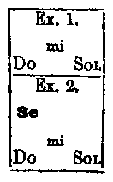 of the relative minor on the left. So with the relative minor: its dominant is on the right as in the major scale. If a base requires the common chord in successive notes, or in arpeggio, they come easily thus (Ex. 1), the keys being all together. The chord of the sevnth is taken thus (Ex.2). The diatonic scales may be played in their melodic order, Do, Re, mi, etc., without having to skip farther than the second key above or below, or a distance of five inches. Further capabilities in this key-board will appear as it is studied.
33. Consequently, there is equal facility as in the tempered organs for managing the pedals, for the swell organ, for bringing on and taking off the stops, etc. Without considering that difficulty should stand in the way of accomplishing a desirable object which is possible aad worth the expense, I would submit to those interested that it is practicable to manage an organ constructed on the principles I bave proposed, and that it would give general satisfaction to the lovers of music - nearly the whole civilized world - to listen to it. I consider that the only great difficulty is in getting the requisite money applied to its cost. Still it is not impossible that some one who believes, or knows, what the result will be, will some time be able to build a great organ worthy of its name. If it will help 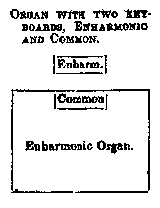 its success - in view of the reluctance of organists to learn a new key-board - it might have, in addition to the enharmonic key-board, the common one with selecting apparatus, like that of the organ of 1849, to be managed by the feet of the organist, or by the fingers of the director One of these key-boards, with the draw-stops and all necessary might be in front of the organ, facing forward, and the organist by turning on his seat could play on eitber, or another player could play at the same time.
34. I propose to add to my organ-which now has the common key-board and transposition pedals-the enharmonic key-board; which will then be as represented here. But I think the new keyboard alone sufficient.
35. In the theory I have advocated, the major keys are based on the first series of sounds (� 12), and the minor keys on the sixths of the major keys, or on the series II. That there must be such a relation and order is inevitable. But respectfor other authorities - among them Rev. Henry Liston, and especially Gen. T. Perronet Thompson - make it proper to mention that the major key of E may be taken on e, the third of the natural key; and that of the minor key on c, which I have assigned to the signature of three flats, may be taken on C, with the natural signature. Indeed, Mr. Liston, in his organ of 1810, and Gen. Thompson in his of 1850, have this arrangement.* Musicians must decide upon the utility of taking the minor key of c upon the key-note of C major, or the scale of Ab major with C of the natural scale as its third. If this is desirable, I have provided a finger-key at the back end of each black key, giving the minor third to the key-note, to which this black key gives the major third. For example, at the end of the key e, is Eb, minor third to C. This key is on a vertical wire with a circular head rising above the black key; and the whole key can be removed, it found to be in the way when not wanted. The sound, if introduced, will form a series VI (�12), and will require but eight extra organ-pipes, whatever the number of signatures. The key-note of the ninth signature above, is but 0.09 of comma sharp for a minor third; but applying the correction (�30) needed for other notes, these minor thirds are made mathematically perfect. Thus the key-notes (see enharmonic table, p. 13,) C to D#, become the series Dbb to Eb (series VI, �12), minor thirds respectively above the key-notes Bbb to C.
* The three key-boards of Gen. Thompson's organ give respectively the keys of C, e, and d: thu scale of 4# being based on e, the third of the natural scale, and that of 2# on d, the sixth of 1b, instead of on D, the second of the scale of C. The key-notes, D and A, their thirds f# and c#, and fifths, A and E, are given; but here the series of fifths ends. B and g# are not embraced in the forty-two notes of his octave, in which all are employed in thirds and fifths, and none for the perfect sevenths.
36. By transposing a scale by fifths, above or below, we first obtain a pitch widely different, and afterward approach that from which we started. For example, beginning with C we have G far removed, but in the next transposition comes D, only one diatonic interval - the tone - above C. Proceeding in the same direction, we shall ascend until at the seventh step we reach C#, a large chromatic semitone above C. At twelve sharps B# is reached above C by what is called the comma of Pythagorus, or 1.09252 comma. This is the "circle" of the equal temperament, where the tuner divides this excess among the 12 fifths: making tolerable fifths but intolerable substitutes for thirds. With twelve other notes for thirds fair intervals could he had. At each successive twelve transpositions we rise by this one comma until at fifty-three sharps the key-note is closer than ever to the starting pitch - only 0�16813 of comma sharp. If this small interval is divided among the 53 fifths, leaving each flat 0.00316 of comma the circle will meet, and the octave will be divided into 53 equal intervals*. These are nearly exact for all the combinations of the triple diatonic scale, in these 53 keys. The fifths are as stated. The major thirds are 0.065 of a comma sharp - near the limit where they draw into tune by "sympathy. In equal temperament they are sharp 0.63582.
* This is most readiiy done by its logarithm, viz, 0.00567,98112,38943,04142; which, added to itself 53 times, gives the log. of the octave, 2:1.
It is related that Mr. Briggs, in constructing his logarithmsd, in or der tto find the first small number, began with the number 10, and its logarithm 1, and extracted continually the root of the last number, and bisected its logarithm, till he arrived at the 53d and 54th toors and their annexed logarithms as here below : where he found the decimals in the natural numbers are to each other in the ration of the logarithm, or as 2:1.
Numbers. Logarithms. 53 1.00000,00000,00000,25563,82986,40064,70 0.00000,00000,00000,11102,23024,62515,65404 54 1.00000,00000,00000,12781,91493,20032,35 0.00000,00000,00000,05651,11512,31257,82702
37. The following table, page 21, serves to show: 1. this equal division into 53 notes, and how each division serves for six different notes in such close approximation that the eye would take them as one; 2. the perfectly tuned notes in their order as regards acuteness of pitch; as they result from successive transpositions by sharps and by flats to the 53d degree: and 8. any other adjustment In order to economize in the number of organ-pipes.
38. If the ear is content with the thirds 0�065 of comma sharp, we can have 53 signatures in sharps, and as many in flats - l06 keys - complete in all except the perfect sevenths: these will all be supplied by 53 other pipes, making 106 pipes in the octave for what mathematically requires 640.
39. But there is an arrangement by which we can have perfect thirds and all other intervals. By flatting the fifths 0.0113 or comma, as described in �30, and adding eight pipes, we have the triple diatonic scale perfect in 53 signatures, with 61 pipes. The perfect sevenths are supplied, and the double diatonic scales completed, by 53 additional pipes. For the minor mode we require 8 pipes each for the dominant thirds and sevenths; making a total of 130 to the octave for 53 keys absolutely perfect. They can be taken above or below the natural signature, as from 26 flats to 26 sharps: or in any other connected series of signatures. We should not have the circle joining exactly, �36, but we should have perfect intervals within these wide limits. An enharmonic key-board for 53 signatures, on the scale I have drawn, would require about four feet of width, which could be divided into two or three boards.
40. Other adjustments can be made which are favored by the closeness of the intervals, and the large range within which the differences can be divided. In a temperament of 12 sounds, the grand difficulty is to dispose of a comma among 5 intervals, viz., 4 fifths and a major third-ignoring the chord of the seventh. The third of C, e, must serve for E. In any system the sum of the errors in these 5 intervals is always exactly a comma. The mean-tone temperament gives it all to the fifths, one-fourth of a comma each, and the equal temperament, dividing but one-twelfth to each fifth, leaves the third sharp by two-thirds of a comma. Here we have a difference of only one-eleventh of a comma, and have 8 fifths among which to divide it.
41. The following table gives the names of the key-notes of 10 regular transpositions by fifths, according to common musical rules, and the number of sharps or flats in the signature of each. It gives, besides, the thirds and dominant thirds of the minor mode which are closely approximate to the key-notes, together with the signature in which each note of the two latter series is found. A column of figures ascending from 1 to 54 indicates that there are so many notes arranged in the order of their acuteness or increasing rapidity of vibration. The first half of the table assigned to "transposition by sharps" is divided into three double columns, of each of which the first column gives the number of sharps in the signature, where the note at its right is found in the relation of key-note, third, etc, as indicated at the head of the column. The keys in flats have three double columns arranged in like manner. In each double column the figure following the letter shows how many times this letter is sharped or flatted. We read |14|C 2#| "signature 14 sharps, key-note Cx" (C twice sharped or double sharp). |30|D 4#| is "signature 30 sharps, key-note Dxx" (quadruple sharp).
| Transpositions by Sharps | Transpositions by Flats | ||||||||||||||||||||
| Key-notes | Thirds. | Dom. 3ds Rel. Minor | Key-notes | Thirds. | Dom. 3ds Rel. Minor | ||||||||||||||||
| #s in Sig. | Let. | Times sharped | #s in Sig. | Let. | Times sharped | #s in Sig. | Let. | Times sharped | #s in Sig. | Let. | Times flatted | #s in Sig. | Let. | Times flatted | #s in Sig. | Let. | Times flatted | ||||
| OCTAVE, 2:1. | 54 | 0 | C | 0 # | 8 | b | 1 # | 16 | a | 3 # | 0 | C | 0 b | 45 | g | 6 b | 37 | f | 4 b | ||
| 53 | 41 | F | 6 " | 49 | e | 7 " | 4 | b | 1 " | 12 | D | 2 " | 4 | c | 0 " | 49 | g | 6 " | |||
| 52 | 29 | G | 4 " | 37 | f | 6 " | 45 | e | 7 " | 24 | E | 4 " | 16 | d | 2 " | 8 | c | 0 " | |||
| 51 | 17 | A | 2 " | 25 | g | 4 " | 33 | f | 6 " | 36 | F | 5 " | 28 | e | 4 " | 20 | d | 2 " | |||
| 50 | 5 | B | 0 " | 13 | a | 2 " | 21 | g | 4 " | 48 | G | 7 " | 40 | f | 5 " | 32 | e | 4 " | |||
| Si, Seventh, 15:8. | 49 | 46 | E | 6 " | 1 | b | 0 " | 9 | a | 2 " | 7 | C | 1 " | 52 | g | 7 " | 44 | f | 5 " | ||
| 48 | 34 | F | 5 " | 42 | e | 6 " | 50 | d | 8 " | 19 | D | 3 " | 11 | c | 1 " | 3 | b | 0 " | |||
| 47 | 22 | G | 3 " | 30 | f | 5 " | 38 | e | 6 " | 31 | E | 5 " | 23 | d | 3 " | 15 | c | 1 " | |||
| 46 | 10 | A | 1 " | 18 | g | 3 " | 26 | f | 5 " | 43 | F | 6 " | 35 | e | 5 " | 27 | d | 3 " | |||
| 45 | 51 | D | 7 " | 6 | a | 1 " | 14 | g | 3 " | 2 | B | 1 " | 47 | f | 6 " | 39 | e | 5 " | |||
| 43 ¾ Perfect Seventh. | 44 | 39 | E | 5 " | 47 | d | 7 " | 2 | a | 1 " | 14 | C | 2 " | 6 | b | 1 " | 51 | f | 6 " | ||
| 43 | 27 | F | 4 " | 35 | e | 5 " | 43 | d | 7 " | 26 | D | 4 " | 18 | c | 2 " | 10 | b | 1 " | |||
| 42 | 15 | G | 2 " | 23 | f | 4 " | 31 | e | 5 " | 38 | E | 6 " | 30 | d | 4 " | 22 | c | 2 " | |||
| 41 | 3 | A | 0 " | 11 | g | 2 " | 19 | g | 4 " | 50 | F | 7 " | 42 | e | 6 " | 34 | d | 4 " | |||
| La, Sixth, 5:3. | 40 | 44 | D | 6 " | 52 | c | 8 " | 7 | f | 2 " | 9 | B | 2 " | 1 | a | 0 " | 46 | e | 6 " | ||
| 39 | 32 | E | 4 " | 40 | d | 6 " | 48 | c | 8 " | 21 | C | 3 " | 13 | b | 2 " | 5 | a | 0 " | |||
| 38 | 20 | F | 3 " | 28 | e | 4 " | 36 | d | 6 " | 33 | D | 5 " | 25 | c | 3 " | 17 | b | 2 " | |||
| 37 | 8 | G | 1 " | 16 | f | 3 " | 24 | e | 4 " | 45 | E | 7 " | 37 | d | 5 " | 29 | c | 3 " | |||
| 36 | 49 | C | 7 " | 4 | g | 1 " | 12 | f | 3 " | 4 | A | 1 " | 49 | e | 7 " | 41 | d | 5 b | |||
| Dom. 3d, Minor. | 35 | 37 | D | 5 " | 45 | c | 7 " | 0 | g | 1 " | 16 | B | 3 " | 8 | a | 1 " | 0 | g | # | ||
| 34 | 25 | E | 3 " | 33 | d | 5 " | 41 | c | 7 " | 28 | C | 4 " | 20 | b | 3 " | 12 | a | 1 b | |||
| 33 | 13 | F | 2 " | 21 | e | 3 " | 29 | d | 5 " | 40 | D | 6 " | 32 | c | 4 " | 24 | b | 3 " | |||
| SOL, FIFTH, 3:2. | 32 | 1 | G | 0 " | 9 | f | 2 " | 17 | e | 3 " | 52 | B | 8 " | 44 | d | 6 " | 36 | c | 4 " | ||
| 31 | 42 | C | 6 " | 50 | b | 7 " | 5 | f | 2 " | 11 | A | 2 " | 3 | g | 0 " | 48 | d | 6 " | |||
| 30 | 30 | 4 " | 38 | c | 6 " | 46 | b | 7 " | 23 | B | 4 " | 15 | a | 2 " | 7 | g | 0 " | ||||
| 29 | 18 | E | 2 " | 26 | d | 4 " | 34 | c | 6 " | 35 | C | 5 " | 27 | b | 4 " | 19 | a | 2 " | |||
| 28 | 6 | F | 1 " | 14 | e | 2 " | 22 | d | 4 " | 47 | D | 7 " | 39 | c | 5 " | 31 | b | 4 " | |||
| 27 | 47 | B | 6 " | 2 | f | 1 " | 10 | e | 2 " | 6 | G | 1 " | 51 | d | 7 " | 43 | c | 5 b | |||
| 26 | 35 | C | 5 " | 43 | b | 6 " | 51 | a | 8 " | 18 | A | 3 " | 10 | g | 1 " | 2 | f | # | |||
| 25 | 23 | D | 3 " | 31 | c | 5 " | 39 | b | 6 " | 30 | B | 5 " | 22 | a | 3 " | 14 | g | 1 b | |||
| 24 | 11 | E | 1 " | 19 | d | 3 " | 27 | c | 5 " | 42 | C | 6 " | 34 | b | 5 " | 26 | a | 3 " | |||
| FA, FOURTH, 4:3. | 23 | 52 | A | 7 " | 7 | e | 1 " | 15 | d | 3 " | 1 | F | 0 " | 46 | c | 6 " | 38 | b | 5 " | ||
| 22 | 40 | B | 5 " | 48 | a | 7 " | 3 | e | 1 " | 13 | G | 2 " | 5 | f | 0 " | 50 | c | 6 " | |||
| 21 | 28 | C | 4 " | 36 | b | 5 " | 44 | a | 7 " | 25 | A | 4 " | 17 | g | 2 " | 9 | f | 0 " | |||
| 20 | 16 | D | 2 " | 24 | c | 4 " | 32 | b | 5 " | 37 | B | 6 " | 29 | a | 4 " | 21 | g | 2 " | |||
| 19 | 4 | E | 0 " | 12 | d | 2 " | 20 | c | 4 " | 49 | C | 7 " | 41 | b | 6 " | 33 | a | 4 " | |||
| Mi, Third, 5:4. | 18 | 45 | A | 6 " | 0 | e | 0 " | 8 | d | 2 " | 8 | F | 1 " | 0 | e | 0 " | 45 | b | 6 " | ||
| 17 | 33 | B | 4 " | 41 | a | 6 " | 49 | g | 8 " | 20 | G | 3 " | 12 | f | 1 " | 4 | e | 0 " | |||
| 16 | 21 | C | 3 " | 29 | b | 4 " | 37 | a | 6 " | 32 | A | 5 " | 24 | g | 3 " | 16 | f | 1 " | |||
| 15 | 9 | D | 1 " | 17 | c | 3 " | 25 | b | 4 " | 44 | B | 7 " | 36 | a | 5 " | 28 | g | 3 " | |||
| 14 | 50 | G | 7 " | 5 | d | 1 " | 13 | c | 3 " | 3 | E | 1 " | 48 | b | 7 " | 40 | a | 5 " | |||
| 13 | 38 | A | 5 " | 46 | g | 7 " | 1 | d | 1 " | 15 | F | 2 " | 7 | e | 1 " | 52 | b | 7 " | |||
| 12 | 26 | B | 3 " | 34 | a | 5 " | 42 | g | 7 " | 27 | G | 4 " | 19 | f | 2 " | 11 | e | 1 " | |||
| 11 | 14 | C | 2 " | 22 | b | 3 " | 30 | a | 5 " | 39 | A | 6 " | 31 | g | 4 " | 23 | f | 2 " | |||
| RE, SECOND, 9:8. | 10 | 2 | D | 0 " | 10 | c | 2 " | 18 | b | 3 " | 51 | B | 8 " | 43 | a | 6 " | 35 | g | 4 " | ||
| 9 | 43 | G | 6 " | 51 | f | 8 " | 6 | c | 2 " | 10 | E | 2 " | 2 | d | 0 " | 47 | a | 6 " | |||
| 7 ¾ Dom. 7th, minor. | 8 | 31 | A | 4 " | 39 | g | 6 " | 47 | f | 8 " | 22 | F | 3 " | 14 | e | 2 " | 6 | d | 0 " | ||
| 7 | 19 | B | 2 " | 27 | a | 4 " | 35 | g | 6 " | 34 | G | 5 " | 26 | f | 3 " | 18 | e | 2 " | |||
| 6 | 7 | C | 1 " | 15 | b | 2 " | 23 | a | 4 " | 46 | A | 7 " | 38 | g | 5 " | 30 | f | 3 " | |||
| 5 | 48 | F | 7 " | 3 | e | 1 " | 11 | b | 2 " | 5 | D | 1 " | 50 | a | 7 " | 42 | g | 5 b | |||
| 4 | 36 | G | 5 " | 44 | f | 7 " | 52 | e | 8 " | 17 | E | 3 " | 9 | d | 1 " | 1 | c | # | |||
| 3 | 24 | A | 3 " | 32 | g | 5 " | 40 | f | 7 " | 29 | F | 4 " | 21 | e | 3 " | 13 | d | 1 b | |||
| 2 | 12 | B | 1 " | 20 | a | 3 " | 28 | g | 5 " | 41 | G | 6 " | 33 | f | 4 " | 25 | e | 3 " | |||
| DO, KEY-NOTE. | 1 | 0 | C | 0 # | 8 | b | 1 # | 16 | a | 3 # | 0 | C | 0 b | 45 | g | 6 b | 37 | f | 4 b | ||
42. Each of the 55 notes is approximate to the six which appear in the same horizontal line, and these are the sounds which are made identical by the small correction mentioned. For example, if we divide the octave into 53 equal intervals, �36, the first note of the table - which see - will serve as (1) C, key-note of the natural signature; (2) b#, third in 8 sharps; (3) ax#(triple sharp), dominant third to the minor key in 18 sharps; (4) C, as before; (5) gbbbbbb (septuple flat), the third of 45 flats; (6)fbbbb, dominant third in the minor of 37 flats.* And in like manner, the six notes of each line will have the same pitch.
43. Interesting relations are found in this table. Every signature has 12 sharps or flats more or less than that which precedes. And by the division into groups of 5 intervals, curious coincidences appear. At the bottom of the first column of key-notes is C: each five intervals advance the signature seven degrees, and at the notes 6, 11, 16, etc., we have C with 1, 2, 3 sharps regularly to 36, where C sextuple sharp is key-note of 49 sharps; and C has maintained its place in eight successive groups.[+] There are many mathematical harmonies which point to the conclusion that music should be given in its purity, and in accordance with the laws of numbers, on which all the pleasure derived from listening to it depends.
* Notes several times sharped or flatted always bear to each other the same relation as respects these signs. The thirds of C, F, and G have the same chromatic signs as their roots. Thus the third of C is e; of C#, e#; of Cxx, exx. But the thirds of D, E, A, and B have one sharp more: the thirds of D is f#; of Dxx, fxx#. When these letters are flattd, the rule holds good, by changing "one sharp more" to "one flat less." The letters whose thirds take one sharp more - or on flat less - are B E A D (see p.13, note). Those which do not are G C F.
[+] In examining the relative vibrations of the notes in a series of fifths descending in the octave below, taking C as 1, the following notes are represented by these decimals, all of which are recurring or perpetually repeated. F, 0.666... ; Bb, 0.888... ; Eb, 0.522... ; Ab, 0.790123456... ; Db, 0.526748971193415637860082904... The ration of the comma below, or c, is 0.987654320...