|
||||
|
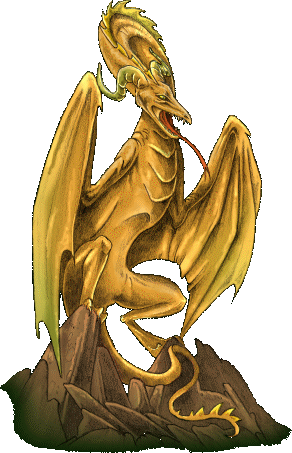
The Chinese dragon like the Indian Naga's, are often associated with water and rain and lakes and rivers. Chinese Dragons are divine mythical creatures that brings with it ultimate abundance, prosperity and good fortune. The Chinese proclaim themselves "Lung Tik Chuan Ren", Descendents of the Dragon. Unlike the the negative aspect associated with Western Dragons, most Eastern Dragons are beautiful, friendly, and wise. They are the angels of the Orient. Instead of being hated, they are loved and worshipped. Temples and shrines have been built to honor them, for they control the rain, rivers, lakes, and seas. Indeed China's four great rivers were named after Dragons -- the Heilongjian (Black Dragon) in the far north, the Huanghe (Yellow River) in central China, the Changjiang (Yangtze, or Long River) farther south, and the Zhujiang (Pearl) in the very far south. The Chinese Dragon, or Lung , symbolizes power and excellence, valiancy and boldness, heroism and perseverance, nobility and divinity. A dragon overcomes obstacles until success is his. He is energetic, decisive, optimistic, intelligent and ambitious. Most often these dragons are associated with royalty and the emperors are closely aligned with the image of dragon. Before history began, China's first emperor, Fu Hsi was said to have a dragons tail and his successor, Shen Nung, was said to have a dragon as father. The Imperial Dragon or lung has five claws instead of four. The ordinary dragon or mang depicts temporal power instead of spiritual prowess. The lung, or Dragon King issued orders for the Emperor by moving in four directions simultaneously. The fifth direction (in connection with the fifth claw) is the center where he remains. Dragons are used as decorations everywhere and described in terms of the dragon: dragon-throne, dragon-robe, dragon-bed, dragon-boat. Calling an emperor "dragon-face" was a supreme compliment. The Dragon brings upon the essence of life, in the form of its celestial breath, known to many as sheng chi. He yields life and bestows its power in the form of the seasons, bringing water from rain, warmth from the sunshine, wind from the seas and soil from the earth. The Dragon is the ultimate representation of the forces of Mother Nature. The greatest divine force on Earth. The Chinese Dragon is often seen as the symbol of divine protection and vigilance. It is regarded as the Supreme Being amongst all creatures. It has the ability to live in the seas, fly up the heavens and coiled up in the land in the form of mountains. Being the divine mythical animal, the Dragon can ward off wandering evil spirits, protect the innocent and bestow safety to all that hold his emblem. The Chinese Dragon is looked upon as the ultimate symbol of Good Fortune.  There are nine major types of Chinese dragons. The Horned Dragon The Winged Dragon The Celestial Dragon The Spiritual Dragon The Dragon of hidden treasures The Coiling Dragon The Yellow Dragon The Dragon King The most powerful generalized type of Chinese dragon is the horned dragon, or lung, which can produce rain and is totally deaf. Additionally, there is a homeless dragon (Ii) that lives in the ocean and another type (chiao) that is scale-covered and usually inhabits marshes but also keeps dens in the mountains. Nine Dragon Characteristics There are also nine ways the Chinese have traditionally represented these dragons, each one revealing a different dragon characteristic. There are dragons carved on the tops of bells and gongs, A second type is carved on the screws of fiddles, since most dragons are fond of music. A third is carved on the tops of stone tablets, because of dragons' love of literature. A fourth is found at the bottom of stone monuments, as dragons can support heavy weights. A fifth is placed on the eaves of temples, as dragons are ever alert to danger. A sixth occurs on the beams of bridges, since dragons are fond of water. A seventh is carved on Buddha's throne, as dragons like to rest. An eighth is placed on the hilts of swords, since dragons are known to be capable of slaughter. The ninth is carved on prison gates, as these are dragons that are fond of quarreling and trouble making. |
||||