 |
the California Missions |
 |
|
the California Missions |
|
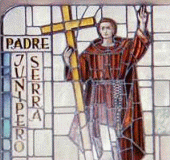
Junipero Serra is an extremely important
figure in the development of present-day California. His missions not only
served as the centerpiece to the development of Catholicism in California,
but also as a key foundation to the growth of the major California cities
such as San Francisco, San Jose, and San Diego. His legacy still remains
along the former El Camino Real (present day Hwy 101&San Diego Freeway)
in the form of twenty-one missions, nine of which he personally founded
and developed. Each has its own individual identity, history, and unique
traditions.
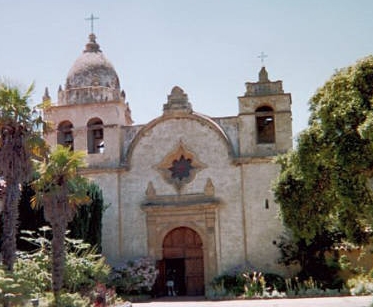
Each mission was built in a quadrangle for security (from the outside). The mission included a prominent church, rooms for priests, storehouses, housing for unmarried women, soldier barracks, dining facilities, and indoor workshops. Married Indians lived in a village within close proximity to the mission. Keep in mind that at no time did the Franciscans see mission land as their land, but as land rightfully belonging to the Natives to be handed over when they were comfortably acculturated to society and Christianity.
In addition to evangelization, the missionaries helped to improve the lives of the natives by introducing new and more reliable food sources than they previously had; most notably the modern (18c.) agricultural system of raising crops and livestock. What was produced by the mission Indians benefited solely the mission population.
 The
Indians certainly faced terrible hardship adjusting to this new way of
life. They mainly suffered from abusive soldiers who were responsible for
the spreading of diseases, such as pox and syphilis, and the mistreatment
of Indians (though many unfairly blame Serra for the abuses). Serra tried
to prevent the devastating effects, but knew the overall system would benefit
the Indians. It is true when one looks at it from an anthropological view,
the mission system seems harsh. But we must remember we are looking at
it through a twentieth century viewpoint. When one realizes the mentality
of the time Serra and his Franciscans held, the societal norms towards
unknown civilizations of the time (i.e. the U.S. treatment of the Indians),
what the Natives most likely would have endured without a mission system,
and the missionaries saw themselves as responsible for the conversion and
care of the souls of the Natives for their salvation, then one can understand
the reasoning of Serra was for the benefit of the Indians. The claims by
anti-Serra activists of Indian whippings were really comparable to a slap
on the wrist (which was a common punishment in Spanish society for disobedience).
The
Indians certainly faced terrible hardship adjusting to this new way of
life. They mainly suffered from abusive soldiers who were responsible for
the spreading of diseases, such as pox and syphilis, and the mistreatment
of Indians (though many unfairly blame Serra for the abuses). Serra tried
to prevent the devastating effects, but knew the overall system would benefit
the Indians. It is true when one looks at it from an anthropological view,
the mission system seems harsh. But we must remember we are looking at
it through a twentieth century viewpoint. When one realizes the mentality
of the time Serra and his Franciscans held, the societal norms towards
unknown civilizations of the time (i.e. the U.S. treatment of the Indians),
what the Natives most likely would have endured without a mission system,
and the missionaries saw themselves as responsible for the conversion and
care of the souls of the Natives for their salvation, then one can understand
the reasoning of Serra was for the benefit of the Indians. The claims by
anti-Serra activists of Indian whippings were really comparable to a slap
on the wrist (which was a common punishment in Spanish society for disobedience).
The reality is that the Indians now had a reliable food source (which they did not have prior to the missionaries); learned new trades, which later would become useful; and, most importantly from the Catholic viewpoint, their souls were saved (which was the only known way of achieving salvation from the Catholic perspective of that time).
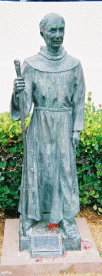
With the attitudes of the day, Serra should be viewed as one who truly cared for the Indians. When we look at other societies of this time period, we find there was no toleration for the Native Americans. For instance, a century after Serra founded the missions, the American government gave the public the right to kill “wild” Indians who were “in the way”. (This makes you wonder what would have happened to the natives if the Americans came before the Spanish !?.)
The fact is that Serra was not out to destroy the Indian society, but to protect it. This is exemplified in his call for Indian Rights. Outraged over the abuses by the soldiers, especially military commander Pedro Fages, Serra traveled to Mexico City in 1773 to propose what some would call a ‘bill of rights’. He called for complete missionary charge of the Indians and the removal of Fages. The Viceroy (the king’s representative in the ‘New World’) granted both requests which lead the way for the Indians to be treated fairly and justly along with enabling the missionaries to evangelize more effectively.
Many activists have claimed Serra to have
been a very unholy man who beat and tortured Indians. But there has never
been one piece of historical documentation to prove any of their claims.
(In fact, if any proof existed, his canonization process would be halted.)
Expert, unbiased historians, after piecing through all the historical documentation
and other evidence, have confirmed no abuses or mistreatment have occurred
by Serra. But it is sad that the historical facts of Serra’s life and the
California  Mission
system today are still tainted by wild opinion and speculation of activists
without any attempt to substantiate their claims. This leads to confusion
in the public spectrum and a history based on a complete misrepresentation
of the truth and the reality of this time period. (By truth, I am referring
to facts; by reality, I am referring to the social, political, economic,
and religious situation of Spanish society.)
Mission
system today are still tainted by wild opinion and speculation of activists
without any attempt to substantiate their claims. This leads to confusion
in the public spectrum and a history based on a complete misrepresentation
of the truth and the reality of this time period. (By truth, I am referring
to facts; by reality, I am referring to the social, political, economic,
and religious situation of Spanish society.)
The only conclusive historical evidence that can be proven is that Blessed Junipero Serra was a zealous missionary devoted to the spread of the Gospel Message. He taught and lived out the Gospel message, converted thousands of Native Americans to Christianity, and was a strong and courageous leader of the natives who constantly fought for their rights and provided them with the means for adapting in this new society. Pope John Paul II remarks that Serra “is an exemplary model of a selfless evangelizer, a shining example of Christian virtue and the missionary spirit...He not only brought the Gospel message to the Native Americans, but as one who lived the Gospel he also became their defender and champion”.
For comments or questions, please e-mail
me.
| For those students who are doing school projects, please contact the individual missions for information. You may find address, phone, or web info on each mission by by clicking here. |
(c) 2002 Brian Grisin, Monterey & Ojai, Ca
 since 1998