
Eighth of March - International Women's Day
March 8th is International Women's Day.
This doesn't mean women from all over the world get together and go on a huge
shopping spree.
Instead International Women's Day is an occasion to reflect on women's
accomplishments and to consider their continued struggle for equality, justice,
and development around the world.
Women account for more than 51% of the total population of the world, but they
still do not receive the fair equal treatment and statues as that of men. With
the rise of the women's rights movement, feminism and the feminist awareness,
this inequality has been reduced in the west but by no means eliminated. Women
in Africa, Asia, Latin America and may other parts of the world are still faced
with gender based persecution.
In the years surrounding the turn of the 20th century, women were entering the
workplace in larger numbers than ever before, thanks largely to the expansion of
nineteenth century industrialisation. The jobs they filled were segregated by
gender and were mainly in the areas of manufacturing, textiles and in domestic
services where working conditions were dismal, and wages even worse. The
political climate was one of turmoil and change - Socialism and Trade Unionism
were coming into being as working people the world over sought to improve their
status and working conditions. Additionally, Women's Suffrage, the right to
vote, was a still un-realized goal.
The first Women's Day was held on the last Sunday in February 1908, initiated by
groups of American socialist women for the purpose of demanding the Vote and to
call attention to the political and economic status of women. It continued to be
held on the final Sunday in February through 1913, when celebrations of the day
began to shift to the first Sunday in March. When the Russian Czar abdicated in
1917, the provisional Government granted women the right to vote - this took
place on February 23, according to the Julian calendar then used in Russia, but
on March 8 according to the Gregorian calendar used by most of the rest of the
world.
In the ninety-plus years since its inception, International Women's Day has
formed a rallying point for coordinated efforts by the growing international
women's movement to call for women's rights and increased participation in the
political and economic process.
On this day we commend women's struggle for gender equality and equal
opportunities and participation across nations, while at the same time try to
understand why women have to struggle so hard to achieve gender equality despite
the evident commitments and obligations that have found their articulation
through various movements, speeches, conventions and declarations in the last
decades.
On this day, we dream of a world in which human diversity is celebrated, rather
than used as a pretext for discrimination, marginalization and violence.
On this day, let's not forget the plight of women in Africa, Asia, Latin America
and most of the mulim countries, where women live as second-class citizens,
where women are never heard, where women are considered to be reproductive
machine 'only', where women suffer from malnutrition, where women are victims of
domestic violence, forced marriages and child marriages, where families marry
off their children to settle disputes, including over murder or debt, and women
are killed if they are thought to have brought dishonor to their families...
this shameful chapter of miseries continues...
Closing Gender Gaps: Why It Matters plus some Facts and Figures
When women are given opportunities for education, access to
resources, and a place at the political table, not only is their quality of life
improved, but studies have shown that economies are strengthened, health care is
enhanced, and policies that benefit children, families, and marginalized groups
are given more attention, as primary caretakers of the next generation,
investments in women provide returns for decades.
The Historical View
When looked at over time, great strides have been made in advancing gender
equity. But many challenges remain.
The question is whether countries' verbal commitments to gender equality have
really been matched by implementation of programs on the ground. Powerful
cultural and religious barriers to equality remain, persistent disparities in
education, employment, and access to health care to argue that gender gaps
haven't closed fast enough.
Entrenched attitudes about women means that rape goes unpunished in many Arab
countries; poor women have significantly higher mortality rates than rich women
in Indonesia and many other countries; female infanticide remains a regular
practice in places like India and China; female genital mutilation is still
practiced extensively in parts of Africa; and violence against women is routine
almost everywhere, including the United States. A report from the Women's
Environment and Development Organization also cites several global trends that,
in their view, have created an environment hostile to the advancement of women.
These include growing militarization, market-driven policies that have increased
inequalities, and rising fundamentalist movements. Extremist politics in the
name of religion are gaining strength in the Arab and Muslim region, preventing
women from participating in an already limited public space, the report notes.
Poverty often prevents many children”but especially girls”from finishing even
these basic levels of education. According to the U.N. Population Fund's State
of the World Population report for 2005, in South Asia only 69 percent of girls
complete primary school and only 47 percent enroll in secondary school. In
sub-Saharan Africa, only 49 percent of girls complete primary school and just 30
percent enroll in secondary school, where they could learn the skills they need
to compete in the economic and political arenas and wield greater power within
the family.
While the international community's focus on education for girls is a welcome
development, this is still setting the bar at the lowest level for achieving
gender equality. Even when girls are educated, they argue, they may still face
significant discriminations in their lives in the workplace for example.
Gender discrepancies in the labor market continue to reflect the value that is
placed on a woman's work. Globally, women have a more difficult time entering or
re-entering the workplace and are at higher risk of losing jobs than are men.
And, segregation by sex according to type of occupation still occurs extensively
in all countries. Of course, human trafficking is one of the worst forms of
labor discrimination, with hundreds of thousands of women being sold annually
for sex or domestic labor. In Africa, women spend about 800 hours a year
collecting water and fuel wood. Worldwide, women face double burdens in caring
for children and answering to an employer. The transformation of work
environments to support child care responsibilities has a long way to go in many
countries.
Consider property rights for women, which are still lacking or non-existent in
many countries, especially in the Muslim world, in parts of Africa, and in Latin
America. Many widowed women who vacated their homes to seek supplies after the
October 2005 earthquake in the mountains of Pakistan, for example, faced seizure
of their property by male relatives. In Iraq and other countries where Shar'iah
law has a presence, women continue to struggle to protect their rights with
respect to matters like inheritance and child custody.
Iran, however, is to an extent a model of social change regarding gender
equality in the Islamic World. There is over 98 percent literacy in Iran, over
65 percent of university entrants are women, birth rates are now below
replacement at the national level, and, overall, women are seen as being at the
frontlines of social change. But, these strides are made under a patriarchal
system where women continue to face significant barriers to their freedom and
political participation.
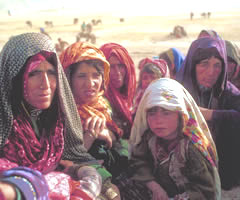
Afghanistan, even years after Taliban remains one of the worst examples of
gender inequality and discrimination.
... and as you read this miseries still continue...
Facts:
--Each year, more than 500,000 women -- aat least one every minute -- die from
pregnancy-related causes. The vast majority of these deaths occur in developing
countries. An African woman's lifetime risk of dying from pregnancy-related
causes is one in 16; in Asia, it's one in 65. In Europe, it's one in 1,400.
--Women now account for almost half of alll cases of HIV/AIDS. In countries with
high prevalence rates, young women are at higher risk of contracting HIV than
young men.
--Of 876 MILLION illiterate adults in thee developing world, two-thirds are
women.
--Of the more than 600 million school-agee children in the developing world, 120
million primary school-age children are not in school; 53 percent are girls.
--In higher education, the level of womenn's enrollment equals or exceeds that of
men in western Asia, Latin America and the Caribbean, and developed regions
outside western Europe. But in sub-Saharan Africa and southeast Asia, women's
enrollment continues to lag behind, with 44 and 38 women per 100 men,
respectively.
--In Africa, women account for more than 60 percent of the rural labor force and
produce 80 percent of the food. A shifting emphasis on cash crops for export
means more work for women, as they also must grow food for their families.
--Women produce half the world's food, buut own only one percent of its farmland.
--Self-employment, part-time and home-bassed work have expanded opportunities for
women's participation in the labor force but are characterized by lack of
security, lack of benefits and low income.
--Half of the world's refugees and displaaced people are women and girls. As
refugees, they are particularly vulnerable to sexual violence while in flight,
in refugee camps and during resettlement.