Fifth Anniversary of the Destruction of the Buddhas of Bamian
People say history repeats itself. In case of the Buddhas of Bamiyan history did very well repeat itself, note once but again and again. Let's be more to the point and accept that it is not history that repeats itself but it is us who repeat the history.
People of the world have evolved and have become more civilized and humane as they have passed through different phases of time. Unfortunately some haven't and have instead devloped in the extent of their stupidity and inhumanity. To be more exact "Stupidity has not Limits!" It gets worse when stupidity is inspired by belief and broadmindedness.
“I may never get to understand the ideological fervor attached to those statues but what I do understand is that humanity can never ever overcome the loss of the Buddhas of Bamiyan. I understand that no structure built in the place of Buddhas of Bamiyan can ever ever replace them.”
The
Bamiyan Buddhas were among the most impressive Buddhist monuments in the World,
before their demolition in March 2001. The Hazaras of central Afghanistan (Hazarajat)
believe them to be the symbol of their elegant civilization that existed two
mellenia ago. They trace their existence back to the Koshani or Kushan
civilization that once ruled today's northern Afghanistan, Northern Pakistan,
Southern China, northern India.
No one knows exactly when they were constructed, but it was likely that they
were erected sometime in the 1st or 2nd century AD. For two millennia they
stood sentinel to groups of wandering monks and merchants along the famous "silk
road" from Rome to China. Alongside the Buddhas, monasteries once existed here
as places of sanctuary, but were abandoned in the 9th century as Islam displaced
Buddhism in Afghanistan.
Buddhist monk Xuanzang, who traveled to India to bring back to China copies of the original sutras of the Buddha's teachings, bore witness to the statues in A.D. 630-31.
The two Buddha figures were commonly classified as the larger and smaller one (‘Salsaal’ 58 and ‘Shamama’ 38 meters, respectively). They were once covered with a mixture of mud and straw decorated from top to toe with gold, ornaments and jewellery but that had worn away long ago. The straw was covered with plaster and painted to model the rich expressions of the face, hands, and robes. Long before their destruction this year, both the plaster covering and the surrounding cave paintings were rubbed away.
For decades cash from the trade of pieces of relic, ornaments, statues… filled pockets with millions in the markets of the immediate neighbors, East Asia and the west. Many masterpieces ended up in the showcases of the offices, homes and private collections of many bureaucrats, businessmen, smugglers, warlords, ‘ministers’ and leaders.
In March 2001 (fiver years ago), Television pictures showed a massive explosion which shook the ground, followed by plumes of dust and smoke. Unidentified voices could be heard crying "Allahu Akbar" (Allah is Great) and "Ma Sha'Allah" (Whatever Allah Wills).
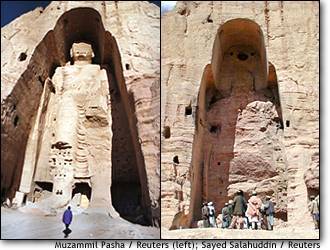
As the smoke cleared, it was evident that where the giant Buddhas had once stood, there was now a gaping big hole. Barbarians destroyed the ancient relics calling them ‘Un-Islamic’ and ‘idolatrous’. Taliban officials scrambled up into the crevice where the 135-foot figure once stood and the camera panned around to show a panoramic view of snow-capped mountains and terraced plains around a river bed.
It took the Taliban nearly two weeks to act on an edict to destroy the giant statues. Later that week hundreds of cows were slaughtered as “atonement for the delay in destroying the Buddhas."
What would happen if any country decided to destroy all statues or religious symbols of Christianity or Judaism or Islam? Some cartoons cause protest by the followers of one religion across the globe and the protests cost dozens of lives. Let’s not even try to imagine how the Buddhists would have felt seeing their ‘gods’ being destroyed!!!
In the early seventh century Muslim iconoclasts painstakingly cut the eyes and nose off the large Buddha image, but left the figure standing. An Afghan source comments tersely: 'the face was scratched by Amir Abd-ur-Rahman on Islamic considerations'. Subsequently, in the 17th century, the Persian ruler Nadir Shah is said to have 'broken the legs' of the larger Buddha--the right leg, slightly bent at the knee, remains intact, whilst the left appears to have sheared away naturally at the hip.
In 1221, a terrible disaster befell Bamiyan when it was conquered by Genghis Khan. The great Mongol, never pleased when faced with resistance, fell into a rage when his grandson, Mutugen, was killed in the attack on Shar e Gholghola in Bamiyan Vallery. Genghis ordered Bamiyan to be utterly destroyed, and all the defenders killed. The ruins of the citadel, and the crumbling remains of the old city, are still clearly, eerily, visible from modern Bamiyan. Genghis caused no further damage to the Buddha images, however, which survived both his passing and the return of Islamic authority to the valley--the only major relics of Buddhism in ancient Afghanistan to have survived.
The destruction of the Buddhas came in for strong “verbal criticism” but the criticism and rescue efforts remained in words only. Only Sri Lanka and India really did practical efforts and the rest of the world, the Islamic countries, the west and the United Nations did nothing except making press statements and giving interviews and ‘expert’ views.
The Taleban also expelled the BBC correspondent in Kabul, Kate Clark, for broadcasting what it described as "biased" reports of the Bamiyan statues destruction. Ms Clark said she believed the main reason for her expulsion was her filing of a report in which she said most Afghans opposed the statues' demolition.
The Bamiyan Buddhas survived for nineteen centuries in the remote fastness of the HinduKush. Neither the ravages of time, nor the conquering armies--not even the scourge of Genghis Khan--had laid them low. By any standards, these towering images formed part of the common cultural heritage of mankind. Viewed in this context their recent destruction by zealots is truly a mindless crime, both against antiquity and humanity.
Photos of Buddhas of Bamiyan before their destruction
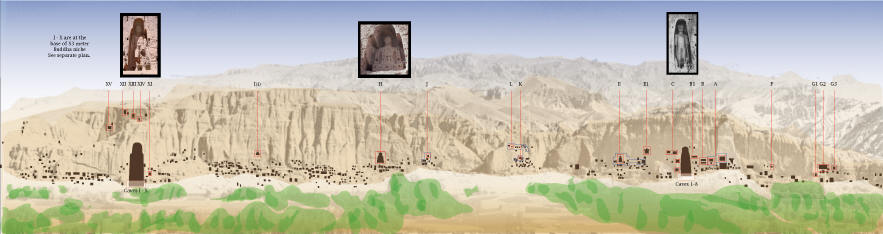
Photos of Bamian and Buddhas in 2005
Bamiyan Laser Project - An easier way of keeping the memories alive
An elaborate laser show plans to
"recreate" Afghanistan's famous Bamiyan Buddhas, the towering, 1600-year-old
statues destroyed by the Taliban amid international outrage in 2001.
The life-size, lurid images will be projected on to the clay cliff faces of the
Bamiyan Valley where the archaeological treasures originally stood on the Silk
Road linking Europe and Central Asia.
Some 140 "statues" will make up the installation, due to premiere in June 2007,
subject to approval by UNESCO, the United Nations cultural organisation.
Hiro Yamagata, 58, a Japanese-born California artist, wants to use wind and
solar power to project the images on to 6.5 kilometres of the cliffs in the
central Hindu Kush mountains, about 150 kilometres from Kabul. The Afghan
Government supports the project.
UNESCO, which has a prominent presence in Bamiyan, where it has been evaluating
methods of preserving mural paintings in man-made caves surrounding the Buddha
sites, must ascertain whether the laser beams could damage the cliffs.
Carved into the mountainside, the two Buddhas were of international cultural
significance. The larger of the two was, at 53 metres, thought to be the world's
tallest standing Buddha. The smaller stretched to 35 metres and both were
sheltered by giant niches hollowed from the rock.
The statues escaped damage during the Soviet invasion of Afghanistan and the
country's bitter civil war in the 1990s but in 2001 the Taliban leader, Mullah
Mohammed Omar, ordered them destroyed, although UNESCO said the act would be "a
crime against culture". In March, militants used dynamite and artillery to blow
up the fifth-century statues. The Taliban considered the Buddhas idolatrous and
anti-Muslim. All that remains is rubble and the cavities in the cliff.
The demolition triggered calls for the rebuilding of the statues or some
commemoration at the location, a site of pilgrimage for centuries because of the
Buddhist monastic complex that flourished from the second to the eighth
centuries. A Swiss plan to rebuild the Buddhas at $A37.5 million each was
abandoned.
Mr Yamagata's $12 million installation will feature 14 laser systems casting
overlapping, faceless images on to the cliffs every Sunday.