
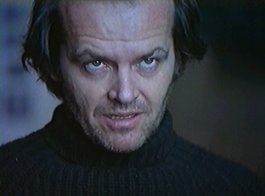
THE WRITERS DEMONS
THE WRITERS DEMONS
Kubrick later described the manuscript of The Shining as:
"One of the most ingenious and exciting stories of the genre I had read... It seemed to strike the extraordinary balance between the psychological and the supernatural in such a way as to led you to think that the supernatural would eventually be explained by the psychological - 'Jack must be imagining these things because he�s crazy' - and this allowed you to suspend your belief of the supernatural until you were so thoroughly into the story that you could accept it without noticing."
However, Kubrick was not sufficiently pleased with King�s own screenplay - which, like the source novel, emphasised Jack Torrance�s alcoholic past and his battles with the bottle - preferring instead to emphasise alcohol as only one of the many internal demons Jack Torrance is to face. This was the source of a displeasure in King who was deeply emotionally attached to the project, as the alcoholic subplot of the novel and screenplay were heavily autobiographical, and dominate vast portions of the book.
As it stands, Jack�s drinking is barely referenced in the film, excepting that Jack is a functioning and apparently recovered individual who battles, and for the most part, succeeds in resisting temptation : he never actually partakes in alcohol throughout the film in a realist sense.
However, despite this, it is clear that the family unit Jack heads up, completed by Wendy and son Danny, is obviously dysfunctional and fractured. Affection is sparse, conversations tilted and clipped, and the family unit is already at best strained before the family is joined by it�s fourth, malicious member, The Overlook Hotel itself, which seeks to manipulate and amplify the existing divisions- unlike Kings novel, Kubrick�s Jack is man trying to maintain a tight grasp upon a reality that is often slipping out of his control : his career, his finances, and his self-control have already failed him, and it is only through determined effort that Jack is able to keep his life in check. However, with the introduction of a meddling, extra party into this situation - The Overlook itself - Jack loses control, and yields it to forces outside himself, as often he does in his life, being a pawn of alcohol, or circumstances, or finance, or - as implied through the hopelessly poor match of The Torrances - unwanted pregnancy.
In effect, The Shining is also Kubricks �divorce� movie : depicting, by using supernatural presences to represent the psychological terrors and forces that tear couples apart, the collapse and fracture of a marriage by partners who, forced by circumstance to stick together, tear themselves apart.
home | reviews | rants | poems | writings | trivia | news | links | about mark | guestbook
� copyright Mark Reed, 1991-2003 except where indicated