

Richey James Edwards. 1966-?
Richey James Edwards. 1966-?
UK law states that seven years following the disappearance of an adult individual that they can be legally declared �dead�. In the eyes of all but a hopeful, but probably deluded few, and to all intents and purposes, unless something dramatic happens, that will be Richey�s fate - the man who fell off the Earth, and following his family�s decision not to declared his demise, forever the Great Mystery of Rock..
Unfortunately to most people, he was nothing more than �that guy that went missing and threw himself off a bridge� when the Manic Street Preachers meant little and made difficult records. Well, when the Manics meant little to most people - their singles charted at the low 30�s, their albums fell out of the charts after a week at Number 8, and they could only headline Universities and Town Halls to about 2,000 at most.
But to a lot of other people, even back then, the Manics used to mean everything. In the same way as these days, when the Manics circus rolls into town and the venues are awash with people aged between 15 and 35 in fake fur and camouflage, in home made spray painted shirts and panda eyes make up, the Manics inspired the same, almost unhealthy devotion. Though to be honest, probably very few of the people who now go to gigs wearing angel wings ever saw Richey with their own eyes. Even a relatively short period of time like seven years in the past has become another age. And when the Manics first come to our attention, eleven years ago, Punk was as far away in the past as 1990 is today.

Bomb The Past:
The great leaders were selling off the family silver in the form of privatisation. The big evil facing the country was always dole cheats. And Mrs Thatcher, with an arthritic claw for a hand, was bleeding the country dry before even her own party got so sick of her they threw her out in the nearest thing a democracy ever came to a military coup.
Culture was dead. The NME was proclaiming the Happy Mondays - thuggish drug dealers with a side line in music - the epitome of cool. There were three music weeklies - and they defined taste for you. The Internet only existed in the movies. Every shop closed at 5.30. The only thing that was on late night TV was �Jobhunters Teletext�. Night buses still ran. MC Hammer and Guns N Roses ruled the world.
If you were the cover of the NME it was a big deal. It meant something. Indie bands just didn�t make the top 40. If you were in the top 40 you were the exception, and not just the rule.
The first defining moment of the Nineties, for me at least, was a small selling single on an even smaller label, that went by the name of �Motown Junk�. The first time my life was touched by the Manics was late one weeknight, watching MTV. There were four puppyfaced cloned boys - with instruments too big for them - jumping up and down like hyperactive children playing a poorly recorded piece of illegible crap. I didn�t know what the words meant but I knew it meant a lot more than the sludge that was choking the charts. I knew it in the gut that it was great - if not particularly good.
This incidentally, is to prove that the Manics weren�t always bloated, old stadium rockers.
Motown Junk got to about 94 in the charts. It sold 3,000 copies. And the Manics were the band that everyone had an opinion about. Most people hated them, whilst they played endlessly in tiny back rooms across the UK to audiences of between 5 and 50 people. The audience was a handful of laughable panda-eyed fake fur clones, curious onlookers and sceptics.
Sleeping With The NME:
Every interview came with quotes that read like ancient philosophy written by poets. The band stood united, identical, speaking with one voice. It was something I�d never seen before. Phrases like �The geometry of contempt� spilled out of their mouths. The average lyric read: �Our lives drift into a faceless sense of void/everything of meaning becomes destroyed� .
They articulated things that most people don�t want to think about: that democracy is a lie, that capitalism has failed, that life is fundamentally empty, and that above all, that most of us waste our lives because we don�t know what else to do.
This isn�t the rambling of some awestruck 16 year old in a fake tiara and homemade spray painted combat shirt. This is what it was like a decade ago - they were one hell of a shock. Most people hated them.

Rebellion Always Sells For A Profit
Nowadays it might be the norm. But then, it was like something wrong had been beamed into the television. When they played �Faster� on Top Of The Pops, draped in military outfits, surrounded by flame, wearing balaclavas, the show got more complaints than ever before in its 33 year history.
They were deeply moral when the rest of the music at the time was - seemingly - a moral void. They supported old fashioned principles such as hardwork, cleanliness, discipline, control, and study. There seemed to be nobody less rock n roll than the Manics, even though they wanted to be The Clash and Camus.
The music may have been almost mainstream, particularly the second album Gold Against The Soul, but their concerts were almost religious experiences. A typical Manics gig, during the 1992 to 1994 period, was a violent celebration of both joy (at being alive) and disgust (at the lives we live).
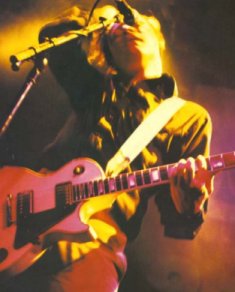
Over time, the four clones split off into their own personalities. Quiet drumming powerhouse Sean said nothing. Nicky stood tall in tiaras and mouthed off. James drank and pushed the band forward with an intense workaholism. For some reason most people gravitated to the impossibly thin black eyed boy that was Richey Edwards. A guitarist who didn�t play any guitar, a lyricist whose lyrics read more like some form of bizarre poetry, and a deeply flawed human being.
At various times in his life Richey was an alcoholic, anorexic, prone to bouts of self-mutilation, a suicide risk, someone who proudly did the groupie rounds yet celibate, addicted to cigarettes, and emotionally cold - the band used to call him �Android�. I prefer to think of him as a University lecturer trapped in a rock n roll band.
Sometime in 1994, it all went wrong. The reasons have been documented laboriously elsewhere - in print and on the net. By then, the man Richey Edwards had ceased to exist. He had become a myth. Idolised by fans, he was seen as some kind of superhuman totem of pain whilst in the depths of intense mental illness.
Above all, Richey was always, somehow, different. For me, I never saw it as difference for the sake of being different. It was just the way he was. Something in his DNA made him different to others. And people gathered to him as some kind of flawed saviour. Stage left, where he thrashed at his useless guitar, became the area where his congregation flocked. I lost count of the amount of times I laughed inwardly at flocks of sixteen year old girls in eyeliner and spray paint, with adolescent marks where they�d cut themselves staring adoringly at a man just as fucked up as they were, and trying quietly to run away from the pressure - yet dutybound by his internal rhythms to remain in an untenable position.
The seemingly infinite treadmill that surrounded the third album The Holy Bible showed no sign of abating. The band were on the eve of a 40 date US tour to support an album that had not yet been released in that country - then a Japanese tour. The album itself was a concise 13 track summary concentrating largely on the theme of mankind as a failure, masterminded by a man who would soon collapse.
He returned from an illness enforced absence to play a final series of tours in late 1994. The final shows he was to play with the band came at London�s Astoria, which saw a climatic destruction of every piece of equipment the band owned on the final night.
Further Away
For me personally, the following months were difficult. I still went to work, did the daily things that we have to do. But every time I opened a newspaper, or walked past a newsstand, or switched on the TV, I saw Richey. And they always managed to choose the most angst ridden photograph of him they could find, despite the fact that he had tried not to be photographed alone in the latter days of the band to avoid being seen as exploiting his illness for column inches. No matter - the editors chopped the rest of the band out of the frame and stuck him on the cover. Most of it was the same old sensationalist lies that the media are used to propagating unchallenged with a smattering of fact. �Glamorous Rocker vanishes�. �Suicide mystery of Rock idol�, �The Truth About The Mad Pop Idol�, became the bane of my life.
There was no corpse. Just an abandoned car, and a series of ever more hysterical headlines by people who didn�t give a shit what they printed as long as it filled the column inches. In the meantime, everyone else was stuck - frozen in time. �Fans� chopped themselves up by proxy on his behalf, the band and his family stood in an awkward and painful state of limbo. Without a body, there can be no grief. No resolution. No end.
And that�s what it was. A series of slowly-decreasing-in-frequency articles, and nothing. Silence. Richey had just disappeared.
To his credit, Richey never did things by halves. If he was going to disappear, that�s exactly what he was going to do, and better than anyone else. For him an �A� mark was never good enough, he wanted to know his exact percentage score to see who he beat, and who beat him.
Despite what people have said - and the multitude of rumours - there has not been one single verified sighting or photograph of Richey Edwards since January 1995. It was almost as if he was never there. Castrated as a trio, the Manics survived. They were always always about transcending the circumstances they found themselves in. They evolved from the Pot Noodle Factory of their insular, tiny Welsh hometown into something bigger than just a rock band.
They returned ten months later, supporting The Stone Roses at Wembley Arena, edging hesitantly into the spotlight. They were still the same, but recognisably different. Something had been sucked out of them. Something had been lost.
Everything Must Go
The Manic Street Preachers became a shadow of their former self - of all things, just another rock band. An exciting, literate one, but a diluted, less vibrant version of who they used to be. It wasn�t Richey�s absence that removed their spark., but the experience of the loss of a close friend and a media frenzy that surrounded them at precisely the time they needed to be alone. As a result their work, from the euphoric air of survival that surrounded the Everything Must Go album, to the most recent Know Your Enemy, has brought an increase in popularity and column inches, but a marked decrease in their essence. Slowly they turned into just another, somewhat excellent band.
In the meantime Richey�s family and his closest friends have no idea if one of their best friends is alive, dead, or planning on taking his own life right now. In some respects he will have achieved the immortality - and noterity - his ego craved. But what price now, for a shallow piece of dignity?
An air of finality surrounds the date of February 1st, where a fact that long been considered and all but confirmed can be made legal fact. That Richey Edwards has passed into myth and history, and become, and I�m sure he would sneer disparagingly at the thought of saying it, a legend. And a lot of people will have confront a fact that they would rather not - friends, family, and fans alike - that they have lost a friend. It�s not something anyone deserves to have to face.
home | reviews | rants | poems | writings | trivia | news | links | about mark
� copyright Mark Reed, 1991-2002 except where indicated