
THE KOYANISQATSI TRILOGY
THE KOYANISQATSI TRILOGY
When literally translated, the phrase Koyanisqatsi means :“A state of life that calls for another way of living”. In it, the film travels across the face of the Northern world, showing the environmental and ecological consequences of consumer culture and capitalism, showing nature in its beauty and near incomprehensible vastness, as well as the enormous network that supports mankind. It was a way to see ‘under the board’ of the political world. And the message was clear : rampant consumerism and ambition is unsustainable, and mankind will soon be ringing the bells of its own extinction.
It was also incidentally, a great film to watch stoned. You could stick it in your video player after a hard night out, buzzing at 3am, watch it Coming Down, and spend a while going “Whoa” whilst talking shit with your mates if you wanted. And what it all means, man. (Talking of which, “Koyanisqatsi” is one of the films that would benefit from a fully E-d up commentary track).
Next film in the series, Powaqatsi, was equally powerful. However, it was deemed by many to be less successful, concentrating as it did on The Southern Hemisphere. Familiar reference points such as malls, houses, airports ; all were swept aside. Instead, it revealed the Third World’s way of living : a world of millions carting dirty water in buckets home, of panhandlers looking for that elusive Gold, of the hand-to-mouth survival of the unseen world that exists in parallel to our world of technological advances. (Of course, the soundtrack was fabulous). But the message we unclear : only that our life was out of balance, that it was fundamentally an abuse of power to provide privilege to the few of The First World at the expense of the many, that one day all things and all people face the great leveller : death.

Nagoyqatsi is even better than Koyanisqatsi.And, as Nagoyqatsi is currently in limbo, held ransom by the gutless wonders that only want to foist “2 Fast 2 Furious” on our multiplexes. People who wouldn’t know art if it slapped them in the face. In fact, the only way I have been able to watch this film (which should be regarded as essential viewing by anyone with even a passing interest in film) has been through a Region 1 DVD imported by hand.
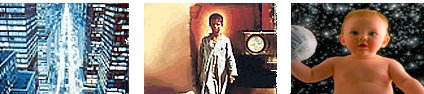
Nagoyqatsi deconstructs everything : the virtual world is shown to be as real as the artificial, and self-imposed, constructs of society. Images of endless computer banks meld into endless rows of skyscrapers… footage of nature is seamlessly morphed into traffic, into people, into rows of numbers, rain, and a truly terrifying montage of nuclear explosions. Rain becomes a series of endlessly rotating Zeroes and Ones, frame graphics of houses, diagrams of nuclear explosions, and ghostly abandoned buildings. Every form of violence – both real and imagined – from the virtual world of Doom to the LA Riots,
The rule of Nagoyqatsi is not only that of “Life as war” but that mankind itself is at war with everything else. “A way of life that consumes others in order to survive”. Mankind cannibalises anything and everything in its unthinking quest to reproduce like a virus. Symbols meld into each other, the dollar, the yen, the Pizza Hut logo, all transform into Swastikas, cogs, wheels, and all these things become clear. Far more than its predecessors, Nagoyqatsi is explicit in it’s imagery : in our quest for all things to be faster, quicker, better, more, we will soon be extending beyond ourselves. We will consume beyond ourselves, devour ourselves, extinct ourselves.
At the films conclusion we see just how fragile we are. The world shrinks to nothing. Stars surround us, and the earth becomes just another light twinkling in the envelope of space. A beautiful as the view from a spaceship overlooking the earth, as chilling as seeing a crisscross pattern of lines from the same spaceship, vapour trails from ICBM’s, the soft, small spots of lights on the earths surface that used to be cities and could now be explosions. Nagoyqatsi is our warning. This world is fragile. Our life hangs in the balance. We will destroy ourselves should we not want to save ourselves.
home | reviews | rants | poems | writings | trivia | news | links | about mark | guestbook
© copyright Mark Reed, 1991-2004 except where indicated
