
No Trainers
No Trainers
But I’m not allowed into the pub. I’m wearing trainers. Oh my god. How could I leave the house wearing those? Well. Lets look at it. I work hard, and when I wear shoes, or a shirt with a tie on it, I expect to be paid. Or be burying someone.
Can there be anything more insulting to hear at any time, any where? There’s something inherently wrong about a door policy that extends to “no trainers”. “No wankers, no drunks, no idiots, nobody looking for a fight”. That’s a fair policy. But no trainers? Since when was footwear indicative of anything at all?
I can’t actually work out why there was a “no trainers” rule. And they couldn’t explain it either. Which leads me to question, like all intelligent beings why this is:
- why does this rule exist?
- where does it come from?
- what does it mean?
I felt like a refugee trying to smuggle my way into the most prosperous country in the world, thrown out for the crime of wearing trainers.
NO MOTIVE, NO REASON
Well, for the first thing, there might very well be no why anymore. No motive. In the same way that policemen no longer look for motive, they only look for the how’s, the where’s, the when’s. The why is the question that seems to have slipped them. And all mankind. Why is the question that people should ask, but never do. Asking why is one of the things that differentiates something from anything. After all, if you know why something happens you can understand it. Make connections. Work out what the driving forces are behind the whole universe.
There is no why anymore. So “No Trainers” is not a preference. Its a law. An undiscriminating, unjustified exertion of power. It’s been that way forever. Probably initiated by a desire not to have coal miners dragging coal into the pub, or builders leaving remnants of brick dust all over the place. But trainers don’t bring brickdust in. Or coal. So what job do you need to wear trainers to do? There aren’t any.
And nobody knows what it means, only that it means something so that they can keep the ingrates out.
JUDGE. JURY. BARTENDER.
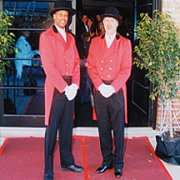
The fateful words came from overdressed, but underthinking, bouncers. Happy to tow the party line. Bouncers are meant to be people managers. Not, as my experience tells me, an employed bunch of muscle acting as an unofficial military police over the pub. On more than one occasion I saw bouncers pummel a man unconscious whilst he was lying face down on concrete
Generally speaking, having bouncers on the door of any venue tends to bring out the worst in people. Especially when they are, frankly, uncommunicative and lacking in interpersonal skills. The very concept of an oversized oaf in a black coat on the door tends to engineer a flashpoint where personalities may clash. Especially if these doormen have no concept of tact or diplomacy. In my time I’ve been refused entry to quite a few places - and not once has any doorman / bouncer been civil. Or been able to explain exactly what the problem with trainers is. Apart from the fact that they’re very comfortable.
That’s because they know that any explanation about why trainers are the mark of the devil doesn’t make any sense whatsoever. It sounds ridiculous when vocalised. Therefore, they refuse the right to give explanations on not letting you in. Judge. Jury. Executioner. Fools.
A PUB IS NOT A CATWALK
Now, I’m not going to denigrate the average Wetherspoons customer , just lay out some basic facts. Wetherspoons are cheap, and I owe a lot of money to the Student Loan people, so I go to cheaper places when I can. It’s not a matter of choice really. I earn a good salary - £10,000 more than the national average - but then again, years of studying and trainee jobs have given me enormous debt, much like most of the rest of the population. So if I can save a £1 on a pint its worth taking.
A Wetherspoons pub, for those of you who don’t know, are not high class establishments. They’re astonishingly cheap, don’t play any music (so don’t pay any fees), have minimal decoration, pay peanuts, and judging from the doorstaff, get monkeys. The clientele are, to be blunt, compressed of a handful of types - poor twenty something’s in underpaid jobs, pensioners, and the unemployed / unemployable. We’re not talking the beautiful people.
The people who don’t mind getting dressed up on a Saturday Night are often the people who don’t get dressed up any other time of the week. People who, to be honest, may very well have menial jobs. And may not always be the sharpest tools in the shed. This sounds horribly elitist but its a fact I’ve seen through years of observation. Through working on factory floors and in multinational boardrooms. So when I wear trainers - which are far more comfortable than leather - I’m relaxing. I’m not worrying about multi-million pound price negotiations.
Such a policy is petty, unreasonable, and completely unjustifiable. Snobbery such as “dress to impress” just doesn’t wash. That’s elitism. It’s a pub. Not a fashion catwalk.
THE UNDESIRABLES
But apparently I - along with near enough everyone else in the world who wears trainers - am an undesirable. Although nobody can explain why. I can’t see a reason for it. Is it perhaps then, one of the following factors?
a) People wearing trainers start fights.
b) People wearing trainers spend little money.
c) People wearing trainers play football or sport in the bar area
d) People wearing trainers are not becoming of a high class establishment and haven’t “dressed to
impress”.
e) None of the above
Well done. The answer is e).
The rest of them are not logically viable. There is no logic - or scientific study - that so far convinces me or anyone else of the poverty or latent aggression within those who wear trainers (or of their propensity to play sports in public houses, or to be undesirable scruffs). The most shocking crime of wearing trainers is that they are generally not seen as acceptable professional office wear.
But I thought it was a low-budget pub we were talking about here. Not an office. Or a multimillion pound nightclub, not that multimillion pound nightclubs should have door policies either. Most business don’t prosper by turning away customers.
Of course then, anywhere which turns me away I tend not to go again. Ever again. By going again you’re not only giving an establishment your money, you’re condoning, approving, and funding discriminatory behaviour. I’m not going to fund an establishment that refuses my business on the grounds of my footwear.
Neither should you.
© copyright Mark Reed, 1991-2002 except where indicated