
IN DEFENCE OF ANIMALS
IN DEFENCE OF ANIMALS
How wrong I was.
Animals is by no means an easy album : no collection of radio-friendly unit shifters here. But then again, genius is rarely easy either. Animals is undoubtedly the densest, darkest Floyd album there is.
For some, Animals has always been perceived, somewhat appropriately, the runt of the litter. : it was just another FloydCD box staring out of a rack (admittedly one that has a really cool picture on the front), another album where the songs never got played live or on the radio, and who wants 17 minute epics where you can sing to pretty songs like Wish You Were Here on the radio.
And I was one of those. It took me until 1999 to buy a copy of Animals. In the past five years it has been the Floyd album I return to the most, and for good reason. Even now I feel as if there is still more to be gained from listening to again � yet another layer of meaning to be unravelled from the complex lyrics and the inventive musicianships. And whilst some may say that Animals is the Floyd�s simplest album, in terms of the bluntness of the lyrics, concept and music, one of the beauties of a democracy is that some have the right to be wrong.

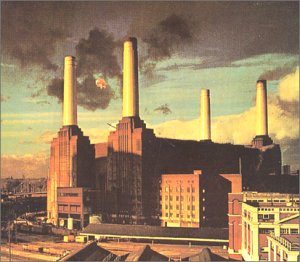
Let us start with the cover.
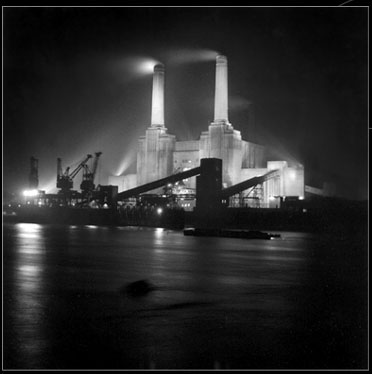
Everyday, as I look out of my bedroom window, I see four white cannons reaching to the sky. I live in the shadow of perhaps the greatest symbol of human ambition, and human failure there is. The single largest piece of undeveloped inner-city real estate in the whole of Europe.
Battersea Power Station, now derelict, the ancient, rotting skeleton of the industrial revolution. On the cover to Animals, in its glory days, the station stands immobile, surrounded by trains, sheds, rail tracks. And a small, tiny pig hovering near one of the chimneys.
Mankind might create something of worth in this world. Man�s ambition to conquer nature may prevail. But we�re all Animals, even the ones that wear clothes. And pigs might fly.
Animals is the most under-rated Floyd album in their body of work. Whereas the albums around it, the immensely popular Dark Side Of The Moon, Wish You Were Here and the bloated The Wall, were all chock full of shorter, more palatable material, Animals, is a dense, difficult work, reprising the side-long 17 minute epics that characterised Meddle and Atom Heart Mother. There�s little chance of ever hearing the splendour of the full version of �Dogs� on the radio, even if it weren�t for the songs aggressively spiteful lyrics and barbed deconstruction of capitalism.
Lyrically and musically Animals is, unwittingly, very much a precursor to the punk revolution. At the time of its release Floyd looked to be just another dinosaur, another relic of the past that may very well be swept aside in the new wave. In some respects, the Floyd were everything that Punk was fighting against, and in the midst of this, they released their most obviously anti-establishment album : Animals is a damning indictment of capitalism, hypocrisy, and near enough everything and everybody.
Thematically, the album revolves around a sort of retelling of Orwell�s Animal Farm, adrift as it is with Sheep and Dogs and Pigs (the three strata of society), and making clear the underlying themes of both texts : man is an animal who happens to wear shoes, and is as ruthless as any other animal in the wild. This theory is offset by Waters sweet love songs �Pigs On The Wing� � the one chink of light in a resolutely grey sky � which serve both as relief from the unremitting nihilism and to reinforce the darkness of the rest of the set.
Following �Pigs On The Wing�, comes �Dogs� : the centre point of the album, and baring the emotional resonance of an album in itself. The song, which evolved from �You Gotta Be Crazy�, premiered on the bands 1974 tour, was a long established staple of their live set by the time of release, and was the only Waters / Gilmour collaboration on the album. In fact �You Gotta Be Crazy� was probably the last time that the Floyd worked together as a cohesive unit, borne as it was from the same writing sessions that gave us �Wish You Were Here�. But the song barely changed from its premiere performances to its final recording in January 1977.
As a whole, �Dogs� is a long, hard song. 17 minutes of Waters spewing bile about humanity : a dog-eat-dog world of hardnosed predatory capitalism, probably best espoused in this lyric:
Side Two � for those of us ancient enough to remember vinyl records � commences with �Pigs (Three Different Ones)�. In Orwell�s Animal Farm, the Pigs are the FatCats, the leaders, the privileged elite who live in a world of luxury, and the three verses of �Three Different Ones� deconstruct three different types of �Pig�. The verses take respectively, a fatcat businessmen endlessly chasing profit, a powercrazed political leader (modelled on Margaret Thatcher), and finally, a very specific attack upon Mary Whitehouse. Probably the most provincial and local of the targets in Animals, Mary Whitehouse came to fame as a staunchly, overconservative campaigner for censorship of television and radio : the equivalent of a very grey, very wrinkled, very old Tipper Gore campaigning for �Parental Advisory� stickers on CD�s. In their ways these three Pigs reinforce the Status Quo in different ways, being seen by Waters as equally problematic : The Pig of the first verse being the driver of big business, mercilessly exploiting anything and everything, the Pig of the second verse being the effectively-mindless reflexive politician chasing comfort and power, and the Pig of the third verse being that of repressed, scared, middle England who wants to live wilfully in ignorance. Musically, �Pigs (Three Different Ones)� is the least interesting song on the album, and one to which I still have difficulty remembering what the music goes like. That said, Thematically it works perfectly in establishing and cementing the concept of the album, despite being relatively slight musically.
The final major song on the album is �Sheep�. �Sheep� is another epic, also premiered on the bands 1974 Winter Tour, which acts as the final closing point of this narrative : In �Sheep� (originally titled �Raving And Drooling�, as we all know), the music is a harsh pounding assault, reminding one of being under hot pursuit by Dogs, and lyrically seems to tie up the loose ends of the other two songs. What are the �Sheep� though? In some respects the Sheep of the song are what a particularly patronising politician may call The People. That is, the generally ignorant working/middle class who know only what the television feeds them, believe what they are told, buy what they are told, and follow the leader, as indicated in this particularly telling couplet :
Following this, the final, swift reprise of �Pigs On The Wing�. In one respect, this resurrects the initial hopeful conclusion, that somehow man can be saved from destruction through the healing power of love, but also provides sharp contrast to the sural and lyrical apocalypse around the album. It doesn�t have to be like that, it says. Because someone can, and does care. And maybe, like John Lennon said, Love Is All You Need.
Whereas each Floyd album rotates around a central theme or idea, Animals is the one that most clearly expresses that idea simply and clearly. Not for this album the convuluted, confusing plots of The Wall or The Final Cut, or the vagaries of Dark Side Of The Moon and Wish You Were Here but a simple and clear statement : Animals is a rock reshaping of Orwell�s Animal Farm, equating all human behaviour to that of Animals.
Animals though, far more than any other Floyd album, is the one for whom there is the deepest affinity. One could be flippant and says it allows an old nihilist like me to vent his absolute disgust with human nature to a pleasing and unchallenging blues-rock soundtrack. On the other hand, one could say that it�s a dark and damning statement about human nature and capitalism. But ultimately, Animals is the Floyd album to which I return the most, for me, it is the most satisfying, most complete of Floydrecords, and also the one in which I feel The Floyd were working at the height of their powers. Then again, when you live in the shadow of Battersea Power Station and see it every day on the train to work, I would say that, wouldn�t I?
� copyright Mark Reed, 1991-2004 except where indicated
