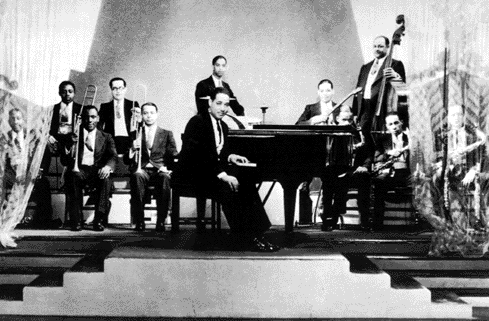
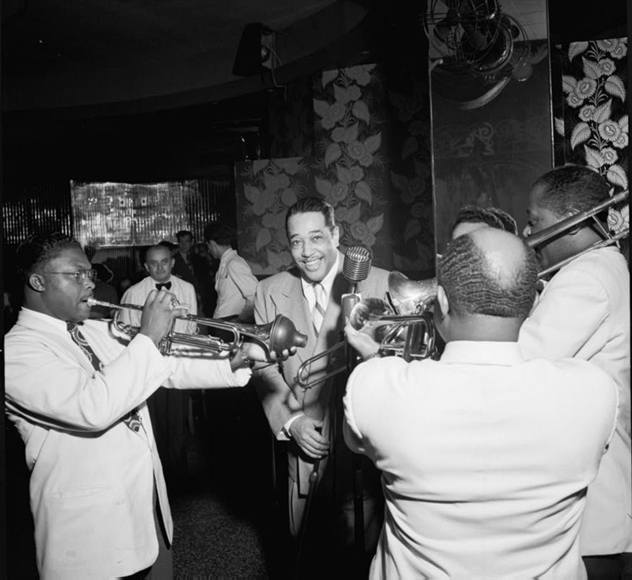
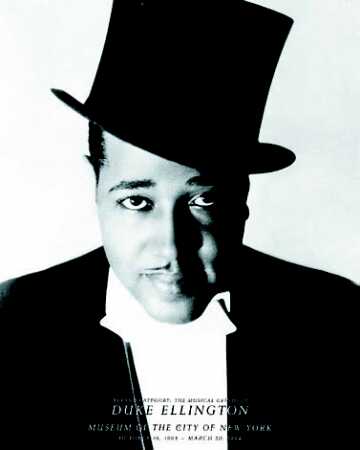
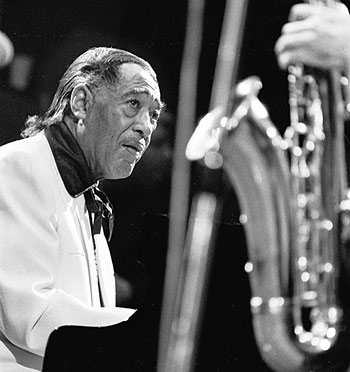
Edward Kennedy "Duke" Ellington (April 29, 1899–May 24,1974), was an American jazz composer, pianist, and bandleader. Ellington was born to J.E. and Daisy Kennedy Ellington at the home of his maternal grandparents in Washington D.C. His mother and father were both piano players and at the age of seven or eight, Ellington began taking piano. He dropped out of high school in his junior year in 1917 and in his autobiography, Ellington claims he missed more lessons than he went to, feeling that the piano was not his talent. Over time, this would change. Ellington snuck into Frank Holiday's Poolroom at fourteen and began to gain a greater respect for music. Hearing a mentor play the piano ignited Ellington's love for the instrument and he began to take his piano studies seriously. He began performing professionally at the age of seventeen. Instead of going to an academic-oriented high school, he attended Armstrong Manual Training School, to study commercial art. |
 |
|
Duke Ellington began his artistic career as a sign painter in Washington, D.C., but by 1923 he had formed a small dance band known as The Washingtonians, and moved to New York City. Shortly thereafter, the group became the house band of the Club Kentucky, an engagement that set the stage for the biggest opportunity in Ellington's life. In 1927, King Oliver turned down a job as the house band for Harlem's famed Cotton Club, and the offer fell into Ellington's lap. With a weekly radio broadcast and famous clientele pouring in nightly to see them, Ellington's popularity skyrocketed. Ellington's band had become a large orchestra and many men, who would later become famous in their own right, had filled the rank. Duke Ellington's orchestra included Bubber Miley (trumpet), Johnny Hodges (saxophone), Harry Carney (baritone saxophone), Barney Bigard (jazz clarinet), Lawrence Brown (trombone), Sonny Greer (rhythm section) and Fred Guy (guitar). The 1930's saw Ellington's popularity continue to increase, greatly due to the wheeling and dealing of Duke's manager Irving Mills, who got more than his fair share of co-composer credits out of the deal. While their United States audience remained mostly African-American in this period, a 1934 trip to Europe showed that the band had a huge following overseas. Meanwhile at home, Mills arranged a private train just for the band, so that they would not have to suffer the indignities of segregated accommodations while touring the South. The band reached a creative peak in the early 1940's, when Ellington wrote for an orchestra of distinctive voices and displayed tremendous creativity. Some of the musicians created a sensation in their own right. Jimmy Blanton transformed the use of the double bass in jazz, allowing it to function as a solo rather than a rhythm instrument alone. Ben Webster, the Orchestra's first regular tenor saxophonist, started a rivalry with Johnny Hodges as the Orchestra's foremost voice in the sax section. Nance, however, added violin to the instrumental colors Ellington had at his disposal. A recording of Nance's first concert date, at Fargo, North Dakota, in November 1940, is probably the most effective display of the band at the peak of its powers during this period. Ellington's long-term aim became to extend the jazz form from the three-minute limit of the 78-rpm record side, of which he was an acknowledged master. He had composed and recorded "Creole Rhapsody" as early as 1931, but it was not until the 1940s that this became a regular feature of Ellington's work. In this, he was helped by Strayhorn, who had enjoyed a more thorough training in the forms associated with classical music than Ellington himself. The first of these, "Black, Brown, and Beige (1943)," was dedicated to telling the story of African-Americans the place of slavery, and the church in their history. Unfortunately, starting a regular pattern, Ellington's longer works were not well received; "Jump for Joy," an earlier musical, closed after only six performances in 1941. In 1951, Ellington suffered a major loss of personnel, with Sonny Greer, Lawrence Brown, and most significantly, Johnny Hodges leaving to pursue other ventures. |
|
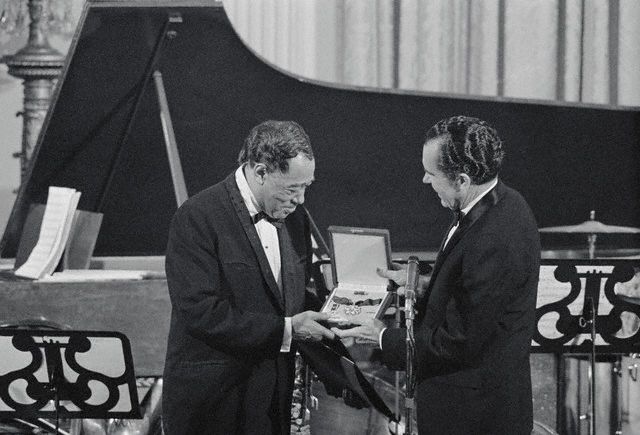
Ellington was nominated for a Pulitzer Prize in 1965, but was turned down. His reaction: "Fate is being kind to me. Fate doesn't want me to be famous too young". In 1966, he performed his first "Sacred Concert", an attempt at fusing Christian with jazz, which was followed by others. This caused enormous controversy in what was already a tumultuous time in the United States. Many saw the Sacred Music suites as an attempt to reinforce commercial support for organized religion, though the Duke simply said it was "the most important thing I've done", perhaps with a touch of hyperbole. Though his later work is overshadowed by his music of the early 1940s, for some critics such as (controversially) James Lincoln Collier, Ellington continued to make vital and innovative recordings, including " The Far East Suite " (1966), "The New Orleans Suite" (1970), and "The Afro-Eurasian Eclipse" (1971), until the end of his life. Increasingly, this period of music is being reassessed as people realized how creative Ellington was right up to the end of his life. He was awarded the Presidential Medal of Freedom in 1969, and the Legion of Honor by France in 1973, the highest civilian honors in each country. Duke Ellington died of lung cancer and pneumonia on May 26, 1974, and was buried in the Woodlawn Cemetery, The Bronx, and New York City. |
|
|
 |