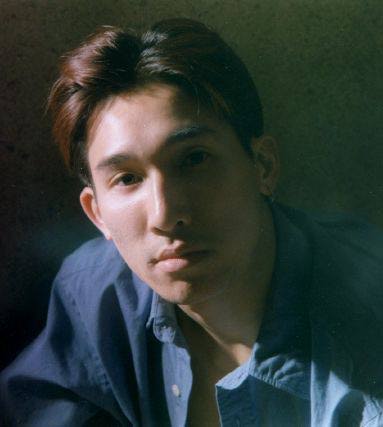
 Kevin So
Kevin So
Kevin So
THE CHINESE-AMERICAN RICKY MARTIN?
KEVIN SO WOULD RATHER BE HIS CULTURE'S BOB DYLAN
By Monica Eng, Chicago Tribune Staff Writer
April 14, 2000
Like a lot of kids who grew up in the '70s and '80s,
singer-songwriter Kevin So harbored dreams of
becoming the next Michael Jackson.
"I remember going over to my relatives' house every
Sunday," says So. "My aunt would make dim sum, and
my cousin Vinny would show me his latest records. I
remember when he got Michael Jackson's `Off the
Wall,' he played it for me, and I just remember staring at
the vinyl and thinking, `Wow."'
To So, his musical dreams and love of R&B were
completely natural. But to his Chinese immigrant parents,
they were whacky. America, they felt, would never
accept an Asian-looking pop sensation.
"They said, `Look, you can be a doctor or a lawyer, but
you can't be a pop star,"' the musician remembers as he
restrings his old Gibson guitar on the floor of his Wicker
Park apartment. "They told me, `You are not going to
be the next Bobby Brown or Michael Jackson, at least
not here in America.'"
Now a rising folk performer, So remembers his parents'
comments less with bitterness than as an inspiration to
break new ground for Asian-Americans who think they
have no place in American popular musical culture.
Consequently, in addition to his bluesy ballads about
faded love and the open road, So has crafted humorous
and warmly melodic tales of Chinese-American life,
immigrant family struggles and race relations.
He'll perform these songs Friday night on a double bill
with Justin Earle (folk rocker Steve Earle's son) at
Winner's Bar & Grill (4530 N. Lincoln Ave.) and an all
ages show Saturday at The Heartland Caf (7000 N.
Glenwood Ave.).
During his five years as a folk performer, So has
released four fine, independently produced CDs
(available only through kevinso.com), exploring his
experiences as traveler, artist and immigrant son. But his
latest, the aptly named "Different," features a decidedly
more soulful sound along with songs that examine issues
of change and displacement.
It's no coincidence that they were all written after So
pulled up roots in New England last September and
moved to Chicago.
A native of the Boston area and one of the few real
townies on the crowded bean town folk scene, So felt
like he had to get away from New England for several
reasons.
"I left Boston because I wanted to expand my horizons
and to build a new audience," says the
late-twentysomething performer. "I figured Chicago is
cold but the people are friendly and it is not that far
away from Boston. More important, I was seeking the
muse of soul music and R&B, and a lot of the music I
love came from and was filtered through here.
"Part of me also just wanted to get away from the
craziness of Boston. Once I got popular I found it really
hard to cope with it on an artistic level. Everyone knew
who I was and they had certain expectations for certain
songs and I just kind of wanted to break free of that. So
I just wanted to go to Chicago and disappear."
His move also allowed So to leave behind a habit that
had started to eat into his productivity as an artist.
"I didn't want to be one of those people who really
messed up their career with pot, so on Aug. 22, I just
stopped," he says, from the sun-dappled floor of his
apartment as Sam Cooke drifts out of the stereo.
"Today, I feel incredible, I feel healthy and like I am
getting my edge back. I feel I have got so much more
focus and I love my job again. I love to connect with my
audience and if I'm stoned then they're not really getting
the attention they deserve."
Although Chicago has turned out to be a good fit, it
wasn't So's first choice. Ever since he attended his first
Kerrville Folk Festival in 1996, he has thought of Austin,
Texas, as his second home. With nothing more than a
guitar and a box of demo tapes, So worked (and
played) his way up from festival volunteer to main stage
performer (standing between Peter Yarrow and Paul
Stookey) that first year and has returned every spring
since.
"I got down to the festival and people in Texas really
took to my music, more than even in Boston," says the
songwriter, whose strong lyricism and laid back
melodies sound right at home in the land of Townes Van
Zandt. "So my first choice was Austin, but it's so far
away that I wouldn't be able to get back to Boston as
often."
Brought up on pop music and classical piano and violin
(an obligatory part of every Asian-American kid's
childhood), then educated at the University of Southern
California as a jazz studies major, So was a relative
stranger to folk music before a friend introduced him to
the music of Bob Dylan in his post-college years. Oddly,
these folk discovery years coincided with So's time
playing piano "for Elvis and Tina Turner impersonators in
this cheesy Vegas style revue on a cruise ship" and then
touring the country in a cover band called XPO.
"We played cover music, Boyz II Men, Brandy and
dance music like `You got to show me love, blah blah,'"
he sings in a falsetto. "So for my job I was doing this
lounge stuff and then I would go back to my room and
listen to Robert Johnson and Bob Dylan and all these
acoustic songs. Finally, I left the cover band because I
wanted to pursue my own music, whether I fell on my
face or what."
But So didn't fall on his face. He moved back in with his
parents (who despite their hopes of his finding a real
profession always supported him), did some more
writing and hit the Boston open-mike scene. There he
picked up the ropes of being folk singer, learning how to
interact with an audience, how to book his own shows
and how to make his own flyers.
It's also where he found his voice as an Asian-American
songwriter, one who wasn't afraid to draw from his own
heritage to create music. What came out are songs like
"Stanley Chin," that, despite the name change, is about
So's father's frustration over his son's refusal to take
over the family restaurant business; "Dragon Lady,"
about So's mother's lost dreams; and "Just Like You
(I'm an American)," a playful tune So wrote in response
to a headline that read "American beats Michelle
Kwan."
Although there are a growing number of
Asian-Americans breaking into the national music scene,
including Seam, "Big Head" Todd Park Mohr, James
Iha, Anna Fermin and Tatsu Aioki, few incorporate their
backgrounds into their music as openly as So, who was
dubbed by his first producer as "the Amy Tan of the
singer-songwriter world."
"I remember my parents telling me that there are no
Asian male pop stars and so what made me think I
could make it," he says. "Well, first, that's not really why
I'm doing it. And second, if I don't try, then I may see
somebody come along and think, Man, they're not doing
it right. So at least I am not sitting on my butt. I am out
there trying to make change.
"I think it is the artist's responsibility to create a picture
of reality and I would hope that reality would make
someone feel like they're not alone, like this goes on in
my household too. That is the stuff that really moves me
and resonates. I write about [Chinese-American life] not
just to raise consciousness, to educate people but to
show them the beauty in that life, the beauty in the
culture."