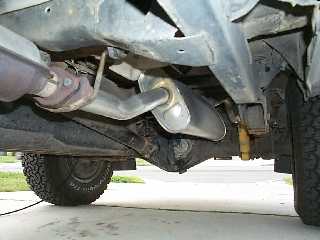
When I purchased my 4Runner, I noticed that the exhaust system looked very new. Turns out that the previous owner replaced the muffler and tail pipe with OEM Toyota parts. He also replaced the catalytic converter with an aftermarket free-flowing model.
So, technically there was nothing wrong with the exhaust, however I kept hearing over and over again that getting rid of the stock exhaust in favor of a larger-diameter system with a free-flowing muffler and cat (which was already installed) would give a good performance boost.
The deciding factor, however, was that at the time I was trying to sell my '87 pickup which was in really good condition, but the muffler and tailpipe on it had seen better days. The muffler was disintegrating inside, and the tailpipe looked like Swiss cheese. It sounded bad and I had a couple of prospective buyers comment about it. So, to help me sell my truck and to silence those who wished to use it as a bargaining tool, I decided to swap the muffler and tailpipe with the practically new ones on the 4Runner.
Turns out that the that tail pipe is routed differently on the 4Runners due to the lower body line in the back. It wasn't a problem putting the 4Runner exhaust on the truck. I had to modify the rear-most exhaust hanger and the pipe exited lower from the body than the stock pipe, but it looked just fine and the truck sounded so much better and even idled a lot smoother.
I installed the truck's muffler and tail pipe on the 4Runner as a temporary measure until I had a chance to go to the muffler shop. Since it exited higher on the truck, I had to cut the tail pipe off at the muffler so it wouldn't hit the plastic bumperette (which I ended up removing anyway). Talk about fumes!!! It is very important that the exhaust exits to the side on 4Runners.
There is a point to this narrative... due to the magic of rust, the muffler that had been on the truck had basically become a "free-flowing" muffler of sorts, where as the new muffler that was on the 4Runner was as restrictive as an OEM muffler can be. So, although the truck sounded and looked much better with the 4Runner's exhaust, I noticed that it didn't have as much power as it used to. Likewise, I noticed that the 4Runner gained a little power after putting the cheese muffler on. This was further evidence that I needed to upgrade my exhaust.
First, I looked at several pre-made aftermarket systems, but they were very expensive and I heard that sometimes they didn't fit properly. I decided to have a local muffler shop make a cat-back system for me. Since the cat on the 4Runner was already a free-flowing model, I didn't need to buy a new cat.
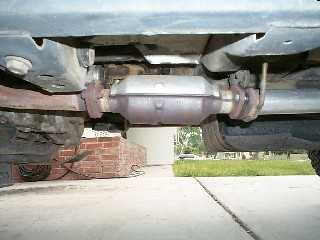
The shop bent up 2.25" aluminized pipe and installed a 2.25" Dynomax Super-Turbo muffler. Here are some pictures:
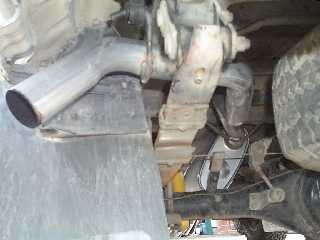
The reason why the muffler sits at an angle is because I wanted it away from the actuator on my electric-locking differential so it wouldn't heat it up any hotter than it already gets.
In the 3rd picture, you can see the OEM header pipe and the existing cat.
It took the shop about an hour to do the work. When I got back on the road, I immediately noticed the difference. I had a lot more power, especially on the freeway where I could easily accelerate on the freeway in 5th gear. My gas mileage also improved by about 4 extra MPG. Another benefit was that I had a lot more power at high altitude (6000' plus).
It is a bit louder that than the stock exhaust, however at normal driving RPM's it is not bad at all (Note: once I installed my header, things did get a bit louder). In fact, it is quieter inside my 4Runner than before. However, when the RPM's get above 4000, there is definitely a lot of noise coming out of the tailpipe. It is a good sound; not the bumblebee-in-a-can you hear from most imports, but rather a loud trumpeting sound. I kind of like it :).
All in all, this modification had a very high bang-for-the-buck factor, and is the first performance mod I'd recommend for these vehicles.