Created: 11/8/2001
Last Update: 3/26/2002
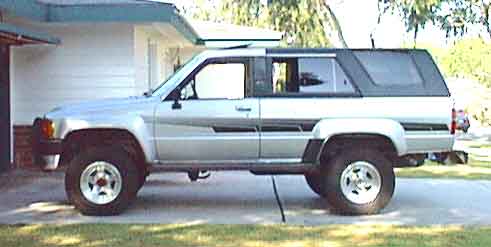
I put 33x950R15 BFGoodrich All Terrain's on my '86 4Runner. They are on 15x7" American Racing rims. Backspacing is 3.5" (measured from inner edge of rim to mounting surface). According to BFGoodrich's specs, these tires have an actual diameter of approximatly 32.7" on 7.5" wheels. This is important because different brands of tires will vary in diameter.
Before
After
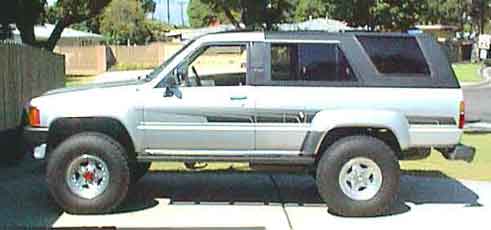
Tall & Narrow... These things look like they should be on a tractor!
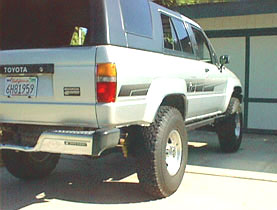
Before I installed these tires, I read all the posts I could find on the various Toyota BBS's regarding installing 33" tires. I knew that I was going to have clearance issues, however, I felt reasonably confident that they wouldn't be too bad with 33x950's. From what I read, it sounded like the width was the major factor in fitting 33's. Wider tires have a wider arc they swing through while turning. Wheel back-spacing also plays a role.
Aside from a 1" lift in the rear (add-a-leafs) and cranking my front torsion bars up 1" (see below), my 4Runner's suspension is bone stock as pictured. However, I have since lowered my front back down to stock height, and the 1" lift in the rear is not necessary to fit these tires.
First impressions
The 33's on a 15" wheel have a lot more rubber between the rim and the road. Coupled with their narrow width, I noticed that they felt more "squishy" in turns. Air pressure makes a big difference. At first they were at about 26psi, but after I inflated them to 35psi they are a lot tighter. I have gotten used to driving with these tires, but the handling is definitly not as good as before. Because this is my only vehicle, and I do a lot of driving on Southern California freeways, I am always concerned about how it will handle if I have to take evasive maneuvers in an emergency situation. I've also noticed that I have a more drift on curvey roads... it tends to understeer now.
I noticed a bit of power degradation. I have 4.56 gearing, so I went from being about 5% under-geared with my 30" tires to being about 4% over-geared, for an overall 9% change. It isn't that noticable driving around town. I have a 22RE (vs a 22R), and the exhaust mods I have done have upped the power somewhat. I actually like the taller gearing because first gear is more usable in the city. However, it is definitly slower going up hills. There is a hill by my house that I use as reference to test modifications. Even with 30" tires and 4.56 gearing, I could never maintain 60MPH to the top of it in 5th gear. However, I used to be able to accelerate past 60MPH going up it in 4th gear. Now with the 33" tires, I can't maintain 60MPH in 4th either. 4.88 gears would be a better match for these tires, but overall I'd say that 4.56 gearing is adequate.
Checking Clearance
After installing the tires, it was time to check how badly they would rub. I drove around and found a spot where I could ramp my 4Runner to full suspension compression on two corners. Note: I disconnected my sway bar to help facilitate full suspension compression in the front. Normally, I drive with it on. Despite what others say, I can tell you that the sway bar does make a big difference in handling on close-to-stock 4Runner and trucks.
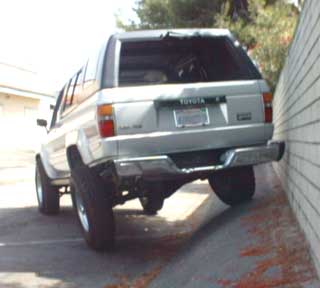
Here, almost all the weight of my 4Runner is resting on the front left wheel and the rear right wheel. The other two wheels have almost no load on them. The suspension is fully compressed so that the bump stops (stock height) are squished a bit.
The IFS is flexing like mad :D
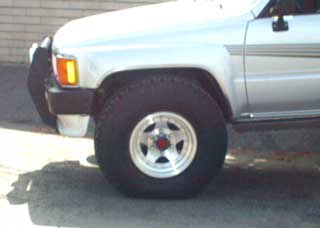
The front wheel well is plenty tall enough to hold the 33" tire at full compression:
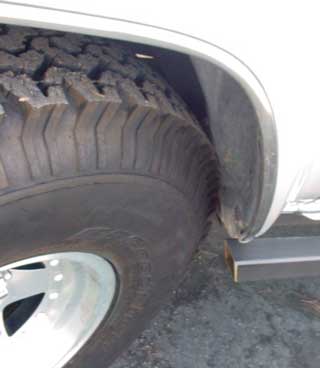
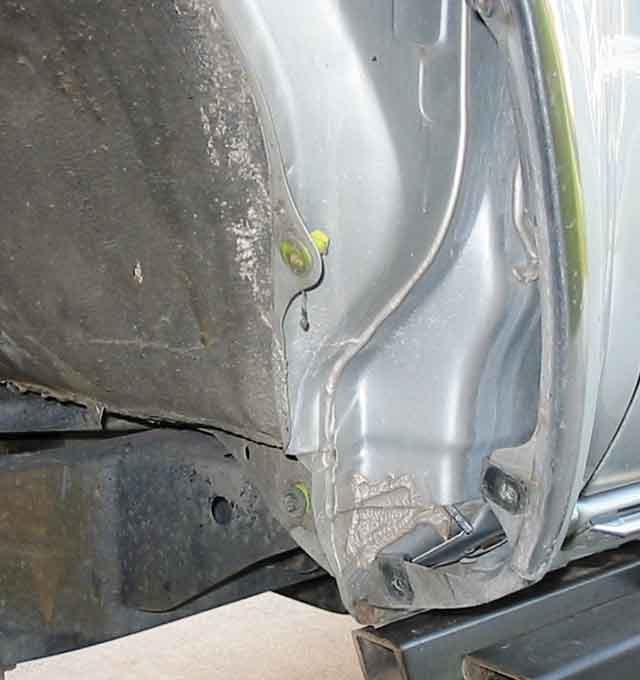
The only clearance issue I ran into (aside from mud-flaps) is that is that the tire contacts the lower part of the fender seam while turning at full or near-full compression:
The rear tires stuff nicely into the wheel wells.
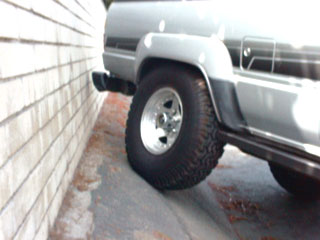
The suspension is fully compressed here, bumpstop squished.
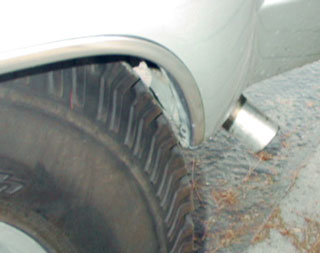
It is very close, but there are no clearance issues in the rear, except for possibly some slight rubbing on the mud-flaps:
See below for updates.
Regarding the Torsion Bars
Before I installed the tires, I cranked the torsion bars up about 1" (12 turns of the bolts) because I had read many accounts that said some lift is needed to fit 33� tires. The accounts conflicted on how much lift was needed. One person even put 33's on a slightly lowered truck with some fender trimming. I figured I'd try cranking the torsion-bars up about an inch first, and see how things worked. I thought I might also end up having to do a 1" body lift, but I wanted to see if I could get away with just cranking the torsion bars and pounding the fender seam flat. My ultimate goal was (and is) to find a happy median betweeen enhancing the off-road capabilities of my 4Runner and maintaining good handling characteristics on the street. Because of this, I wanted to keep my 4Runner's suspension and height as close to stock as possible.
After cranking the torsion-bars, I drove to the tire shop to get the new tires mounted. On the way, I noticed that my handling was significantly degraded. My 4Runner felt like it was going to tip over while turning... not literally, but my camber was definitely off (Note: at this point in time I still had my sway-bar hooked up). This was something I hadn't expected. I knew that my alignment would be affected a little bit, but I hadn't expected it to be this bad. I really didn't want to have to mess with the alignment.
I had read several accounts that said that cranking the torsion bars increases ride stiffness. Personally, I didn't notice that the ride was any stiffer, but I only went up an inch.
Interestingly enough, once I compressed my suspension and saw the control arm contacting the bumpstops, I suddenly realized that cranking the torsion bars has absolutly no effect at all fitting these tires. At full compression, everything is going to be in the same position regardless of where the torsion bars are set. In other words, the relationship between the tire and the chassis is fixed at full compression. Doh! This is so obvious... why didn't I think of it before? I wasted my time messing with the torsion-bars (it took a few hours to get those lock-nuts loosened)!
I am actually happy that it doesn't make a difference! I was uncomfortable about cranking the torsion bars. Aside from throwing off my alignment, it practically eliminates down-travel; the control arms were almost resting on the upper bumpstops. Plus, it puts additional stress on steering linkage and on the CV joints in 4WD. So, I lowered the torsion bars back to their stock settings. The handling was greatly improved and the tires still cleared just fine. Assuming that you want your suspension to be able to compress all the way to the bumpstops, cranking your torsion bars is only going to have negative effects both on and off-road. The only potential benefit I can see to cranking the torsion bars is that it raises the height of the front crossmember, but in the real world, this does not make any difference to the off-road ability because the drawbacks of (even more) limited suspension travel far outweigh the benefits of an extra 1" - 2" or crossmember clearance.
Clearancing the Front Tires
I broke out the Proverbial Hammer and flattened the fender seams in the front. I also pounded the firewall in a little bit.
Before:
After:
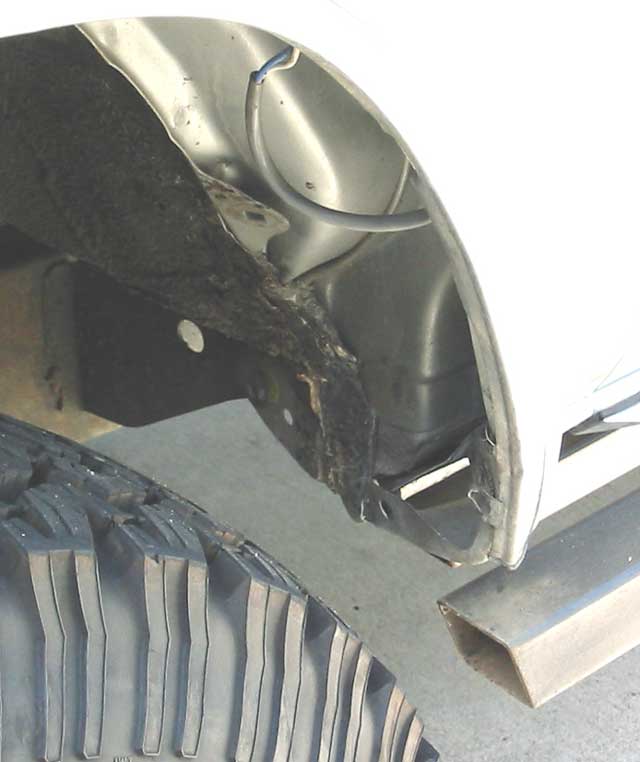
This appears to allow the tires to just barely clear... no body-lift needed!
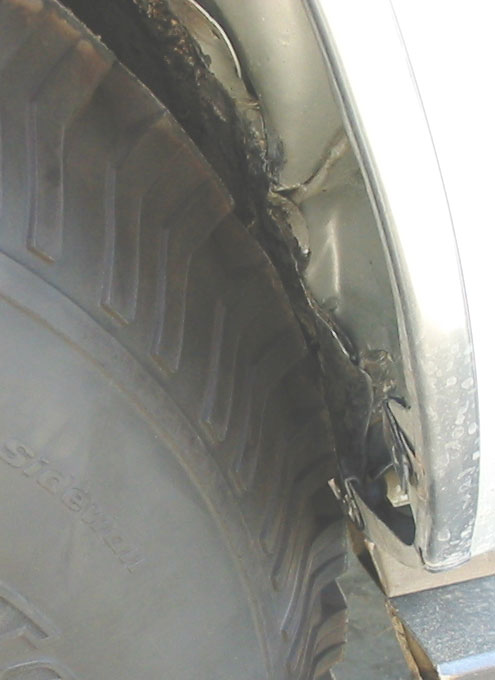
Notes:
Conclusions
Well, I am happy to say that I have successfully fitted 33" tires on my 4Runner without any major modifications. Since installing them, I have gone on a couple of good wheeling trips that have given my suspension a full workout, and I haven't experienced any rubbing.
I hope that you found this article to be useful. The question of fitting 33's on a stock rig comes up often, and I found it hard to get clear and concrete answers (due to the number of variables).
Remember that aside from tire size (varies by brand), rim width and backspacing is going to play a significant role too.
UPDATES: