http://y23.com/apddatas.htm
The Datasheet
Astronomical calculations supplement to
The Astronomical Pocket Diary
Because I can not make an edition for every point on earth, I sometimes
send "the wrong edition". Almost always this "wrong edition" is in the
right language and/or for the right time zone, but does not contain the
correct rise and set times. If time permits I offer a DataSheet
which gives the correct data, as it is calculated for the correct location.
However, should the needed corrections be less than 10 minutes, I usually
don't bother. Most people live in areas of heavy air-pollution, where objects
at the horizon cannot be seen anyway.
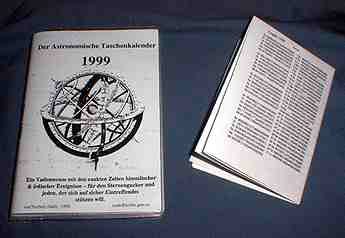
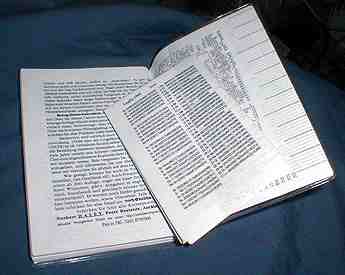
The datasheet is printed on both sides, you are supposed to fold
it up and insert it into the "pockets" of the plastic-cover of the
Diary.
The following text is printed on the back-side:
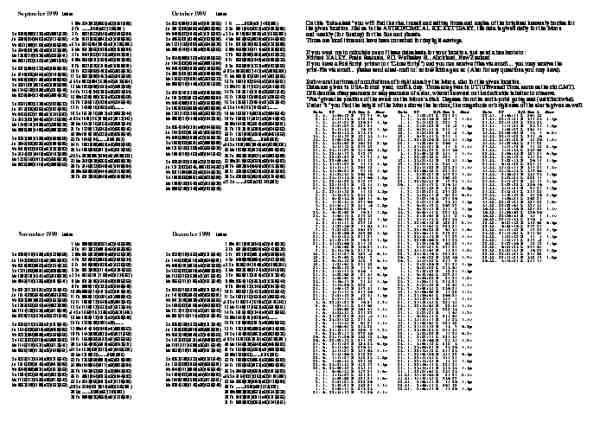
On this "data-sheet" you will find the rise, transit and setting times
and angles of the brightest heavenly bodies for the given location. Just
as in the ASTRONOMICAL POCKET DIARY, the data is given daily for the Moon
and weekly (for Sunday) for the Sun and planets. Times are local time and
have been corrected for daylight-savings.
To calculate this datasheets for your location, just send a large beer's
worth banknote to:
Norbert HALEY, Poste Restante, P.O. Wellesley St., Auckland, New Zealand
If you have email, a PostScript printer (or "GhostScript")
or ACROBAT for PDF files ....
you may receive the print-file via email... please send a test-mail to:
click here
(Also for any questions you may have).
Download a Sample-datasheet:
sample datasheet for Saint Louis, MO,
USA (23kB)
Year2000, 38.6degN 90.2degW, GMT-6, Paper: US-Letter
sample datasheet for Amsterdam, Netherlands
(22kB)
Year2000, 52.4degN 5degE, GMT+1, Paper: A4
And here you'll find the Data for Auckland
2000 TEXT-ONLY
What Data is on the Data Sheet?
-
Day of the week
-
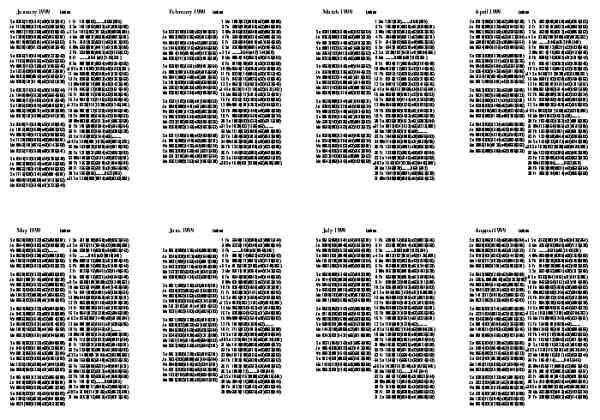
Moon's daily rise, set, transit times (corrected for daylight savings),
rise and set azimuths (where on the horizon the Moon rises or sets), transit
height and direction.
-
Sun, Jupiter,
Venus,
Saturn,
Mars,
Mercury:
weekly
rise, set, transit times (corrected for daylight savings), rise and set
azimuths, transit height and direction for .
-
UTC (GMT) times/data of occultations of bright stars by the Moon.
How the
Rise, Transit and Setting Times
for Sun, Moon, Jupiter, Venus, Saturn, Mars and Mercury
are given:
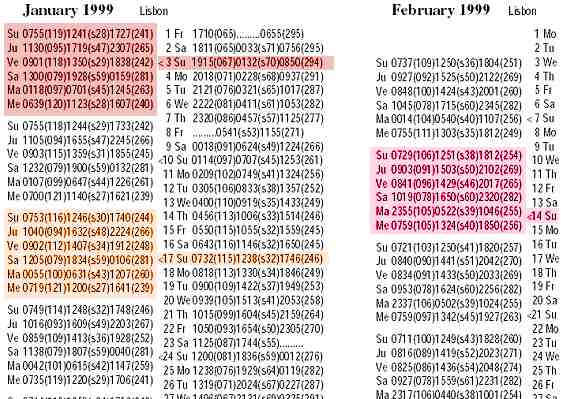
Lets start on the top left.
WEEKLY DATA:
You see a block of data, the rise and set times etc for the Sun, Jupiter,
Venus, Saturn, Mars, Mercury.
These times are for Sunday the 2nd as indicated by the <
sign to the right of the block.
Before we go to the right-hand column lets see what the numbers mean
in detail:
Below January 2000, St, Louis, MO, you'll
see Su 719(119)1205(s29)1651(241)
This means theat the Sun (Su)
rises at 7:19am at 119 degrees from geographical true North (so its almost
exactly south-east!). Beware, your compass points to the magnetic northpole,
not the geographic one.
The Sun "transits" (reaches its highest point in the sky) at 12:05,
5 minutes after midday. At that time it will be over true south (s),
so when you see the Sun at 12:05, you know where exact south is. Finally,
the Sun sets at 16:51 (51 minutes after 4 p.m.) at 241 degrees, in the
south-west.
In the same block in the line below Su,
you see Ju 1219(078)1849(s60)0122(282)
The same story ... Jupiter (Ju)
rises at 12:19am at 78 degrees from true North (about east-north-east).
It "transits" (reaches its highest point in the sky) at 18:49, that's
49 minutes after 6 p.m due south and 60 degrees high.. And so on. So you
see Jupiter sets 1:22 am (it sets before it rises in the 24 hours we are
talking about). 8 hours and 31 minutes later than the Sun and, clouds permitting,
should be a brilliant "star" visible in the evening skies about 8 hours
(120degrees) "after" the Sun towards the east.
and so on for Venus (Ve) Saturn
(Sa) Mars (Ma)
and
Mercury (Me).
The next "block" is for Sunday the 9th of January, the next block is
for Sunday the 16th, and so on.
DAILY (MOON) DATA:
Now let's look at the right-hand colum where the days of the month
appear.
Next to the day of the month and the weekday, you will find the
MOON's
rising time (rising azimuth), transit time (direction
and altitude) setting time (setting azimuth)
1 Sa 0237(103)0813(s40)1343(254)
This is Saturday the 1st of January 2000
< 2 Su 0334(108)0857(s37)1415(250)
This is Sunday (< shows the week for the block to the left),
the 2nd.
3 Mo 0430(112)0942(s34)1451(247)
Monday, January 3, 2000 moon times for St. Louis.
Now skip down to
14 Fr 1156(083)1825(s58)........
The moon did not set that Friday.
And
20 Th 1650(064)........0641(297)
The moon did not transit that Thursday.
This is the data for rise/set times/angles etc for the Moon.
The Moon changes its times too fast to just give them once a week. Thats
why they are given daily.
Say it out loud 5 times: The Moon rises one
hour later each day.
The following text on the DataSheet explains how the occultation
data is given:
Below are the times of occultations of bright stars by the Moon, also
for the given location.
Dates are day and month. (3.1 means January 3rd.)
Times are given in UT (Universal Time, same as the old GMT).
D/R denotes disappearance or reappearance of a star.
The event on the dark side is better to observe.
"Pos" gives the position of the event on the Moon's disk in degrees
from the north-point going east (anticlockwise).
Under "h" you find the height of the Moon above the horizon.
The star's magnitude (brightness) is given as well.
From the Lisbon 1999 datasheet:
Date   UT      D/R Pos h  Star
 3. 1.  1:34:52 D   77 70  4.9p
 3. 1.  2:50:01 R  303 64
 8. 1.  1:59:35 D  174 28  5.9p
 8. 1.  2:38:37 R  235 35
 3. 1.  2:55:15 D   94 63  6.8p
 3. 1.  4:10:51 R  291 51
11. 1.  3:16:02 D  179 11  6.6v
11. 1.  3:45:34 R  229 16
27. 1.  1:21:47 D  140 23  3.6p
27. 1.  1:55:02 R  207 17
30. 1. 21:00:37 D  108 44  5.2p
30. 1. 22:15:07 R  263 57
28. 1. 22:27:27 D   78 70  5.6p
28. 1. 23:47:49 R  280 63
TIDES: At most sea-coasts of the earth, the ocean-tides change
with the moon. So if your high-tide is always two hours after the moon
rises and again after the Moon sets, you can go by that! However, Norbert
can also calculate complete tide-tables for you,
should you need them.
back to the Astronomical Pocket Diary page