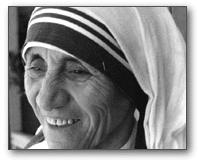
In 1962, Mother Teresa received the Philippines-based Ramon Magsaysay Award for International Understanding, given for work in South or East Asia. The citation said that "the Board of Trustees recognizes her merciful cognizance of the abject poor of a foreign land, in whose service she has led a new congregation". By the early 1970s, Mother Teresa had become an international celebrity. Her fame can be in large part attributed to the 1969 documentary Something Beautiful for God, which was filmed by Malcolm Muggeridge and his 1971 book of the same title. Muggeridge was undergoing a spiritual journey of his own at the time. During the filming of the documentary, footage taken in poor lighting conditions, particularly the Home for the Dying, was thought unlikely to be of usable quality by the crew. After returning from India, however, the footage was found to be extremely well lit. Muggeridge claimed this was a miracle of "divine light" from Mother Teresa herself.Others in the crew thought it was due to a new type of ultra-sensitive Kodak film.Muggeridge later converted to Catholicism.
Around this time, the Catholic world began to honor Mother Teresa publicly. In 1971, Paul VI awarded her the first Pope John XXIII Peace Prize, commending her for her work with the poor, display of Christian charity and efforts for peace. She later received the Pacem in Terris Award (1976). Since her death, Mother Teresa has progressed rapidly along the steps towards sainthood, currently having reached the stage of having been beatified.
Mother Teresa was honoured by both governments and civilian organisations. She was appointed an honorary Companion of the Order of Australia in 1982, "for service to the community of Australia and humanity at large." The United Kingdom and the United States each repeatedly granted awards, culminating in the Order of Merit in 1983, and honorary citizenship of the United States received on 16 November 1996. Mother Teresa's Albanian homeland granted her the Golden Honour of the Nation in 1994.Her acceptance of this and another honour granted by the Haitian government proved controversial. Mother Teresa attracted criticism from a number of people for implicitly giving support to the Duvaliers and to corrupt businessmen such as Charles Keating and Robert Maxwell. In Keating's case she wrote to the judge of his trial asking for clemency to be shown. Universities in both the West and in India granted her honorary degrees.[64] Other civilian awards include the Balzan Prize for promoting humanity, peace and brotherhood among peoples (1978),and the Albert Schweitzer International Prize (1975).
In 1979, Mother Teresa was awarded the Nobel Peace Prize, "for work undertaken in the struggle to overcome poverty and distress, which also constitutes a threat to peace." She refused the conventional ceremonial banquet given to laureates, and asked that the $192,000 funds be given to the poor in India, stating that earthly rewards were important only if they helped her help the world's needy. When Mother Teresa received the prize, she was asked, "What can we do to promote world peace?" She answered "Go home and love your family." Building on this theme in her Nobel Lecture, she said: "Around the world, not only in the poor countries, but I found the poverty of the West so much more difficult to remove. When I pick up a person from the street, hungry, I give him a plate of rice, a piece of bread, I have satisfied. I have removed that hunger. But a person that is shut out, that feels unwanted, unloved, terrified, the person that has been thrown out from society—that poverty is so hurtable [sic] and so much, and I find that very difficult." She also singled out abortion as 'the greatest destroyer of peace in the world'.
During her lifetime, Mother Teresa was named 18 times in the yearly Gallup's most admired man and woman poll as one of the ten women around the world that Americans admired most, finishing first several times in the 1980s and 1990s.In 1999, a poll of Americans ranked her first in Gallup's List of Most Widely Admired People of the 20th Century.In that survey, she out-polled all other volunteered answers by a wide margin, and was in first place in all major demographic categories except the very young.
(Read More)
Criticism
Main article: Criticism of Mother Teresa
Towards the end of her life, Mother Teresa attracted some negative attention in the Western media. The journalist Christopher Hitchens was one of her most active critics. He was commissioned to co-write and narrate the documentary Hell's Angel about her for the British Channel 4 after Aroup Chatterjee encouraged the making of such a programme, although Chatterjee was unhappy with the "sensationalist approach" of the final product.Hitchens expanded his criticism in a 1995 book, The Missionary Position.
Chatterjee writes that while she was alive Mother Teresa and her official biographers refused to collaborate with his own investigations and that she failed to defend herself against critical coverage in the Western press. He gives as examples a report in The Guardian in Britain whose "stringent (and quite detailed) attack on conditions in her orphanages ... [include] charges of gross neglect and physical and emotional abuse", and another documentary Mother Teresa: Time for Change? broadcast in several European countries.
The German magazine Stern published a critical article on the first anniversary of Mother Teresa's death. This concerned allegations regarding financial matters and the spending of donations. The medical press has also published criticism of her, arising from very different outlooks and priorities on patients' needs.Other critics include Tariq Ali of the New Left Review and the Irish investigative journalist Donal MacIntyre.
She has also been criticized for her view on suffering. She felt that suffering would bring people closer to Jesus. Sanal Edamaruku, President of Rationalist International, criticised the failure to give painkillers, writing that in her Homes for the Dying, one could "hear the screams of people having maggots tweezered from their open wounds without pain relief. On principle, strong painkillers were not administered even in severe cases. According to Mother Teresa's philosophy, it is 'the most beautiful gift for a person that he can participate in the sufferings of Christ'.
The quality of care offered to terminally ill patients in the Homes for the Dying has been criticised in the medical press. The Lancet and the British Medical Journal reported the reuse of hypodermic needles, poor living conditions, including the use of cold baths for all patients, and an approach to illness and suffering that precluded the use of many elements of modern medical care, such as systematic diagnosis.Dr. Robin Fox, editor of The Lancet, described the medical care as "haphazard", as volunteers without medical knowledge had to make decisions about patient care, because of the lack of doctors. He observed that her order did not distinguish between curable and incurable patients, so that people who could otherwise survive would be at risk of dying from infections and lack of treatment. Dr. Fox makes it a point to contrast the term "hospice", on the one hand, with what he calls "Mother Teresa's Care for the Dying" on the other hand; noting that, while hospice emphasizes minimizing suffering with professional medical care and attention to expressed needs and wishes of the patient, her approach does not.
Colette Livermore, a former Missionary of Charity, describes her reasons for leaving the order in her book Hope Endures: Leaving Mother Teresa, Losing Faith, and Searching for Meaning. Livermore found what she called Mother Teresa's "theology of suffering" to be flawed, despite being a good and courageous person. Though Mother Teresa instructed her followers on the importance of spreading the Gospel through actions rather than theological lessons, Livermore could not reconcile this with some of the practices of the organization. Examples she gives include unnecessarily refusing to help the needy when they approached the sisters at the wrong time according to the prescribed schedule, discouraging sisters from seeking medical training to deal with the illnesses they encountered (with the justification that God empowers the weak and ignorant), and imposition of "unjust" punishments, such as being transferred away from friends. Livermore says that the Missionaries of Charity "infantilized" its sisters by prohibiting the reading of secular books and newspapers, and emphasizing obedience over independent thinking and problem-solving.
Hitchens and Stern have said Mother Teresa did not focus donated money on alleviating poverty or improving the conditions of her hospices, but on opening new convents and increasing missionary work.Mother Teresa accepted donations from the autocratic and corrupt Duvalier family in Haiti and openly praised them. She accepted $1.25 million from Charles Keating, involved in the fraud and corruption scheme known as the Keating Five scandal and supported him before and after his arrest. The Deputy District Attorney for Los Angeles, Paul Turley, wrote to Mother Teresa asking her to return the donated money to the people Keating had stolen from, one of whom was "a poor carpenter". The donated money was not accounted for, and Turley did not receive a reply
|