





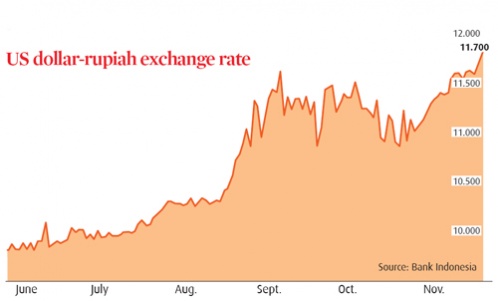
The rupiah plunged to a four-year low on Friday as fears over the reduction of the US monetary stimulus and surging demand for the US dollar continued to drag down the local currency. The rupiah fell 0.9 percent this week to 11,730 per dollar as of 3:20 p.m. in Jakarta, after touching 11,736 earlier, the weakest level since March 2009, according to prices from local banks compiled by Bloomberg. Thailand’s baht slid 0.8 percent to 31.84 and Malaysia’s ringgit dropped 0.4 percent to 3.2157.
Bank Indonesia’s (BI) move to raise its key interest
rate by 25 basis points to 7.5 percent this month to lure foreign inflows
apparently had little impact to shore up the currency, which this week touched
Rp 11,736 per dollar earlier, the weakest level since March 2009. BI
Governor Agus Martowardojo attributed the depreciation trend of the rupiah to
the minutes of the US Federal Open Market Committee’s (FOMC) meeting released
this week, which revealed that the reduction of its bond-buying stimulus could
take place in the “coming months”.
“[The minutes of the] FOMC meeting affects all currencies across the globe, so
if there’s any weakness in the rupiah at present, we see it as something that is
still rational,” Agus told reporters in his Jakarta office on Friday. BI, which
recently loosened its market intervention and opted to pile up its foreign
exchange (forex) reserves instead, reaffirmed its commitment of not steadfastly
holding the currency at a certain mark. “We do not want to target the currency
at a certain level — the present currency rate has reflected the fundamentals of
our economy,” Agus said.
Nevertheless, he said that BI would remain vigilant because the rupiah would
normally see “heavy” pressure before the turn of the New Year due to the high
dollar demand for companies’ foreign debt payments and earnings repatriation.
The rupiah, which has depreciated by more than 17 percent year-to-date, is among
the worst performers in Asia, as Indonesia’s high current-account deficit
triggered heavy sell-offs among foreign investors, who were already anxious over
the prospect of tighter US monetary policy.
Indonesia’s current-account deficit stood at US$8.4 billion in the third
quarter, equivalent to 3.8 percent of gross domestic product (GDP). Agus told
reporters that BI aimed to push down the current-account to a more sustainable
level of between 0.2 to 2.5 percent of GDP. The high current-account deficit
would make the rupiah and the Indian rupee “the first [two currencies] in the
firing line” when the US Federal Reserve started tapering its monetary stimulus,
according to London-based research firm Capital Economics Ltd. “The rate
increases that we have seen in Indonesia should make a difference, but it is
going to be a while before they take effect,” Capital Economics analyst Gareth
Leather said
The demand for dollars, both for debt and import payments, is traditionally high
at the end of the year. According to BI data, the amount of the foreign debt
payments in October and December reached a total of $21.02 billion. About $18.89
billion will come from the private sector and another $2.13 billion from the
government and the central bank. Lana Soelistianingsih, an economist with PT
Samuel Aset Manajemen, noted that the rupiah faced intense pressure this week
because importers were buying dollars as they feared that the currency might
weaken further in December on high demand for the greenback during the month.
She expected BI to prioritize currency stabilization and perform intervention
gradually, but warned the central bank to closely monitor developments so that
the rupiah depreciation would not spiral out of control. “With sizeable amount
of imports in the economy right now, could you imagine if the currency suddenly
traded at 12,000 per dollar?” Lana said. “That would really hurt the real sector
and pose risks to the economy.”