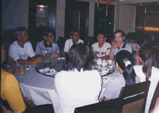
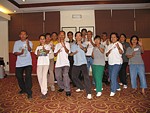
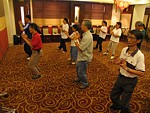
Dr. Paul Lam during lunch with TCA trainees. (Photo courtesy of Phil. Tai Chi Network.)
Dr. Paul Lam (center) with TCA trainees in Manila.
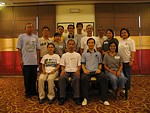
Dr. Paul Lam (sitting 2nd from right) during the graduation ceremony of TCA training.
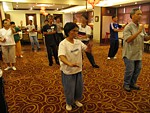
TCA trainees doing waving-hands-in-the-clouds Sun style
TCA trainees doing single-whip.


Graceful "Tai Chi" May Help The Frail Elderly

Washington - TAI CHI, a graceful form of martial arts, makes elderly people less likely to fall and break their brittle bones, according to research released on Thursday by the Naitonal Institute on Ageing (NIA).

It also appears to help people aged 70 and over maintain the gains from other balance and strength training exercises.

Both studies were done as part of a special NIA program on reducing frailty and appear in the May edition of the jornal of the American Geriatrics Society.

TAI CHI is a slow and graceful martial arts that enhances balance and body awareness.

In the first study, Steven Wolf and colleagues at Atlanta's Emory Univeristy of Medicine found in a study of 2000 participants over age 70 that a 15-week TAI CHI program reduced risk of falling by 47.5 percent.

"It also appears to help people age 70 and over maintain the gains from other balance and strength training exercises"

Many also reported that they worried less about falling, about half the study participants voluntarily continued to keep meeting informally once the experiment is over.

In the related study, Dr. Leslie Wolfson and colleagues at the University of Connecticut in Farmington, found several effective ways for the elderly to improve their strength and balance, and TAI CHI helped preserve those gains for the next six months.

Each year, falls are responsible for at least $12 billion in medical and disability bills. Some older people never fully recover from severe fractures, and may require nursing home care. NIA researchers are looking for simple, and low-cost solutions like TAI CHI.

"People can do this at home and with friends once they have had the proper training" said NIA geriatrics expert Chandra Dutta.


Hosted by www.Geocities.ws

1