NEAR
One of the largest and best observed near-Earth asteroids is 433 Eros, discovered in 1898 independently by G. Witt (Germany) and A. Chalois (France). Eros accounts for nearly half of the volume of all near-Earth asteroids. The potato-shaped Eros is one of the most elongated asteroids, with estimated dimensions of 40 x 14 x 14 kilometers, so it almost fits within the Baltimore Beltway Eros orbits around the Sun with a perihelion of 1.13 AU (169,045,593 km) and an aphelion of 1.78 AU (266,284,209 km), and it rotates once every 5.27 hours. The gravity on Eros is very weak but enough to hold a spacecraft. A 100-pound (45-kilogram) object on Earth would weigh about 1 ounce on Eros. A rock thrown from the asteroid's surface at 22 miles/hour (10 meters/sec) would escape into space.There is no air and no evidence of water. The "day time" temperature of Eros is about 100°C (212°F), while at "night" it plunges to -150°C (-238°F)!
On Monday, 12 February 2001, the NEAR spacecraft touched down on asteroid Eros
|
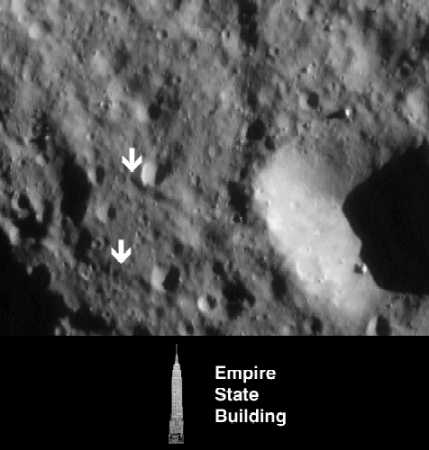
| This image, taken May 4, 2000, from an orbital altitude of 50 kilometers (31 miles), shows a variety of small surface features. The whole scene is about 1.8 kilometers (1.1 miles) across. To better visualize the size of the features, a to-scale Empire State Building is inset at the bottom of the image. The shallow, linear troughs in the lower part of the photo (marked by arrows) are 60 meters (197 feet) across. The boulder on the floor of the large crater at right is 30 meters (98 feet) across, whereas the crater itself measures about 800 meters (2,625 feet) across |
|
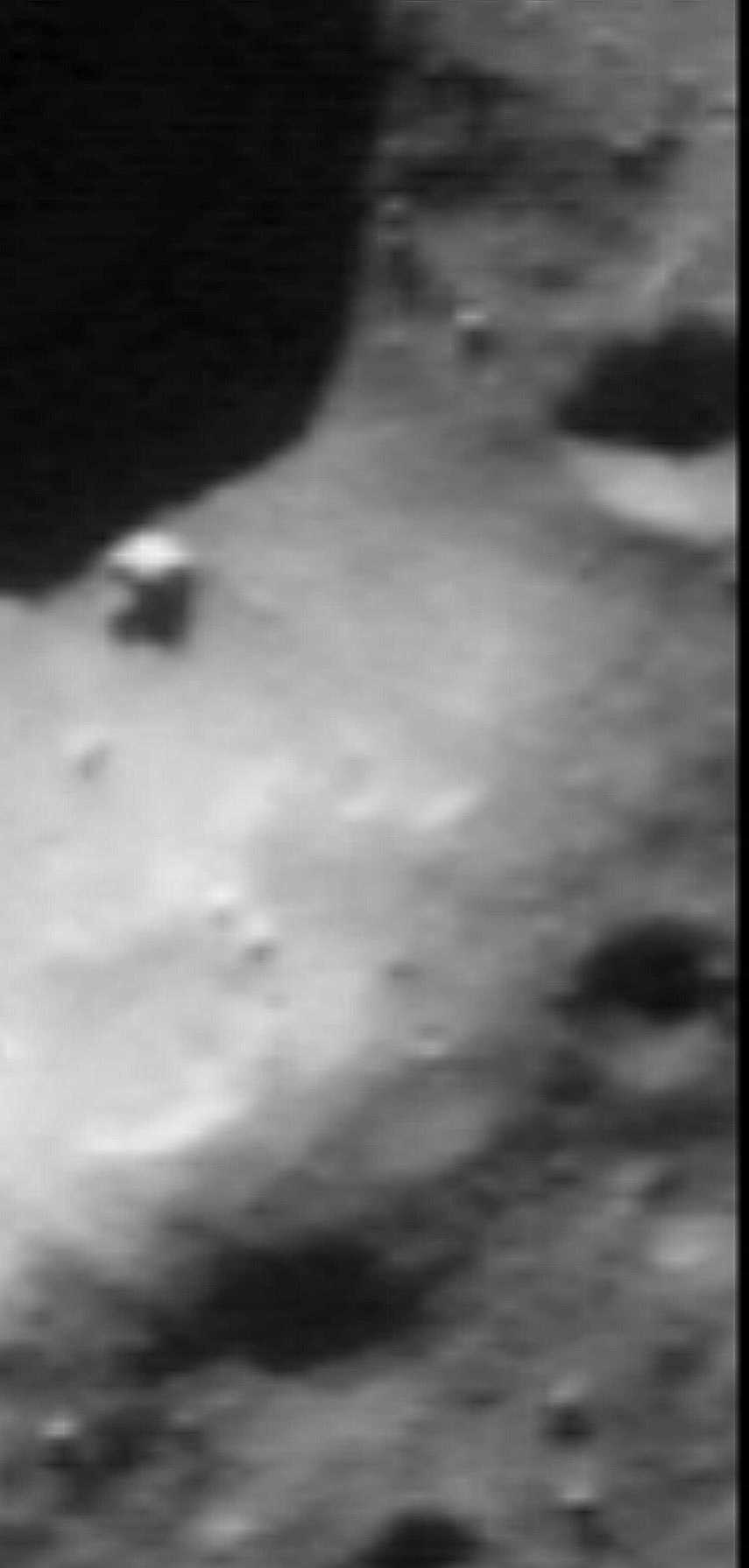
| Zoom in the boulder(?) with the strange shape , linear features like a cross |
 |
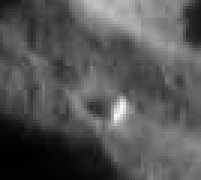 |
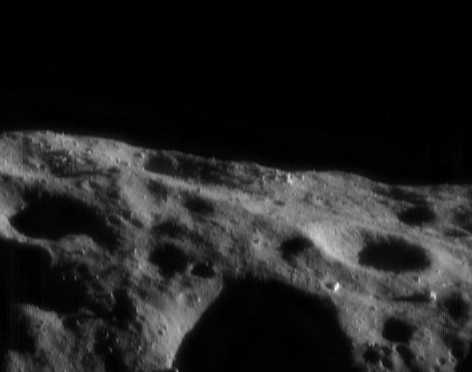
| Another area with a big crater and boulders | Monolith (?) |
Links NEAR Shoemaker
Sign Ancient MysteriesGuestbook
 Back to Back to Mysterious Space Images |
 |
 |