
Man over million years
NEWS
 The
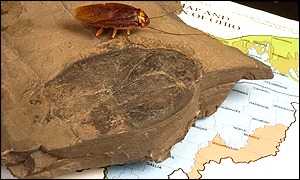
largest complete fossil of a cockroach
The
largest complete fossil of a cockroach
The largest complete fossil of a cockroach
has been found in the United States. The insect, about the size
of a mouse, lived 55 million years before the first dinosaurs
walked the planet. The specimen, from a time when the land was a
giant tropical swamp, was unearthed in a coalmine in eastern
Ohio. Scientists say the discovery could shed light on the
diversity of ancient life and how the Earth's climate has changed
throughout history.Cary Easterday, a geologist at Ohio State
University, was among the team that found the fossil.
"Normally, we can only hope to find fossils of shell and bones, because they have minerals in them that increase their chances for preservation," he said.
"But something unusual about the chemistry of this ancient site preserved organisms without shells or bones in incredible detail."
Scientists are unsure what caused such
intricate features to be preserved at the mine, which also
contains the fossil of the earliest known conifer in the
Appalachian Basin. But they hope it could yield clues to how
ancient plants and animals coped with a changing environment. At
the time, 300 million years ago, during the Carboniferous period,
the swamp was rapidly drying out. The cockroach, which is nine
centimetres (3.5 inches) long, has visible legs, antennae and
mouth parts. Veins can be seen on its wings as well as fine bumps
covering the wing surface.The creature is about twice the size of
the average cockroach found today in North America. Some modern
cockroaches living in the tropics can grow bigger. The cockroach
was found at the mine in 1999 by Mr Easterday and fossil
collector Gregory McComas.
Details of the find were presented on Wednesday at the annual
meeting of the Geological Society of America in Boston.
 Jelly turned to rock
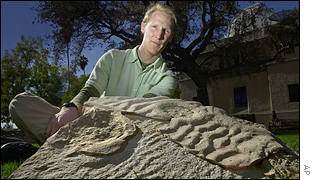
An extraordinary group of jellyfish fossils
has been uncovered by researchers in a quarry in Wisconsin, US.
The circular impressions left in 500-million-year-old sandstone -
several measure up to a metre across - represent some of the
largest finds of their kind anywhere in the world. It is very
unusual for jellyfish to be preserved in the fossil record; they
have no bony parts and when they are stranded on a beach, they
are usually eaten by predators. These jellyfish must have been
covered by sand soon after they came ashore. "It is very
rare to discover a deposit which contains an entire stranding
event of jellyfish," said Dr James Hagadorn, a scientist at
the California Institute of Technology and co-author of an
article reporting the find in February's issue of the journal
Geology. "These jellyfish are not just large for the
Cambrian, but are the largest jellyfish in the entire fossil
record. What is also of interest is that they were among the
largest two types of predators in the Cambrian." During the
Cambrian, Wisconsin is thought to have enjoyed a tropical
environment, and was most likely covered by a shallow inland sea.
Skewed view Dr Hagadorn and colleagues believe that the jellyfish
were preserved because of a lack of erosion from seawater and
wind, the lack of scavengers, and the lack of any significant
sediment disturbance by other organisms burrowing into the sand
after it had covered the jellyfish. Hagadorn believes jellyfish
may have been under-appreciated in previous studies of Cambrian
ecosystems and that they were probably important predators in
Cambrian food chains. "We use fossils to assess the
diversity and ecology of ancient communities," the geologist
said. "To date, most of our information about the trophic
(food chain) structure of the Cambrian - when multicellular
animals burst onto the scene - is based on animals with hard
parts or on exceptional deposits which contain soft-bodied
organisms." He added: "When we analyse the trophic
structure of the Cambrian - who ate whom, who ate them, and so
forth, or when we analyse how abundant each type of organism was
in each part of the food chain - we may have been inadvertently
omitting a huge amount of information about all of the
soft-bodied animals that were swimming around in the water
column, munching on other organisms, but which were rarely
fossilized. "This deposit provides us a rare opportunity to
study such animals."
Last Update:01/02/2002
 Back to Back to
|
Return to |