JET PROPULSION LABORATORY
CALIFORNIA INSTITUTE OF TECHNOLOGY
NATIONAL AERONAUTICS AND SPACE ADMINISTRATION
PASADENA, CALIF. 91109. TELEPHONE (818) 354-5011
http://www.jpl.nasa.gov

PHOTO CAPTION
P-48525
April 9, 1997
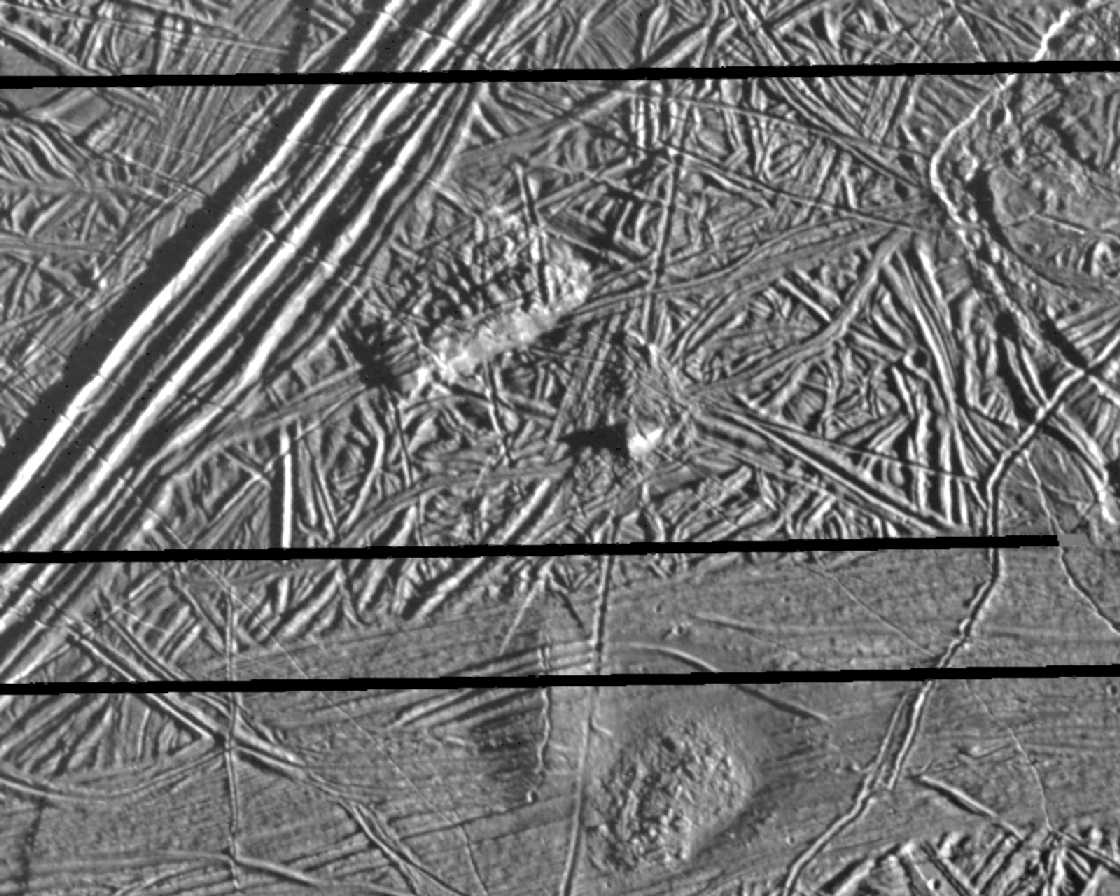
This picture of Europa, a moon of Jupiter, was obtained on February 20,
1997, by the Solid State Imaging system onboard the Galileo spacecraft

north latitude, 275.7 degrees west longitude, on the trailing hemisphere of
Europa. As Europa moves in its orbit around Jupiter, the trailing hemisphere
is the portion which is always on the moon's backside opposite to its
direction of motion. The area depicted is about 32 kilometers by 40
kilometers (20 miles by 25 miles). Resolution is 54 meters (59 yards). The
Sun illuminates the scene from the right (east).

A section of a triple band crosses the upper left of the picture and extends
for hundreds of miles across the surface. Triple bands derive their name
from their appearance at lower resolution as a narrow bright band flanked by
a pair of darker bands. At the high resolution of this picture, however, the
triple band is much more complex and is composed of a system of ridges 6
kilometers (4 miles) across. Some ridges reach heights of about 180 meters
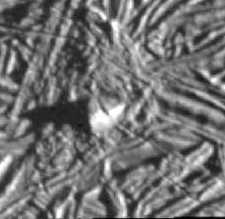
(200 yards). Other features include a hill in the center of the picture
about 480 meters (500 yards) high. Two mounds about 6 kilometers across (4
miles) are seen in the bottom of the picture. The ridges, hills and mounds
probably all represent uplifts of the icy crust of Europa by processes
originating from the interior.

Launched in October 1989, Galileo entered orbit around Jupiter on December
7, 1995. The spacecraft's mission is to conduct detailed studies of the
giant planet, its largest moons and the Jovian magnetic environment. The Jet
Propulsion Laboratory, Pasadena, CA manages the mission for NASA's Office of
Space Science, Washington, DC.
|
 Back to
