
Ancient Constructions1
Dragon houses
Remnants of an unknown culture, dwellings of dragons
which wandered around the mountains and the imagination of
ancient people, the dragon lairs of Evoia (Greece) are the silent
witnesses of a totally distinctive period in the island's
history. At the end of the 18th century, the English geographer
M.P. Haukings discovered the first of these enigmatic buildings
at the top of Mount Oche (1450 m) . Were they the residences of
gods or men? Shelters of quarrymen of funerary buildings? Temples
or shepherd dwellings? All we know is that they are cyclopean
constructions built on mountain peaks and craggy cliffs in
southwestern Evoia and that we are impressed and perplexed. The
identity of their builders is equally perplexing. Were they the
Dryopes, mythical residents of Karystia, who possessed the
know-how to construct these megalithic buildings? Or were they
the Carians, who were mountain people from Asia Minor, well known
for their architecture in Alicarnassus which shows several
similarities to the buildings in Evoia? So, up to today, the
paternity of these monuments still remains concealed within the
mists of the past.
The robust sizes of the stones, the use of large orthogonized
monoliths, and the skillful joinery indicate an environment of
competitive excellence. The uniqueness of the dragon lairs offers
convincing evidence that they were created by a local culture who
had remarkable skills in working with stone and great knowledge
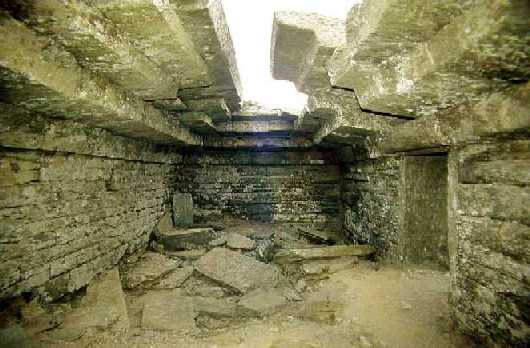
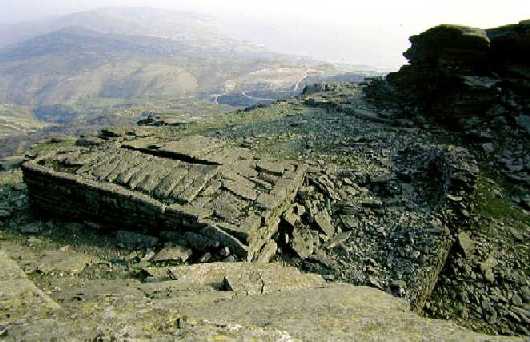
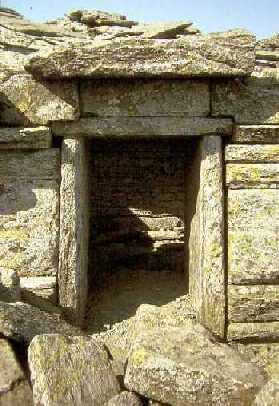
of architecture. The most famous dragon house is the dragon house
of Oche (see pictures). (The mid stone's dimensions of the
trilithon are 1.2 m x 2.3m x 0.25m and weights about 10 tn)
Our own incomplete knowledge about the specific monuments in
Evoia has created a veritable cornucopia of legends about when,
how and why they were constructed. Their recent use by shepherds
and the older stories about dragons reveal the multiple functions
served by the buildings through the centuries. We may justifiably
call Evoia a "Mystery Island", since many basic aspects
of his history remain unknown.
 |
 |
 |
(Click at the pictures for full size)
 The Fortress of
Sacsayhuaman
The Fortress of
Sacsayhuaman
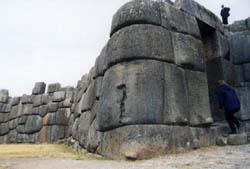
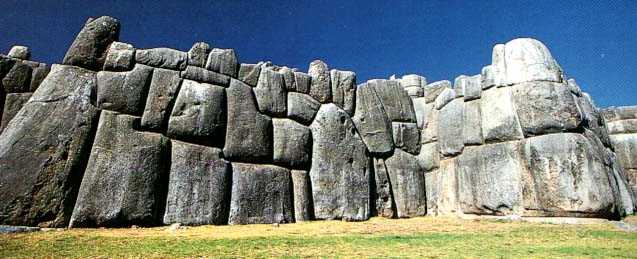
Sacsayhuaman is located only 2 kilometers from Cusco, the ancient
city of Peru and the distance can be walked in about 45-minutes,
although the climb is steep, and at an altitude of 3500 meters
(more than 10,000 feet above sea level). Sacsayhuaman is noted
for its irregularly-shaped, gargantuan stone blocks, one of which
weighs more than 300 tons. They are fitted together without
mortar, and the ones now remaining have withstood not only
attempts by the Spanish to knock them down, but also more than
half a millennium of earthquakes and other natural forces.
Pictured at the left is an entrance near which a serpent pattern
is carved into the rock. Almost exactly the same size as the
human brain and spinal column, this carving is believed to
represent the seven chakras, and it is said that the seven
gouged-out areas were once filled with gold, crystals and
gemstones.
(Click at the picture for full size)
Cyclopean
Walls
Mycenae, the
legendary home of the Atreides, is situated upon a small hill-top
on the lower slopes of Euboea Mountain, between two of its peaks,
on the road leading from the Argolic Gulf to the north (Corinth,
Athens, etc.).
The site was inhabited since Neolithic times (about 4000 BC) but
reached its peak during the Late Bronze Age (1350-1200 BC),
giving its name to a civilization which spread throughout the
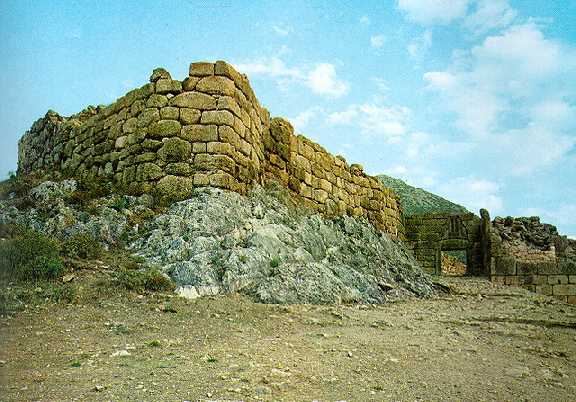
Greek world. During that period, the acropolis was surrounded by
massive "cyclopean" walls (Picture 1) which were built
in three stages (ca.1350, 1250 and 1225 BC) except on its SE
flank where a steep ravine provided natural defense.
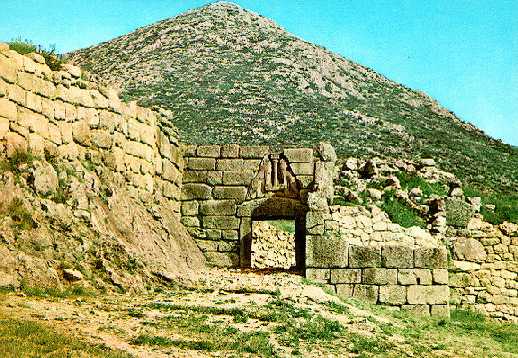
A palace was built on the summit of the hill while towards the
Argolic plain lay the wall - painted "Cult Center", the
main gate or "Lion Gate" (Picture 2) and "Grave
Circle A" which contained the treasures now displayed at the
National Archaeological Museum of Athens. On the NE side, a
tunnel leading to a subterranean fountain was built in
"cyclopean" masonry in around 1225 B.C.
More tombs, "Grave Circle B", and large tholoi as well
as houses were discovered outside the walls. Mycenae was occupied
without interruption until 468 B.C. when it was conquered by the
city of Argos and its population banished. It was reoccupied in
the 3rd century B.C. for a relatively short period. It had been
abandoned for some time when Pausanias visited the site during
the 2nd century A.D.
Who were these mighty builders? Pausanius said that "the
walls of Tiryns were built by the Cyclopes," and Euripides
called the plain of Argos the "Cyclopean land." The
identity of the Cyclopes is shrouded in mystery.
 |
 |
 Back
to Back
toAncient Structures |
Return to Ancient Mysteries |
