
A continent the size of Europe(?), boasting beautiful cities,
advanced technology and utopian government... subjected to a
great cataclysm and reduced to rubble that sank beneath the sea,
lost forever.The Greek philosopher Plato wrote of Atlantis in two
of his dialogues, "Timaeus" and "Critias,"
around 370 B.C. Plato explained that this story, which he claimed
to be true, came from then-200-year-old records of the Greek
ruler Solon, who heard of Atlantis from an Egyptian priest. Plato
said that the continent lay in the Atlantic Ocean near the
Straits of Gibraltar until its destruction 10,000 years previous.
In "Timaeus," Plato described Atlantis as a prosperous
nation out to expand its domain: "Now in this island of
Atlantis there was a great and wonderful empire which had rule
over the whole island and several others, and over parts of the
continent," he wrote, "and, furthermore, the men of
Atlantis had subjected the parts of Libya within the columns of
Heracles as far as Egypt, and of Europe as far as
Tyrrhenia."
 Plato goes on to tell how
the Atlanteans made a grave mistake by seeking to conquer Greece.
They could not withstand the Greeks' military might, and
following their defeat, a natural disaster sealed their fate.
"Timaeus" continues: "But afterwards there
occurred violent earthquakes and floods; and in a single day and
night of misfortune all your warlike men in a body sank into the
earth, and the island of Atlantis in like manner disappeared in
the depths of the sea."
Plato goes on to tell how
the Atlanteans made a grave mistake by seeking to conquer Greece.
They could not withstand the Greeks' military might, and
following their defeat, a natural disaster sealed their fate.
"Timaeus" continues: "But afterwards there
occurred violent earthquakes and floods; and in a single day and
night of misfortune all your warlike men in a body sank into the
earth, and the island of Atlantis in like manner disappeared in
the depths of the sea."
Interestingly, Plato tells a more metaphysical version of the
Atlantis story in "Critias." There he describes the
lost continent as the kingdom of Poseidon, the god of the sea.
This Atlantis was a noble, sophisticated society that reigned in
peace for centuries, until its people became complacent and
greedy. Angered by their fall from grace, Zeus chose to punish
them by destroying Atlantis.
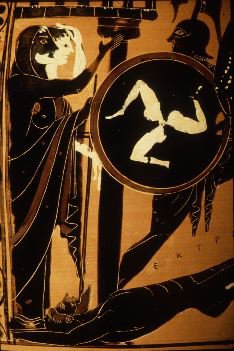
(Click at the picture for full size)
(Painting : King Priam and Hekabe, Achilles and Hektor)
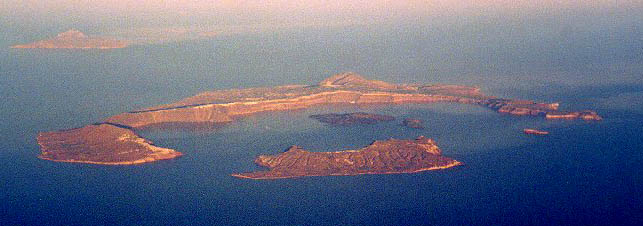 The
destruction of Atlantis may be related to a catastrophic Bronze
Age eruption in the Aegean Sea, the ~1630 BC eruption of
Santorini , is recognized as one of the most explosive volcanic
eruptions in historic times which generated a flooded caldera
and destroyed an advanced Minoan civilization living on the
island group of Santorini.
The
destruction of Atlantis may be related to a catastrophic Bronze
Age eruption in the Aegean Sea, the ~1630 BC eruption of
Santorini , is recognized as one of the most explosive volcanic
eruptions in historic times which generated a flooded caldera
and destroyed an advanced Minoan civilization living on the
island group of Santorini.
Professor Spyridion Marinatos started excavations in Akrotiri (Santorini or Thera) in 1967 to prove his theories of the demise of the Minoan civilization, and uncovered abundant well-preserved architecture, pottery and murals. By October 1, 1974, when he died, about 10,000 square metres of excavation had been roofed and some 17 buildings located.
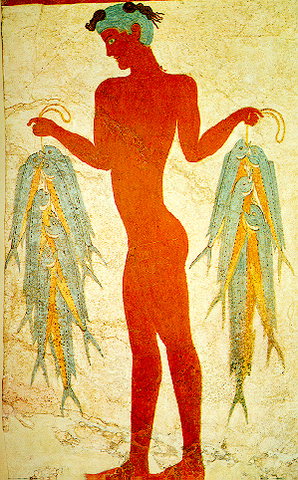
Akrotiri was an urban centre with 2 and 3 storey buildings, mostly residential and all decorated with wall paintings. Typically the ground floors and basements housed mills and grinders, workshops and store rooms, a kitchen and bath tub. To keep them cool, the rooms had a few small windows. Impressive staircases of stone or timber led to the upper stories. The walls were prepared for painting by smoothing with clay and broken straw and coating with plaster which was polished with pebbles. The paintings show men fishing and women gathering saffron. The men wore a loin cloth and the women, long flowing skirts, short sleeved bodices and necklaces, bracelets and earrings of gold, rock crystal and gemstones
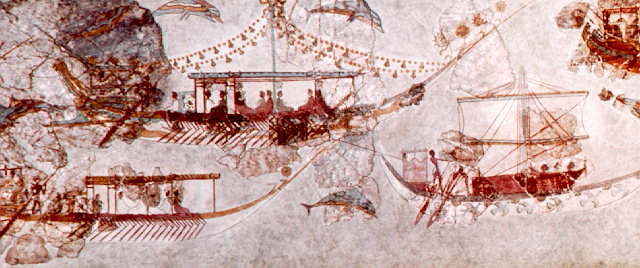
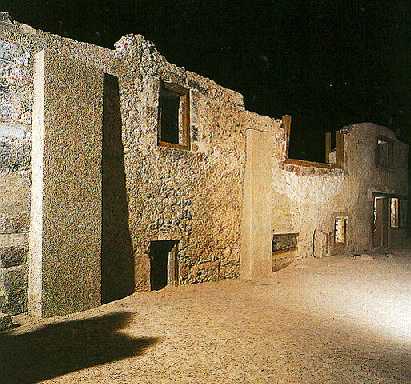 The
West House is a relatively small, but well-organized
building. In the ground floor there are storerooms, workshops, a
kitchen and a mill-installation. The first floor is occupied by a
spacious chamber used for weaving activities, a room for the
storage mainly of clay vessels, a lavatory and two rooms, the one
next to the other, embellished with magnificent murals. The first
was decorated with the two frescoes of the Fishermen, the fresco
of the Young Priestess and the famous Flotilla miniature frieze.
The latter ran around all the four walls and depicted a major
overseas voyage, in the course of which, the fleet visited
several harbours and towns. The rocky landscape, the
configuration of the harbour and the multi-storeyed buildings
identify the port, which is the fleet's final destination, as the
prehistoric settlement at Akrotiri. The walls of the second room
were decorated with a single motif which was repeated eight
times. This motif is identified as the cabin at the stern of the
ships depicted in the miniature frieze.
The
West House is a relatively small, but well-organized
building. In the ground floor there are storerooms, workshops, a
kitchen and a mill-installation. The first floor is occupied by a
spacious chamber used for weaving activities, a room for the
storage mainly of clay vessels, a lavatory and two rooms, the one
next to the other, embellished with magnificent murals. The first
was decorated with the two frescoes of the Fishermen, the fresco
of the Young Priestess and the famous Flotilla miniature frieze.
The latter ran around all the four walls and depicted a major
overseas voyage, in the course of which, the fleet visited
several harbours and towns. The rocky landscape, the
configuration of the harbour and the multi-storeyed buildings
identify the port, which is the fleet's final destination, as the
prehistoric settlement at Akrotiri. The walls of the second room
were decorated with a single motif which was repeated eight
times. This motif is identified as the cabin at the stern of the
ships depicted in the miniature frieze.
 |
 |
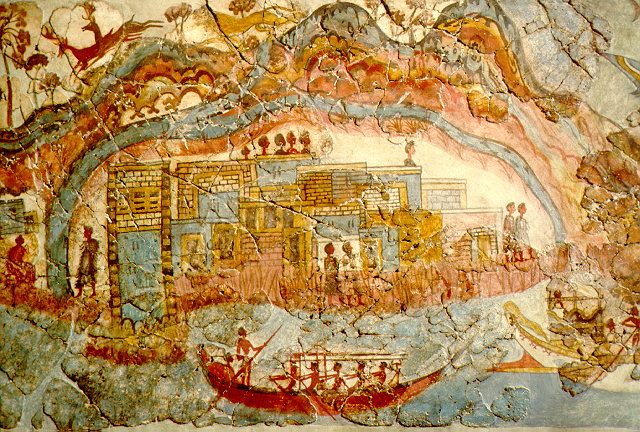 |
| Fisherman | Flotilla miniature frieze | The City |
We do not know what happened to these people. So far, no human body has been found killed by the eruption. It seems that they had been warned in time to evacuate the island.
 Back
to Back
toAncient Man-Species |
Return to Ancient Mysteries |