
Ancient Astronomy's Mysteries
| The Antikythera Mechanism | The planetary system | The Mallia Table | Last Update:24/07/2001 |
 The Antikythera Mechanism
One of the most important and interesting pieces of ancient
technology, used possibly as an astronomical and calendar
calculator. Mechanically, it is a most complex mechanism
incorporating 32 gear-wheels as well as inscriptions related to
the zodiac and the months. Discovered in 1900-1901 by sponge
divers from Syme in an ancient shipwreck near the island of
Antikythera. Dated to ca 80 A.D
(Click at the pictures for full size)
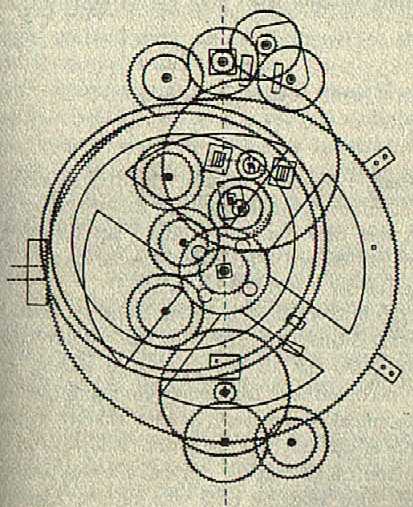 The
mechanism consisted of a box, the external faces of which bore
metal plates that were scaled. On these plates (9) and on the
flaps of the box, various signs were engraved, as well as names
of months, constellations, signs of the zodiac, names of the then
known planets, winds, indications for the equinox and the times
certain constellations appeared and disappeared on the sky .The
mechanism laying in the box consists of 30 toothed wheels (10)
the diameter of which varies from 9 to 132 mm. The most
impressive feature of the mechanism is its differential gear
system (11) accepting two different rotations. This gear is a
characteristic evidence of the high technological standards of
the whole structure. These toothed wheels were set in motion with
the aid of a hand operating shaft and rotated at a different
speed each, putting in motion in their turn other shafts and
indicators on the scaled plates vesting the surface of the box.
So this machine is a Calendar Computer of great accuracy, showing
also the movements of the sun, the earth, the moon, and the main
constellations in their different phases. It is noticeable that
Arthur Clark said about it that although 2000 years passed, this
item represents a level of technological development that the
western technology only reached during the 18th
Century.
The
mechanism consisted of a box, the external faces of which bore
metal plates that were scaled. On these plates (9) and on the
flaps of the box, various signs were engraved, as well as names
of months, constellations, signs of the zodiac, names of the then
known planets, winds, indications for the equinox and the times
certain constellations appeared and disappeared on the sky .The
mechanism laying in the box consists of 30 toothed wheels (10)
the diameter of which varies from 9 to 132 mm. The most
impressive feature of the mechanism is its differential gear
system (11) accepting two different rotations. This gear is a
characteristic evidence of the high technological standards of
the whole structure. These toothed wheels were set in motion with
the aid of a hand operating shaft and rotated at a different
speed each, putting in motion in their turn other shafts and
indicators on the scaled plates vesting the surface of the box.
So this machine is a Calendar Computer of great accuracy, showing
also the movements of the sun, the earth, the moon, and the main
constellations in their different phases. It is noticeable that
Arthur Clark said about it that although 2000 years passed, this
item represents a level of technological development that the
western technology only reached during the 18th
Century.
 The Mallia Table
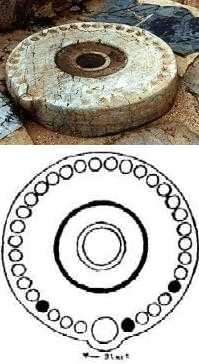
The Mallia Table was discovered in the Central Court of the
Minoan Palace of Mallia on Crete. It is a large limestone disk 90
centimeters in diameter and 36 centimeters thick. Around its
circumference are 33 cups of equal size. A 34th. cup is larger
and is located in a sort of ear that extends beyond the normal
circumference of the disk. The larger cup is oriented due south.
The disk is set in the stone pavement of a small terrace that is
slightly elevated above the level of the Central Court. This
strange monolith, which dates circa 1,900-1,750 BC, has been a
puzzle to scholars since its discovery in 1926 by French
excavators.
C.F. Herberger's thesis is that the disk is a lunisolar clock. The 33 small cups provide a convenient and symmetrical division of the 99 lunation's of the 8-year cycle. By moving markers, one could have a fairly accurate lunisolar clock. The 34th. cup, by virtue of its larger size, would announce the need for an intercalcated month. This sort of clock, even though arrived at empirically, represents a remarkable innovation for a period almost 4,000 years ago.
(Click at the picture for full size)
More Astronomy's Mysteries ? : Ancient Alien Visitors : The Dogons, The Dropas, The Yellow Emperor
 Back
to Back
to Ancient Technological Mysteries |
