Jump:
To whom do we belong? This is the core question of the spiritual life. Do we belong to the world, its worries, its people and its endless chain of urgencies and emergencies, or do we belong to God and God's people? This question is not too difficult to answer. Our milieu - the persons and events we talk and agonize about, rejoice in and give thanks for - reveals to whom we truly belong. The tragedy is that for most of us this milieu is far from the divine milieu.
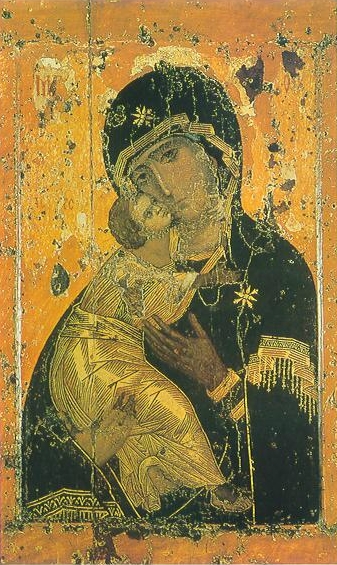
The icon of the Virgin of Vladimir has gradually become for me a strong yet gentle invitation to leave the compulsive and divisive milieu of the world, and to enter the liberating and uniting milieu of God. Over the years I had seen the icon in so many homes, rectories and convents that I hardly paid any attention to it. As familiar as a crucifix, the icon had lost most of its "converting power" for me. But when during a long, silent retreat a large reproduction of the Virgin of Vladimir was placed on my table, I gradually began to discover the inner nature of the icon. As I prayed daily to the Virgin, I felt drawn into its mysterious intimacy and came to "know by heart" its urgent invitation to belong to God.
The icon, also know as "Our Lady of Tenderness," is one of the most venerated of all Russian icons. It was painted by an anonymous Greek artist at the beginning of the 12th century. Around the year 1183 it was brought from Constantinople to Kiev, and about 20 years later from Kiev to Vladimir where it stayed until 1395. Although the icon has been in Moscow for the past six centuries, it is still called "The Virgin of Vladimir." This sacred national treasure has miraculously escaped many fires and plunderers. It has undergone several restorations, yet the faces of the mother and child are still those of the original Byzantine masterpiece.
Contemplating this icon was a profound experience for me. It was the experience of being lifted up through the intercession of the Blessed Mother into the inner life of God. In trying to give words to this experience I shall follow the movements of my contemplation: the movement from the Virgin's eyes to her hands, from her hands to the child and from the child of the Virgin back to her eyes. These movements revealed to me the answer to the question: To whom do I belong?
As a strongly psychologized contemporary person, I always seek eye contact with those I meet. It makes me feel accepted, or at least taken seriously. But as I tried to make eye contact with the Virgin of Vladimir, I realized it was impossible. At first this greatly disturbed me. I wanted her to look at me, to notice me as a unique individual and to know me as her personal friend. But the Mother of God did not look at me. In stark contrast to most of the Renaissance madonnas, whose familiar look engages us in an interpersonal relationship, the Virgin of Vladimir does not enter into our familiar reality; she invites us to enter with her into the eternal life of God. Her eyes look inward to the heart of God and outward to the heart of the world, thus revealing the unfathomable unity between the Creator and the creation. They see the eternal in the temporal, the lasting in the passing, the divine in the human. Her eyes gaze upon the infinite spaces of the heart where joy and sorrow are no longer contrasting emotions, but are transcended in spiritual unity.
The meaning of Mary's gaze is further accentuated by the bright stars on her forehead and shoulders (only two are visible; one is covered by the child). They not only indicate her virginity before, during, and after the birth of Jesus, but also speak of a divine presence that permeated part of her being. She is completely open to the divine Spirit, making her innermost being completely attentive to the creative power of God. This being mother and being virgin are no longer mutually exclusive. On the contrary, they bring each other to completion. Mary's motherhood completes her virginity, and her virginity completes her motherhood. That is why she carries in Greek the highest title that a human being has ever received: Theotokos, "The Bearer of God."
Praying to the Virgin of Vladimir, we learn that although she is not looking at us, she is truly seeing us. She sees us with the same eyes she sees Jesus. They are the eyes which saw her Lord before it became flesh in her and sensed God within before she heard the angel's message. With these eyes the Virgin sees the child. Her gaze is not that of a proud mother of an exceptional baby; she sees him with the faithful eyes of the Mother of God. Before seeing him with the eyes of her body, she saw him with the eyes of faith. That is why the Sacred Liturgy continues to praise Mary as the one who conceived God in her heart before she conceived God in her body.
As Mary sees Jesus, so she sees those who pray to her: not as interesting human beings worthy of her attention, but as people called away from the darkness of sin into the light of faith, called to become daughters and sons of God. It is hard for us to relinquish our worldly identity as noteworthy people and accept our spiritual identity as children of God. We so much want to be looked at that we are ill prepared to be truly seen. But the eyes of the Virgin invite us to let go of our old ways of belonging and accept the good news that we truly belong to God.
The Virgin's hands were the second aspect of the icon to become significant for me. It is impossible to pray long with the icon without being drawn to her hands.
One hand supports the child while the other remains free in an open gesture of invitation. At first I thought the Virgin pointed to Jesus with her open hand. I now realize that the word "point" misrepresents the true meaning of her gesture. She is not simply asking attention for her Son, nor is she directing us to him. That would be too external, manipulative and controlling. I have slowly come to see the Virgin's gesture as a gentle invitation to move closer to Jesus and discover in that movement to God to whom we belong.
Although it appears that the Virgin occupies the center place, prayerful attention reveals that her presence is totally and exclusively for the child. Mary is the mother of Jesus. Her hand does not teach, or explain, or plead. Her hand simply offers the child as the Savior of the world to all who are open too seeing Jesus with the eyes of faith.
The hand of Mary which occupies the heart of the icon is indescribably beautiful. In its centrality it summarizes the entire icon. It makes the whole image into an expression of Mary's song: "My soul proclaims the greatness of the Lord and my spirit exults in God my savior" (Lk 1:46) and gathers everything into an invitation to worship. It says: "Praise Jesus, thank Jesus, glorify Jesus, ask from Jesus, plead with Jesus, and always, always pray to Jesus." But it says all of this in the way a mother speaks to her children, not forcing them, but creating a space for them where they can find in themselves the desire for this unceasing worship.
The Virgin's eyes are not curious, investigating or even understanding, but eyes which reveal to us our true selves. Likewise her hands are not grasping, demanding or directing, but hands which open a space for us to approach Jesus without fear.
When we pray before the icon, the guiding hand of Mary increases in importance. She keeps moving closer to Jesus , as if saying: "I am only here to lead you to Jesus." Mary wants us to let go of our fears and to trust - as she did - that "the promises of the Lord will be fulfilled" (Lk 1:45). As our attention moves from her eyes to her hands, we slowly recognize her profound patience. The word "patience" comes from the Latin pati which means to suffer. Just as the body of the risen Lord still carries the wounds of his suffering, so too is the glorified Mother of God a woman whose heart has been pierced by sorrow. She knows what it means to be poor, oppressed, a refugee, to be uncertain and confused about the future, to be kept at a distance, to stand under the cross and to be the bearer of thoughts and feelings that cannot be shared with anyone. These sufferings liner in the gaze of her eyes and the gesture of her hands, not as frightening pain but as glorified signs of her patience.
Therefore, she is mother not only to her crucified son, but to all women and men who suffer in this world. She invites us, suffering people, to come to Jesus. She does not push us with an impatient gesture, but simply invites us as someone who fully knows our fears, hesitations, agonies, suspicions and insecurities. She is the patient mother who waits for the right time to receive our "Yes." But her patience is strong, unwavering and persevering. Her hand is always there at the heart of the mystery of the Incarnation, inviting us to come to Jesus who is the way to the house of God where we truly belong.
Finally we can see the child. The Virgin's eyes and hands derive their profound significance from the child. While it may appear at first that the child is secondary, a prayerful viewing of the icon reveals that the child gives meaning to all that surrounds him. It is a moving experience to have the child, who is initially dwarfed by Mary, emerge not only as ht Lord of his own mother, bit also as the Lord of all people and all that exist. I continue to be amazes at how the child, with his luminous face and golden mantle, could remain "hidden" for so long within the curving lines of the Virgin. Now I can hardly look at the icon without seeing the child as the older, wiser and stronger one. Now the mother has become the one who introduces the Holy One to us and remains as a reverent distance.
It is easy to see that the child is not an infant. He is a wise man dressed in adult clothes. Moreover, the luminous face and golden tunic indicate that this wise man is truly the Word of God, full of majesty and splendor. He is the Word made flesh, the Lord of all ages, the source of all wisdom, the Alpha and Omega of creation, the Glory of God. All is light within and around the child. In the child there is no darkness. He is, in the words of the Council of Nicea, "God from God, Light from light, true God from true God."
Contemplating the child of the Virgin of Vladimir is like discovering a light that was always there but could not be seen because of previous blindness. Look at the face of the child! A splendid light falls from the right side of the icon, gently toughing the nose of the Virgin and illuminating the face of the child. But light also comes form within. It is an inner glow that shines outward and deepens the intimacy between mother and child already expressed by the tender embrace. The light illumines and gives warmth. There is no sudden, intrusive flash, but the gradual appearance of a tender and radiant intimacy. This light-giving intimacy has not only made the icon a masterpiece in the history of art, but more importantly has drawn countless people into prayerful communion with their Lord. Faithful people from all over the world for nine centuries have come to this sacred image to be consoled and comforted by its life-giving tenderness.
But there is much more! The divine child is giving himself completely to the Virgin. Her arm holds her in an affectionate embrace, his eyes are fixed on hers with complete attentiveness, and his mouth is close to hers, offering her his divine breath. How close to the mystery of the Incarnation is this vision of God's total, unrestricted care for humanity! This sacred image reverberates with the prayer of Jesus to his Gather for his disciples:
"When the Paraclete comes,
whom I shall send to you from the Father,
the Spirit of truth who issues from the Father,
he will be my witness" (Jn 15:26).
Jesus presents all his divine wisdom to the Mother of humanity. All he has received he gives, all he has seen he reveals, all he has heard he speaks, all he is, he offers. It also reverberates with Jesus' promise:
"If you ask for anything in my name,
I will do it" (Jn 14:14).
Yet Jesus not only gives everything, he also receives everything. He not only says everything he has heard, he also hears everything that is said to him. He not only reveals everything he has seen, he also illumines everything that is shown to him. Nothing that comes to him from the Virgin escapes his divine attention. Everything she shows him is received, heard and understood. Hence the Virgin is the spokesperson of humanity, the mother who intercedes for her children whatever their sorrows may be.
The tender embrace of mother and child is far from a sentimental event. It is the portrayal of the mysterious interchange between God and humanity made possible by the Incarnation of the Word.
The deep and lasting quality of this interchange becomes visible in the heavy neck of the child. This child's neck is painted so large because it represents the Holy spirit. Spirit means "breath." They Holy Spirit is the breath of God. It is this divine breath which Jesus offers to humanity:
"It is for your own good that I am going
because unless I go
the Paraclete [the Spirit] will not come to you;
but if I do go,
I will send him to you" (Jn 16:7).
Jesus not only offers his light to humanity he offers his breath, his innermost life, so that we may truly belong to him as brothers and sisters and as sons and daughters of his heavenly Father.
The eyes of the Virgin drew our attention to her hands, her hands drew our attention to the child and the child leads us back to her who speaks to her Son in the name of all humanity.
I have stressed that through prayerful attention we come to see that the child is the one to whom we are asked to go, and that the child offers us - represented by the Virgin - the gift of his own breath, which is the spiritual life.
But what about the Father, the one who sent the Son and whose love for the son is the Holy Spirit? The Father is not absent! On the contrary, he is fully present, omnipresent in fact. We hardly notice his presence unless we dare to see the image as a whole. When we view it from a distance, we see that the Virgin and child are painted in the form of a triangle placed in a rectangular frame. The rectangular frame represents the world, loved by God but held captive by sin and the powers of evil. The triangle, within which the mystery of the Incarnation is expressed, show the redemptive presence of the triune God: Father, Son and Holy Spirit. Although the Father is not directly visible, the geometric form of the icon reveals the Father as the divine iconographer of our redemption.
Thus "The Virgin of Vladimir" is the iconographic articulation of Jesus' words to Nicodemus:
God loved the world so much
that he gave his only Son,
so that everyone who believes in him
may not be lost But may have eternal life (Jn 3:16).
What else is eternal life than to be lifted up into the house of God and made a participant in the intimate communion among the Father, the Son and the Holy Spirit? This is what belonging to God truly means. To this belonging Our Lady of Vladimir invites us.
Excerpt from BEHOLD THE BEAUTY OF THE LORD: PRAYING WITH ICONS (pp31-42)
Henri JM Nouwen (1987), Ave Maria Press.