 Client-Server Architecture
An architecture in which the user's PC (the client) is the requesting machine, and the server is the supplying machine, both of which are connected via a local area network (LAN) or a wide area network (WAN) such as the Internet.
Client-server network is:
Disadvantages of a Client/Server
Expense - Requires initial investment in dedicated server.
Maintenance - Large networks will require a staff to ensure efficient operation.
Dependence - When server goes down, operations will cease across the network
Advantages of a Client/Server
Centralized - Resources and data security are controlled through the server.
Scalability - Any or all elements can be replaced individually as needs increase.
Flexibility - New technology can be easily integrated into system.
Interoperability - All components (client/network/server) work together.
Accessibility - Server can be accessed remotely and across multiple platforms.
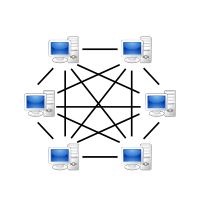 Peer to peer Architechure
Definition :
1. A network model in which all computers can function as
clients or servers as needed, and there’s no centralized
control over network resources.
2. Is a simple, inexpensive network that typically connects
fewer than 10 computers.
Advantages of a peer-to-peer network:
Less startup cost to setup the network architecture - No need for a server.
Easy to Setup up - An operating system (such as Windows XP) already in place may only need to be reconfigured for peer-to-peer operations.
Disadvantages of a peer-to-peer network:
Decentralized - No central repository for files and applications.
Less Security - Does not provide the security available on a client/server network