On The Road Again2
After my first "excellent adventure" on the road in a campervan, I was able to talk Kay into taking a trip with me. We decided on visiting Western Australia and then also be able to visit with her elder son and his new family in Perth, the capital city of Western Australia (WA).
So Kay, Swanny and Jack set off for another 5 weeks on the road. This trip would be about as "outback" as you can get!!
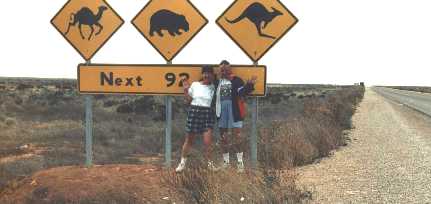
Nullabor Plains
To get from SA to WA via motor vehicle (or train), it is necessary to cross the Nullarbor Plain, which stretches along the inland from the Great Australian Bight. The name Nullabor is not Aboriginal as is often assumed - but comes from the Latin words "nulla arbor" which means "no trees" This expanse of treeless plains extends about 200,000 square kilometres.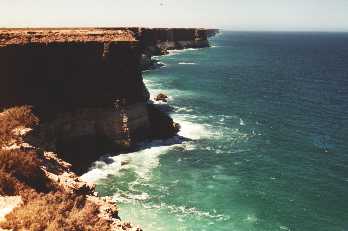
The area between Yalata Roadhouse and the Nullabor Roadhouse is quite spectacular during the whale watch season - and at this very time (September, 1998) there have been reports of pods of over 120 whales and calves swimming offshore. There is a wonderful whale watch station at the Head of the Bight which is attracting a lot of interest with both Australian and visitors from overseas. May through to November is apparently the season for the migration of the southern right whale.
The cliffs along the Nullabor are within 400 metres of the highway and range in height from 90 - 130 metres for a distance of over 200 kms.
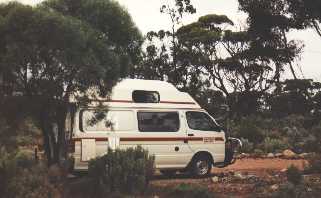 Dusk, and here is our little camper van settling down for the night. This was our first night off the Nullabor and over the border into Western Australia and we experienced a fierce electrical storm. Coupled with the headlights from the Road Trains (semi trailers with up to 3 trailers on them) we were treated to a most amazing light show. The headlights from vehicles show up miles before they drive past and as there is no other light pollution out here - the Milky Way looks more like thin cloud than what we are used to seeing in the cities.
There have been many reported sightings of UFO's by travellers across the Nullabor - but many sightings are passed off by the sceptics as just reflected light from the passing traffic.
******
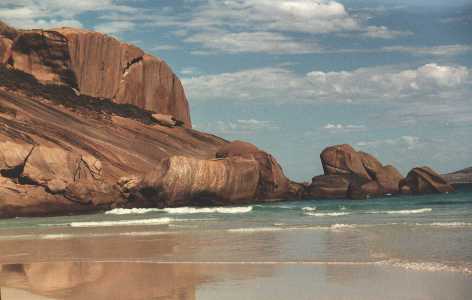
Esperence, Western Australia
- Of all the photographs I took on this trip - this one is my very favourite. A lot of the waters around Esperence are not suitable for swimming as there are many rips and tides and the beaches are not patrolled by Life Savers (a purely voluntary task here in Oz).Esperence became a boom town during the 1890's with miners from the Eastern states landing in this pretty port, buying supplies and then heading for the goldfields of Coolgardie.
In 1979 pieces of Skylab, the United States first space station, fell around the area and are on display in the Municipal Museum. There is a wonderful "Wind Farm" at Salmon Beach. This is the first commercially operated wind generated electricity supply in Australia. Esperence is the second windiest place in Western Australia and the electricity generated by the windmills saves on using fuel oil at the local diesel power station.
******
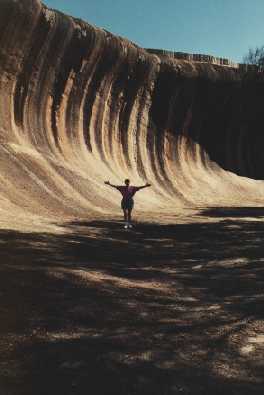
Wave Rock
is in the wheat growing area of Hyden. The local area is supplied with water from a reservoir built at the base of this rock. Along the top of the rock extends a 60 cm high retaining wall. Rainwater then channels off the rock along the wall and into the catchment area.There is an excellent camp ground within the Park area, and considering how remote the area is, the park is well set up with solar powered hot water in the showers and fresh drinking water. There are powered and unpowered sites and also a general store with a quaint museum of early colonial items on display.
Western Australia is known as the "Wild Flower State" and when we visited the local tourist centre at Wave Rock we soon discovered why. The whole ceiling is lined in dried wildflowers and grasses and worked into the most amazing pattern. Well worth a visit.
******
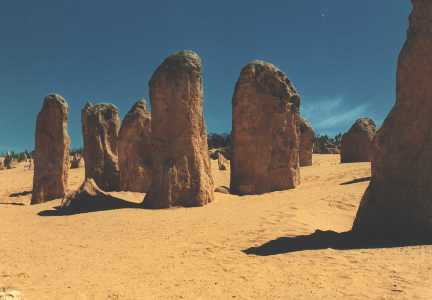
The Pinnacles
Travelling North up the coast from Perth, just outside the little town of Cervantes (named for the wreck of an American whaling ship) is The Nambung National Park. As it is accessible by 4 wheel drive vehicles only, we left Jack to mind the campervan and joined one of the many tours available.The Pinnacles are estimated to be aged between 15,000 and 80,000 years and are of limestone. There are thousands of them - some 20 foot high and others just barely showing above the shifting sand dunes.
We were told (and shown a most spectacular photograph) of a Japanese pianist who visited the area along with sound and lighting technicians and a film crew. They set up generators and flood lights around one area of the park, brought in a Grand Piano. He sat down, played one piece of classical music and then they packed everything up again leaving the park as unspoiled as they had found it. Apparently this was for a "live" crossover to a television station in Japan!!