PET THERAPY
 Getting
involved in a Pet Therapy Program is very rewarding. We have been taking our
Miniature Horses to our local Personal Care Home for summer visits for many
years but in Manitoba, it is not feasible to do this year round. During these
visits we brought along our little dogs as well. Most seniors have had horses
and dogs over the years and it is a joy for us to see their faces light up when
they can touch, smell and interact with our pets. When the Facility decided to
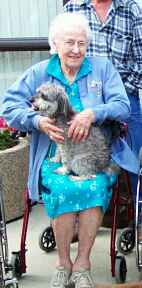
start a Pet Therapy Program we were delighted to have our small dog “Elmo” become a
regular participant. He is very sociable and many residents look forward to his
visits.
Getting
involved in a Pet Therapy Program is very rewarding. We have been taking our
Miniature Horses to our local Personal Care Home for summer visits for many
years but in Manitoba, it is not feasible to do this year round. During these
visits we brought along our little dogs as well. Most seniors have had horses
and dogs over the years and it is a joy for us to see their faces light up when
they can touch, smell and interact with our pets. When the Facility decided to
start a Pet Therapy Program we were delighted to have our small dog “Elmo” become a
regular participant. He is very sociable and many residents look forward to his
visits.
I will try to give you an idea of what is involved in a Pet Therapy Program and
who knows, perhaps you will want to participate at a facility near you.
As our population ages it is becoming increasingly obvious that the most serious
ailment for the elderly is not heart disease or cancer, but loneliness. Love and
companionship are seen as two of the most important factors for remaining in
good emotional, physical and mental health.
Any domestic animal may be suitable for visits but presently dogs are the most
common. Analysis of programs has shown that patients who receive regular visits
from a pet are more receptive to treatment. Depressed residents who were
unwilling to work to regain lost skills resulting from a stroke are much more
co-operative when therapy involves stroking a pet. Pets encourage both love and
acceptance, which affects self-esteem. Improved self-esteem may give a patient
the incentive to recover and the will to live.
Pet visitation programs in nursing homes have led to increased self-care
activity and mobility among the resident population. Those who have
Alzheimer’s disease may feel lonely and emotionally isolated, but a pet loves
people unconditionally. For those who cannot or choose not to speak, petting and
holding an animal is a gratifying experience. Pets make it easier for strangers
to talk. They often help begin a conversation between a resident and a volunteer
that may make the resident feel better just knowing someone is there solely to
listen.
Pet therapy has two visiting formats. It may involve group interaction or be on
a one-to-one basis. Both formats consist of similar activities, but differ in
the amount of time spent with each participant and the intensity level. Elmo and
I have the freedom to move about the building to visit residents wherever they
may be, in their rooms or with a group in the lounge areas, which enables
residents who are in poorer physical condition or those have limited mobility to
participate.
Some of the benefits of pet therapy are:
Provides companionship and affection
Increases self-care activities
Helps alleviate stress, anxiety, loneliness and depression
Is a good source of entertainment
Increases mobility
May increase motivation
Is a source of laughter and conversation
Provides a diversion from troubling thoughts
Encourages exercise
Aids in relaxation
Decreases blood pressure
May increase responsiveness to therapy
Restores self-concept
Increases awareness in the cognitively impaired
Decreases social withdrawal
To
be accepted as a therapy dog, the dog must complete the following elements:
Accepts
a friendly stranger
Good
appearance and grooming
Able
to walk on a loose leash
Capable
of walking through a crowd, including wheelchairs
Ability
to sit down and stay on command
Sits
politely for petting
Calms
quickly after becoming excited
Reacts
appropriately to other animals
Doesn’t
become distracted by noise, smells, etc.
They
also will:
Enjoy
meeting strangers
Show
interest in unusual events but calm down quickly
Be
reliable around other dogs, animals and people
Feel
comfortable amidst unfamiliar sights and sounds
Trust
and have confidence in his/her handler
The
most important aspect of pet therapy is that the people whom the animal visits
must be absolutely safe from the animal. Pets must be forgiving of accidental or
intentional incidents. It is the handler’s job to prevent injury to both the
pet and the person being visited.
For many of us, our pets are considered members of our families. For some
elderly persons, a pet may be the only family they have. It is obvious that
there are many benefits to using animals as part of a therapeutic team to help
treat and care for the needs of an elderly population.