|
"As far as the laws of mathematics refer to reality, they are not certain; and as far as they are certain, they do not refer to reality." Albert Einstein
"Only the imagination can bridge the gap between mathematics and reality." SUNRISE
There has been talk for a long time of something mysterious in the light. It has been briefly touched upon in our UFO CD. Effects of light bending and invisibility in the presence of UFOs are classic examples of this.
Ignoring the UFO situation, we do know that Albert Einstein was also no stranger to this mysterious "thing" in the light. He was fully aware there had to be something more to light than met the eye based on his thought experiments and how light behaved in certain physical experiments. Now, after more than 60 years after his death, there is scientific support for this mysterious thing. And its discovery will soon take the scientific world by storm thanks to the final great scientific theory from the greatest scientific mind of the 20th century and the interpretation from SUNRISE.
About the final great theory
In 1924, Albert Einstein completed his most ambitious and complex scientific achievement of the 20th century known as the Unified Field Theory. Published in 1929, Unified Field Theory is an attempt to explain the nature of gravity and all the known phenomena of the physical universe in terms of the laws of electromagnetism (1).
But did he succeed?
Scientists sceptical of Einstein's final great theory
To this day, scientists believe Einstein's final scientific masterpiece is a failure. Why? Because the mathematics behind the unified field equations are considered too complex (2). And anyway, there is too much work to keep the scientists preoccupied just with the General Theory of Relativity provided by Einstein in his earlier days. Add to this the difficulty in relating the mathematics of the unified field equations with reality to help identify experiments to support it, and most scientists are of the view Einstein had been unsuccessful in his attempt. (3)
Einstein may have succeeded
However, new evidence has come to light, quite literally, which may well show that Einstein's final great theory was indeed successful, and that its implications to science are only just beginning to be realised.
Are you ready for the next major scientific revolution of the 21st century?
Free research
Our essential results are available below:
- INTRODUCTION (1MB)
The Unified Field Theory is published
- THE DEVELOPMENT OF THE UNIFIED FIELD THEORY (9.7MB)
The mystery of light captures the imagination of Einstein
- THE INTERPRETATION OF THE UNIFIED FIELD THEORY (5.2MB)
The secret of oscillating electromagnetic fields
- A NEW EXPLANATION FOR GRAVITY (<1MB)
An alternative theory based on light
- A NEW EXPLANATION FOR QUANTUM WAVE-LIKE BEHAVIOUR (1.8MB)
Is light guiding quantum particles to follow a wave-like path?
- THE AGE PARADOX OF THE UNIVERSE (6.2MB)
Is the Universe infinite or finite in size?
- THE SECRET TO IMMORTALITY (<1MB)
Why do all living things age?
- DOES GOD EXIST? (2.5MB)
Is there a link between light and God?
- CONCLUSION (1.3MB)
Did Einstein succeed in his work?
CD Available
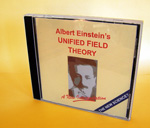 The full results are available on our CD (ISBN 978 0 646314 54 9). It contains the following information for all researchers and scientists: The full results are available on our CD (ISBN 978 0 646314 54 9). It contains the following information for all researchers and scientists:
- Original 1929 UFT paper by Einstein
- Carlos Allende letters and the story behind the Philadelphia Experiment
- Scientific articles relevant to this research
- Rare original unpublished paper by Dr Wilbert Smith on gravity control
- Rare original Einstein letter and school report
This CD is sold as non-profit (to recover research and publishing costs).
NOTES
- Einstein 1929, pp.2-7.
- Professor Tullio Levi-Civita published a simplified presentation of Einstein's Unified Field Theory which was translated into English. However, Levi-Civita was only a mathematician and could not interpret the results of Einstein's final great theory in a real world-view sense.
- Dr Cornelius Lanczos of the School of Theoretical Physics at the Dublin Institute for Advanced Studies confirms this current scientific belief when he said: 'In the meantime, "modern physics" continues to grow and advance without taking account of Einstein's unifying attempts and, in fact, denying even the possibility of such an attempt being successful.' (Lanczos 1965, p.118).
SAMPLE REFERENCES
Einstein, Albert. Einheitliche Feldtheorie: Preussische Akademie der Wissenschaften. Phys-math. Klasse, Sitzungsberichte, 1929, pp.2-7.
Huyghe, Patrick. The Black Hole in Earth's Backyard: Omega Science Digest. January/February 1983, pp.14-17.
Levi-Civita, Professor Tullio. 1949, A Simplified Presentation of Einstein's Unified Field Equations. London: Blackie & Son Limited.
Lanczos, Cornelius. 1965, Albert Einstein and the Cosmic World Order. New York: John Wiley & Sons, Inc.
|