FROM THE STARTING LINE OF 1971's CONCERTS FOR BANGLADESH, ROCK CRANKED INTO TOP GEAR WHILE HURTLINH ALONG THE ROAD TO RESPECTABILITY 1985's LIVE AID EARNED THE BOOMTOWN RATS' BOB GELDOF A KNIGHTHOOD. FURTHER BIG-NAME ALTRUISM INCLUDED SMALLER CONCERTS FOR RESEARCH INTO VARIOUS AILMENTS AND OMNES FORTISSIMO CHARITY 45s
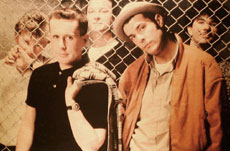 Frankie Goes To Hollywood. 'Relax' and 'Two Tribes' were No.1 and 2 in the UK charts for weeks in 1984. |
In the recessive years after punk, money could still be conned out of government aid to form a group, even if, in the same defeated climate, record companies were no longer chucked blank cheques about - except on dead certs like Dire Straits, Genesis and Stock-Aitken-Waterman creations by such as Rick Astley, Bananarama, Samantha Fox and Kylie Minogue. In Northern England, three cities - Sheffield (home of the Human League, ABC, Clock DVA and Heaven 17), good old Liverpool (Frankie Goes To Hollywood, the Christians, Orchestral Manoeuvres In The Dark) and Manchester (New Order, the Smiths, Happy Mondays, the Stone Roses) - all had periods of being where it's at, and Donegal in Eire cradled Clannad and Enya, chart exemplars of ethereal New Age music.
 Former soap-opera actress Kylie Minogue plugs her latest hit. |
New Tradition, a late development in country rock, encompassed the differing aptitudes of the Judds, k.d.lang, Randy Travis, Dwight Yoakam, Sweethearts Of The Rodeo and, most spectacularly, Garth Brooks, who were forsaking much of C&W's rhinestoned tackiness for a leaner, more abandoned approach. The USA also injected the most progressive serum into rock with the varying talents of the B52s, Laurie Anderson and the Kronos Quartet, while the UK did likewise with mainstream acts such as Bros, Wham!, Kim Wilde (daughter of Marty) and Duran Duran.
Though a case might be argued for Dublin's U2, geography and style did not polarize to any significant degree other incoming sounds such as the chameleon-like Dexy's Midnight Runners, the modern glam of Culture Club, Level 42 and Bryan Adams, whose workmanlike 'Everything I Do' was the mongest-reigning UK Number 1.
In an age of consumption over creativity, just recording a single and all its different mixes was the least of your worries. What about the TV commercial to go with it? The half-page advertisement in a national tabloid? For the video, do you project the artist in a dramatic situation or in a straightforward synchronization with a musical performance? Yet, no matter how it was tarted up - 12-inch megamix on polka-dot vinyl or whatever - the pop single had become a loss leader, an incentive for grown-ups to buy an album, hopefully on compact disc. Teenagers, you see, were no longer the market's most vital target group, having been outmanoeuvred by their Swinging Sixties parents and young marrieds who had sated their appetites for novelty. As in the pre-rock 'n' roll era, the young had to put up with pretty much the same music that their parents liked.
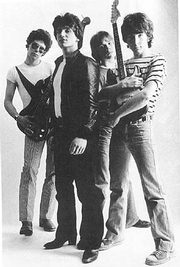 U2 began as a Dublin punk group and evolved into Eighties stadium stars. |
Rock's history as much as its present had been seized upon as an avenue for selling records. All it took, it seemed, was for a swarthy youth to take off his jeans in a launderette for a TV commercial, and British in the mid-Eighties was awash with nostalgia for the Sixties. At one stage, every fourth record in the UK Top 40 was either a reissue or a revival of an old chestnut. Resulting directly from snippet coverage in advertisements and movies were high chart placings for old discs by Ben E. King, Percy Sledge, the Hollies, the Steve Miller Band, Nina Simone, the Righteous Brothers and, from even further back, Eddie Cochran - all as out of step with the strident march of hip-hop, rap, acid house et al, as Viking long-ships docking in a hovercraft terminals.
In the States, jumping out of albums would be an artist's disposable revamp of an oldie, say, Cheap Trick's ham-fisted 'Don't Be Cruel' and Michael Bolton's Top 40 cover of Otis Redding's 'Dock Of The Bay'. In 1982, Van Halen touched Number 12 with Roy Orbison's 'Oh! Pretty Woman'; which the year before had resounded in the UK Top 10 as part of Tight Fit's 'Back To The Sixties' medley. Doing good business too were stylized musical plays like Elvis and Beatlesmania, and imitation acts that included numberless Elvis and Beatles clones and, more recently, Bjorn Again (Abba) and the Scottist Sex Pistols.
 Enya, commercial apogee of New Age music, sprang from the same Irish family that produced Clannad. |
Other performers were content simply to eulogize this or that old hero while buttressing their positions with a plausible influence. The sixtieth birthdays of Fats Domino and Chuck Berry were celebrated before television cameras in back-slapping fashion - though Joe Public might have preferred more typical recitals, unencumbered by the illustrious and more youthful friends who were giving the rock 'n' rollers a contemporary seal of approval to an almost palpable wave of goodwill.
Phil Lynott's 'King's Call' - about Elvis - and Psychic TV's 'Godstar' - on drowned Rolling Stone Brian Jones - will do as examples from what was a high summer of tribute discs. Moreover, two 45s by the Art Of Noise were collaborations with, respectively, Duane Eddy and Tom Jones. U2 cottoned on to blues sexagenarian B.B.King whose fretboard obligatos would tear at 1989's 'When Love Comes To Town', and the Kinks had been a source of hits for many groups including the Jam, the Pretenders and the Falll. Saddest of all was Sgt. Pepper Knew My Father, a charity LP on which Wet Wet Wet, Billy Bragg and other new acts stood on for the Lonely Hearts Club Band for a remark of the Beatles' most famous record.
For all their wrinkles, galloping alopecia and belts at the last hole, it was now not out of the question for stars no longer young to re-enter the hit parade with their latest releases, aided by soft-focus publicity shots, and at a pace which often involved vanishing into the studio for years on end. Polished and pleasant, such albums were never expected to be astounding.
With six Grammy nominations for his hi-tech Back In The High Life album, diffident former Traffic man Steve Winwood was on the boards again for a trans-continental tour - as were Bob Dylan, Paul McCartney, the Rolling Stones, Leonard Cohen, the Who and Paul Simon. From the Stones packing out Madison Square Garden to Bobby Vee on the chicken-in-a-basket trail, it seemed that all acts still intact from as far back as the Fifties had somehow become archetypal units of their own, spanning , with different emphases, every familiar avenue of their professional careers - all the big hits, every bandwagon jumped, every change of image. With repackaging factories in full production by then, it made as much sense to plug recordings 30 years old as well as the most recent album that ticket-holders may or may not have heard.
|
