THE LOOK HAS BEEN HAS IMPORTANT AS THE SOUND IN MANY STRATA OF POP. AS WELL AS THE NARCISSISM OF TEDDY BOYS AND THEN MODS, THERE WERE SHORTER-LIVED FADS IN WHICH CLOTHES AND MUSIC INTERMINGLED.
A craze for Victorian military uniforms precipitated the climb of the New Vaudeville Band's 'Winchester Cathedral' and similar olde tyme whimsy into 1966's hit parade. Previous to this, Jonney Kidd and the Pirates had gone in for nautical stage outfits with galleon backdrop - while Oregon's Paul Revere and the Raiders would, as obviously, don eighteenth-century frock-coats and tights. With each succeeding single after 1968's 'Legend Of Xanadu', Dave Dee, Dozy, Beaky, Mick and Tich would present a different costume drama on British TV's Top Of The Pops
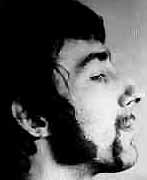 A quiet moment backstage with the Crazy World Of Arthur Brown. |
Theatre was also an integral part of the show for such as the Bonzo Dog Doo-Dah Band, Pink Floyd, the Crazy World of Arthur Brown and Peter Gabriel's Genesis. Ex-art student Pete Townshend acknowledged auto-destructive artist Gustav Metzger as the doubtful inspiration for the Who's practice of smashing up their equipment amid smoke bombs, flashing lights and feedback lament. Fellow Mods the Creation climaxed their act in more two-dimensional manner by splashing an action painting on to a canvas before setting fire to it.
As if it reciprocation, many genuine daubers and other academics were intrigued by pop. Fine art undergraduate Bryan Ferry was to cut his teeth with northeast soul combo the Banshees before forming Roxy Music - and Andy Warhol's sponsorship of New York's decadent Velvet Underground was yet another deliciously sordid tangent to his Pop-Art pot-pourri and media manipulation.
In the hung-over morning after the Swinging Sixties, multitudes demonstrated tacit weariness of heavy metal, pomp-rock and doe-eyed singer-songwriters by scouring junk shops and jumble sales for over-looked artefacts from earlier rock eras to keep the drab Woodstock generation present at bay. A further sign of disassociation from contemporary pop was the popularity of two 1973 films: That'll Be The Day, a poignant evocation of provincial England in the late Fifties, and American Graffiti, which recreated 1962 in a California town. Attempts were made to arrange and perform the old-fashioned sounds by British Teddy Boy revivalists like Crazy Cavan and Shakin' Stevens. In the US, Sha Na Na, Cat Mother and Flash Cadillac were also carrying a torch for the Fifties.
Along with the establishment of vintage record shops, retrospectives in pop journals and the snowballing of more erudite "fanzines", hap-hazard cells of archivist-performers became more cohesive. There were also overturns to spent forces like Bill Haley and Little Richard to appear on nostalgia revues. On the cards too were lucrative "British invasion" reunion tours of the States. By acquiring the rights to ancient catalogues, K-Tel and similar conglomerates specializing in reissues triggered album chart triumphs by the repackaged likes of the Beach Boys, Eddie Cochran, the Dave Clark Five and Roy Orbison.
These often nestled uneasily between the latest by mid-Seventies heart-throbs like David Cassidy, the Osmonds and the Jackson Five. Resplendent in outsize bow-ties and half-mast tartan trousers, the Bay City Rollers were hyped as "the new Beatles" and, for several months, "Rollermania" was rampant among UK schoolgirls - but, with the exceptions of Abba and the youngest Jackson brother, none of these sensations shaped up as either new Beatles or new Elvi.
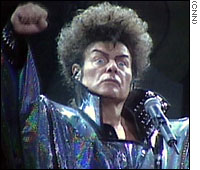 Gary Glitter, godfather of glam. |
Cassidy vaguely resembled a lumberjack but the dress sense of the rest of them was mildly reflective of the swing back to the cheap glamour or rock 'n' roll, the beat boom and even Kasenetz-Katz bubblegum. In the UK singles charts anyway, Woodstock patched pastels were chic no more: "in" now were sequins, form-fitting lurex, gold lame, stiletto heels and mascaraed men dressed up like ladies. Top 30 strikes by T Rex, Slade, Alice Cooper and the Sweet heralded the grand entrance - to tidal waves of female screams - of the greater excesses of Gary Glitter, the veri-table overload of what was now labelled "glam rock".
Its three eminences grises were Mickie Most, the Chapman-Chinn team - the Stock-Aitken-Waterman of their day - and Glitter's studio partner, Mike Leander. When their respective runs of hits continued with Suzi Quatro , Hello, Mud, Arrows and further new signings, other entrepreneurs got in on the act. The biggest fish to be hooked were the Rubettes, Sparks, Queen and, though UK success was not immediate - Kiss. The Kinks, the Faces, Lou Reed and the Sensational Alex Harvey Band emphasized glam elements that they'd always had. Even former early Sixties chart entrant Shane Fenton was exhumed to bowdlerize Gary Glitter's name as "Alvin Stardust", while Chicory Tip and Elton John abandoned their sensible jeans and Woodstock intensity to go the whole flash hog too. On Top of the Pops, and expedient toy windmill twirled on Jeff Lynne's hat as he lip-synched ELO's debut 45.
This reawakening of the singles market was accompanied by catchpenny glam-rock albums, padded out with revivals of old rock standards and unoriginal "originals". However, there emerged a new breed of thinking man's glam-rocker in the art-college camp of Roxy Music, which embraced literate compositions and a clever hybrid of kitsch and the avant-garde. Sartorially, members ranged from leader Bryan Ferry's lounge lizard get-up to the androgyny of Brian Eno whose later concerns as a record producer included the diverse extremities of the Portsmouth Sinfonia and Talking Heads. Attracting intellectuals too was David Bowie who, with the New York Dolls, pioneered the undermining of sexual stereotyping. On top of increasingly more flamboyant attire and overtly camp mannerisms on stage, Bowie's public admission that he was bisexual did not finish him - very much the opposite. Soon afterwards, Gary Glitter was kissing his lead guitarist on the cheek, and Suzi Quatro in biker leathers rehashed 'I Wanna Be Your Man' with no lyrical revision.
Whatever its repercussions, glam wasn't destined to last. It was almost exclusively a teenage phenomenon, and both audience and performers grew up. Yet, for a genre so intrinsically vulgar and fabricated, it is surprising how much scratched glam-rock singles fetch at record fairs, and the extent to which later rock movements were traceable to glam. Furthermore, quite a few of its originators, notably Bowie, Ferry and Glitter, managed to cling to at least an intermittent chart career throughout the Eighties and beyond.
|
