IN 1954, DETROIT'S BILL HALEY AND THE COMETS GOT LUCKY WITH A CLANGOROUS COVER OF SONNY DAE'S R&B RECORDING, 'ROCK AROUND THE CLOCK'. THEY PUBLICIZED IT AND MANY SIMILAR SOUNDING FOLLOW-UPS WITH AN STAGE FROLIC, WHICH SO PAUNCHY, MARRIED HALEY INTIMATED, TO THE PRESS WERE LESS A PLESURE THAN A DUTY TO APPEASE TEENAGE FANS.
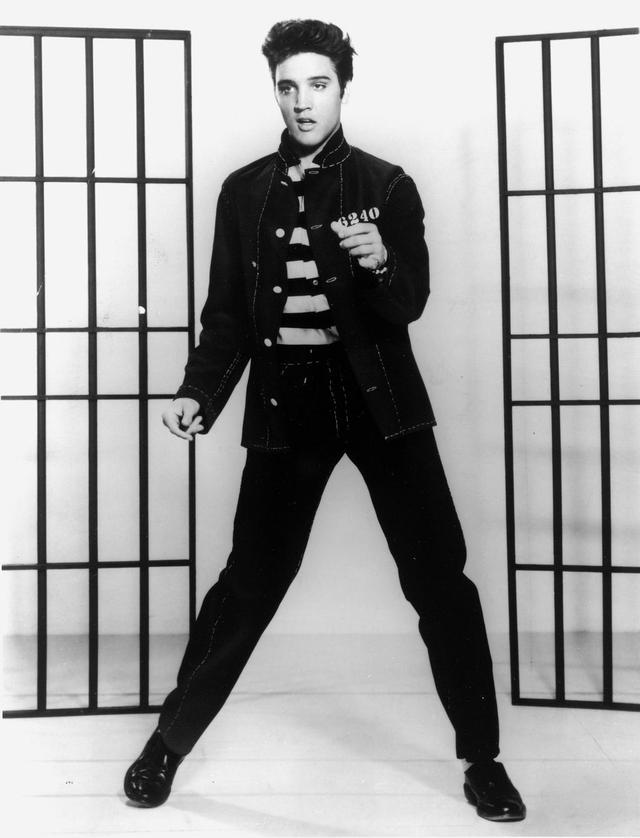
Elvis Presley would make no such apologies when his time came. For a year before the Ed Sullivan Show would dare televise him only from the waist up, Presley had been both hated and adored throughout the South. As it would over the Rolling Stones and the Sex Pistols in succeeding decades, so adult blood had run cold at Presley's epic vulgarity that was taken up by the many other "rockabilly" entertainers who flowered in his wake.
Anyone who'd mastered basic techniques could try rockabilly. The core of its contagious backbeat was a slapped double bass and slashing acoustic guitar - supplemented later by drums and, perhaps, vamping piano. Over this rudimentary impetus, you could holler more or less any old how as long as you got "gone" enough to lend unhinged sorcery to the simplistic hep-cat couplets about clothes, lust and doin' the ooby dooby with all your might. Presley's unprecedented chart success was the tip of an iceberg that would make more fortunes than had ever been known in the history of recorded sound. By the later Fifties, every region of the globe seemed to have thrown down and "answer" to Elvis. Needless to say, these sprouted thickest in the States where the likes of Ricky Nelson and the more gifted Eddie Cochran mirrored the King's lop-sided grin, "common" good looks and hot-potato-in-the-mouth singing.
Many thought that Jerry Lee Lewis was simply an Elvis who substituted piano with guitar. There were also black Presleys in Chuck Berry and Little Richard; female ones in Wanda Jackson and Janis Martin; mute ones in guitarist Duane Eddy. A bespectacled one, Buddy Holly made up for a deficit of manifest teen appeal with creative talents - not least of which was an ability to compose simple but atmospheric songs tailored to his elastic adenoids. A pair of "ducktailed" brothers called Everly could be visualized as two Elvi for the price of one but the Capitol record company was lumbered with a pig-in-a-poke in uncooperative Gene Vincent - "The Screaming End" - unreliable in the rock 'n' roll market place against smoother certainties of the post-rockabilly scene with its leaning towards lightweight tunes with jaunty rhythms and saccharine lyrics. There were vinyl indications too that even Elvis intended to drop raucous rock 'n' roll and get on with lush "quality" material on the premise that rock ' n' roll was just another fad that chanced to be going a bit stronger that the jitterbug or the creep.
This was certainly the case in a backwater like Britain, riven with pragmatic if inhibited copies of US hits by home-grown rockers like Tommy Steele and Marty Wilde. But, as it was in the States, rock 'n' roll was here to stay.
However, as peculiar to Britain as the Teddy Boy - a hybrid of Edwardian rake and Mississippi river boat gambler - was skiffle, which was founded on a more sparse instrumentation and even greater primeval rowdiness than rockabilly. Bossing the form throughout its 1957 prime, Lonnie Donegan was, more than Tommy Steele, a British equivalent of Elvis in his vivacious processing of black music for a white audience. If criticized for broadening his appeal, he made skiffle more homogeneously British by merging black rhythms with pub sing along and English folk music.
After Skiffle lost its flavour on the bedpost overnight, many switched their allegiance to less-than-pure-traditional jazz - which was to undergo such a revival around 1960 that several of its older practitioners - notably Acker Bilk - made the charts. However, most surviving skiffle groups - including many hit-makers from later eras of pop - backslid via wary amplification to playing selections from an increasingly more Americans UK Top 20 in local ballrooms. These provided a link from youth clubs bashes to package tours on the "scream circuit", with a recording contract as a far-fetched afterthought.
With internal sources of new material, the Beatles and other self-created beat groups would give tinpan alley a nasty turn within a few years. In the early Sixties, however, the jobbing tunesmith was an indispensable staple of the record business. In New York's Brill Building, there was even a song-writing "factory" where such stars-in-embryo as Carole King and Neil Sedaka churned out inconsequential but maddeningly catchy doggerel to be whistled by the milkman while the powers that be prepared to market another ditty by reworking the same precept from a slightly different angle.
The US hit parade - and, by implications, those everywhere else - became constipated with one-shot novelties and assembly-line items by insipidly handsome boys-next-door like Bobby Rydell, Bobby Vinton and Bobby Vee. Another sign of stagnation was the high Hot 100 placings of variations on the twist - as much the latest rave world wide as trad had been in British alone. Its Acker Bilk was former chicken-plucker Chubby Checker but all manner of unlikely artists, including Sinatra, were releasing twist records. Worse, it wouldn't go away - maybe because you were too spoiled for choice with alternative dances like the locomotion, the madison, the ungainly turkey trot, the mashed potato, the limbo and even a revival of the charleston. Little dates a Sixties film more than a twist sequence, and, to this day, the elderly will slip into it whenever the music hots up at a dinner and dance.
As hot a property in his way as Checker was Phil Spector, a New York producer, famous for his spatial "wall of sound" technique. Styling himself "the Svengali of Sound", Spector remains best known for hits with two beehive-and-net-petticoat vocal groups, the Crystals and the Ronettes.
Other noteworthy Top 10 newcomers included Roy Orbison with his hillbilly operatic pitch, and Gene Pitney who warped his polished tenor to an incomparable dentist-drill whine. At the latter end of the 3-year hiatus from 1960 came California's Beach Boys who, with their rivals, Jan and Dean, ruled celebrated surfing and its companion sport, hot-rod racing, with a rock 'n' roll chug overlaid with breathtaking chorale. Like Orbison, Pitney and few others from this period, the Beach Boys proved sturdy enough to outlast the prettiest Bobby.
