 First Interactive TV, now the Interactive Execution
 Well, it's the other way round, actually. Interactive executions came first.
It works like this. If the person is being executed for murder, and you relative of the victiare a close m, you can pardon the murderer and opt for "blood money" instead. And you can do that at any point up to the swing of the sword blade.
Last-Minute Pardon Saves Youth From Executioner�s Sword
TABUK, 28 March 2004 � The execution of a murderer was averted with only moments to spare in the crowded execution square here, according to a local press report.The executioner was about to do his duty when the father of the murder victim, Ayed ibn Muhammad Sabr, shouted at police to stop the execution of Abdul Kareem Al-Ghoraid, 20, because he forgave him.
The killer had spent five years in prison, where he memorized the Qur�an.
Joy and tears mingled as the family of Abdul Kareem prayed for the father and thanked him for forgiving their son.
Timing is everything. Too early and you don't get enough tension built up and released. Too late...and it could be too late.

In 2003 executions by shooting were carried out in Chad (9), China (number unknown), Uganda (3), Vietnam (52), and Yemen (3 reported, but almost certainly more). 2 female executions were recorded in China for murder. Shooting is used by 69 or so countries and is the sole method in around 42 of them. Chinese shootings are carried out by a single bullet to the back of the head.
Description: For execution by this method, the inmate is typically bound to a chair with leather straps across his waist and head, in front of an oval-shaped canvas wall. The chair is surrounded by sandbags to absorb the inmate's blood. A black hood is pulled over the inmate's head. A doctor locates the inmate's heart with a stethoscope and pins a circular white cloth target over it. Standing in an enclosure 20 feet away, five shooters are armed with .30 caliber rifles loaded with single rounds. One of the shooters is given blank rounds. Each of the shooters aims his rifle through a slot in the canvas and fires at the inmate. (Weisberg, 1991)
The prisoner dies as a result of blood loss caused by rupture of the heart or a large blood vessel, or tearing of the lungs. The person shot loses consciousness when shock causes a fall in the supply of blood to the brain. If the shooters miss the heart, by accident or intention, the prisoner bleeds to death slowly. (Hillman, 1992 and Weisberg, 1991)
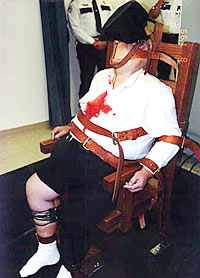 Seeking a more humane method of execution than hanging, New York built the first electric chair in 1888 and executed William Kemmler in 1890. Soon, other states adopted this execution method. The electric chair was used in 2003, for the execution of Earl Conrad Bramblett in Virginia. He had elected this method.
Description: For execution by the electric chair, the person is usually shaved and strapped to a chair with belts that cross his chest, groin, legs, and arms. A metal skullcap-shaped electrode is attached to the scalp and forehead over a sponge moistened with saline. The sponge must not be too wet or the saline short-circuits the electric current, and not too dry, as it would then have a very high resistance. An additional electrode is moistened with conductive jelly (Electro-Creme) and attached to a portion of the prisoner's leg that has been shaved to reduce resistance to electricity. The prisoner is then blindfolded. (Hillman, 1992 and Weisberg, 1991)
After the execution team has withdrawn to the observation room, the warden signals the executioner, who pulls a handle to connect the power supply. A jolt of between 500 and 2000 volts, which lasts for about 30 seconds, is given. The current surges and is then turned off, at which time the body is seen to relax. The doctors wait a few seconds for the body to cool down and then check to see if the inmate's heart is still beating. If it is, another jolt is applied. This process continues until the prisoner is dead. The prisoner's hands often grip the chair and there may be violent movement of the limbs which can result in dislocation or fractures. The tissues swell. Defecation occurs. Steam or smoke rises and there is a smell of burning. (Hillman, 1992 and Weisberg, 1991)
US Supreme Court Justice William Brennan once offered the following description of an execution by electric chair:
..the prisoner's eyeballs sometimes pop out and rest on [his] cheeks.