|
|
EXECUTIONSInteractive Execution First Interactive TV, now the Interactive Execution First Interactive TV, now the Interactive Execution Well, it's the other way round, actually. Interactive executions came first. It works like this. If the person is being executed for murder, and you are a close relative of the victim, you can pardon the murderer and opt for "blood money" instead. And you can do that at any point up to the swing of the sword blade. Last-Minute Pardon Saves Youth From Executioner�s Sword TABUK, 28 March 2004 � The execution of a murderer was averted with only moments to spare in the crowded execution square here, according to a local press report. The executioner was about to do his duty when the father of the murder victim, Ayed ibn Muhammad Sabr, shouted at police to stop the execution of Abdul Kareem Al-Ghoraid, 20, because he forgave him. The killer had spent five years in prison, where he memorized the Qur�an. Joy and tears mingled as the family of Abdul Kareem prayed for the father and thanked him for forgiving their son. Timing is everything. Too early and you don't get enough tension built up and released. Too late...and it could be too late. The Two Chops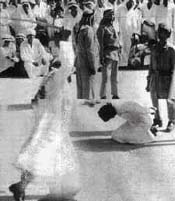 A be-heading scene in Saudi Arabia posted on internet. The photo has been taken just a moment before the chopping off of the head of the convict. RIYADH, Saudi Arabia - A man who shot and killed an acquaintance after an argument was beheaded Tuesday in one of two executions in Saudi Arabia, the Interior Ministry said. In the second execution, Mohammed Wahab Rowaidad, a Pakistani, was beheaded in the western port of Jiddah for smuggling heroin into the country. Saudi laws do not probably provide for well established and elaborate procedures to safeguard the innocents.
>
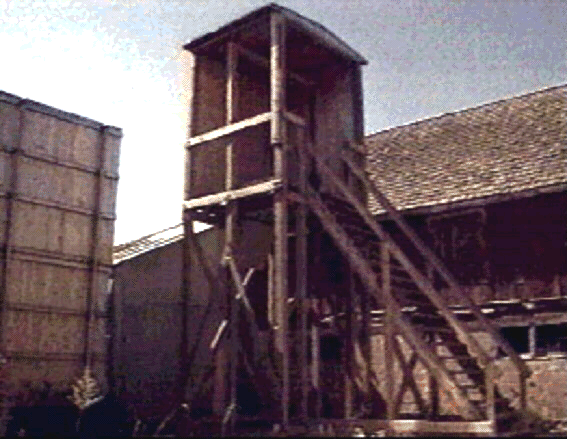
hangingHANGING Procedure: Prior to any execution, the gallows area trap door and release mechanisms are inspected for proper operation. The rope, which is of manila hemp of at least 3/4"and not more than 1 1/4"in diameter and approximately 30 feet in length, is soaked and then stretched while drying to eliminate any spring, stiffness, or tendency to coil. The hangman's knot, which is tied pursuant to military regulations, is treated with wax, soap, or clear oil, to ensure that the rope slides smoothly through the knot. The end of the rope which does not contain the noose is tied to a grommet in the ceiling and then is tied off to a metal T_shaped bracket, which takes the force delivered by the offender's drop. Additionally, prior to an execution, the condemned offender's file is reviewed to determine if there are any unusual characteristics the offender possesses that might warrant deviation from field instructions on hanging. A physical examination and measuring process is conducted to assure almost instant death and a minimum of bruising. If careful measuring and planning is not done, strangulation, obstructed blood flow, or beheading could result. At the appropriate time on execution day, the inmate, in restraints, is escorted to the gallows area and is placed standing over a hinged trap door from which the offender will be dropped. Following the offender's last statement, a hood is placed over the offender's head. Restraints are also applied. If the offender refuses to stand or cannot stand, he is placed on a collapse board. A determination of the proper amount of the drop of the condemned offender through the trap door is calculated using a standard military execution chart for hanging. The "drop" must be based on the prisoner's weight, to deliver 1260 foot_pounds of force to the neck. The noose is then placed snugly around the convict's neck, behind his or her left ear, which will cause the neck to snap. The trap door then opens, and the convict drops. If properly done, death is caused by dislocation of the third and fourth cervical vertebrae, or by asphyxiation. A button mechanically releases the trap door and escorts then move to the lower floor location to assist in the removal of the offender's body. (See Washington Execution Procedures). History: Hanging is the oldest method of execution in the United States, but fell into disfavor in the 20th century after many botched attempts, and was replaced by electrocution as the most common method. There have been only 3 executions by hanging since 1977: Westley Dodd (WA 1993), Charles Campbell (WA 1994), and Billy Bailey (DE 1998). Current Application: Only 3 states, Delaware, New Hampshire, and Washington, currently authorize hanging as a method of execution, all as an alternative to lethal injection, depending upon the choice of the inmate, whether injection is �impractical, or the possibility of lethal injection being held unconstitutional. As of June 1, 2004, 3 of 912 executions (0.3%) performed since 1976 have been by hanging.Lethal Injection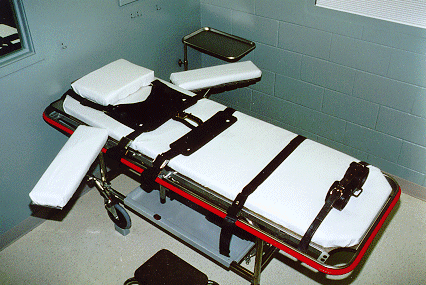 LETHAL INJECTION
Procedure: State statutes typically provide: "The punishment of death must be inflicted by continuous, intravenous administration of a lethal quantity of an ultrashort-acting barbiturate in combination with a chemical paralytic agent until death is pronounced by a licensed physician according to accepted standards of medical practice."
The execution protocol for most jurisdictions authorizes the use of a combination of three drugs. The first, sodium thiopental or sodium pentothal, is a barbiturate that renders the prisoner unconscious. The second, pancuronium bromide, is a muscle relaxant that paralyzes the diaphragm and lungs. The third, potassium chloride, causes cardiac arrest. Each chemical is lethal in the amounts administered.
The inmate is escorted into the execution chamber and is strapped onto a gurney with ankle and wrist restraints. The inmate is connected to a cardiac monitor which is connected to a printer outside the execution chamber. An IV is started in two usable veins, one in each arm, and a flow of normal saline solution is administered at a slow rate. One line is held in reserve in case of a blockage or malfunction in the other. At the warden�s signal, 5.0 grams of sodium pentothal (in 20 cc of diluent) is administered, then the line is flushed with sterile normal saline solution. This is followed by 50 cc of pancuronium bromide, a saline flush, and finally, 50 cc of potassium chloride. (See California Execution Procedures).
The most common problem encountered is collapsing veins and the inability to properly insert the IV. Some states allow for a Thorazine or sedative injection to facilitate IV insertion.
History: Lethal injection had first been proposed as a means of execution in 1888 when New York considered it but ultimately opted for electrocution. In 1977, Oklahoma became the first state to adopt lethal injection. Texas performed the first execution by lethal injection in 1982 with the execution of Charlie Brooks.
Current Application: 17 states and the federal government authorize lethal injection as the sole method of execution. 20 other states provide for lethal injection as the primary method of execution, but provide alternative methods depending upon the choice of the inmate, the date of the execution or sentence, or the possibility of the method being held unconstitutional. As of June1 2004, 744 of 912 executions (82%) performed since 1976 have been by lethal injection, including 258 of the last 261 execution
LETHAL INJECTION
Procedure: State statutes typically provide: "The punishment of death must be inflicted by continuous, intravenous administration of a lethal quantity of an ultrashort-acting barbiturate in combination with a chemical paralytic agent until death is pronounced by a licensed physician according to accepted standards of medical practice."
The execution protocol for most jurisdictions authorizes the use of a combination of three drugs. The first, sodium thiopental or sodium pentothal, is a barbiturate that renders the prisoner unconscious. The second, pancuronium bromide, is a muscle relaxant that paralyzes the diaphragm and lungs. The third, potassium chloride, causes cardiac arrest. Each chemical is lethal in the amounts administered.
The inmate is escorted into the execution chamber and is strapped onto a gurney with ankle and wrist restraints. The inmate is connected to a cardiac monitor which is connected to a printer outside the execution chamber. An IV is started in two usable veins, one in each arm, and a flow of normal saline solution is administered at a slow rate. One line is held in reserve in case of a blockage or malfunction in the other. At the warden�s signal, 5.0 grams of sodium pentothal (in 20 cc of diluent) is administered, then the line is flushed with sterile normal saline solution. This is followed by 50 cc of pancuronium bromide, a saline flush, and finally, 50 cc of potassium chloride. (See California Execution Procedures).
The most common problem encountered is collapsing veins and the inability to properly insert the IV. Some states allow for a Thorazine or sedative injection to facilitate IV insertion.
History: Lethal injection had first been proposed as a means of execution in 1888 when New York considered it but ultimately opted for electrocution. In 1977, Oklahoma became the first state to adopt lethal injection. Texas performed the first execution by lethal injection in 1982 with the execution of Charlie Brooks.
Current Application: 17 states and the federal government authorize lethal injection as the sole method of execution. 20 other states provide for lethal injection as the primary method of execution, but provide alternative methods depending upon the choice of the inmate, the date of the execution or sentence, or the possibility of the method being held unconstitutional. As of June1 2004, 744 of 912 executions (82%) performed since 1976 have been by lethal injection, including 258 of the last 261 execution
| Links China USA Iran Tops Executions China USA Iran Tops ExecutionsEssay Support capital Punishment | China USA Iran Tops Executions

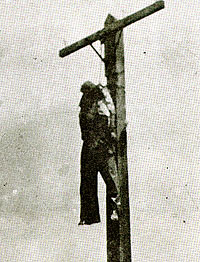
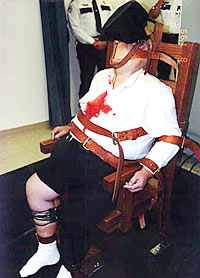 Seeking a more humane method of execution than hanging, New York built the first electric chair in 1888 and executed William Kemmler in 1890. Soon, other states adopted this execution method. The electric chair was used in 2003, for the execution of Earl Conrad Bramblett in Virginia. He had elected this method.