|

TARALGA
Population: 341 (1996 census)
Brief History
Taralga lies about 40 kms from Goulburn amidst rolling plains north of the Cockbundoon Ranges. Also, it is about half way
between Goulburn and Wombeyan Caves. To make your trip worth the while to take a scenic drive north from Goulburn to
Taralga and on to Crookwell and the other villages in the north of the Tablelands.
The rich grazing land here was first traversed by Meehan and Throsby in 1819. These explorers opened most of the Tablelands
for European settlement.
On this occasion, Meehan and Throsby were on a mission from Governor Macquarie to find an overland route from the new
settlements at Cowpastures and Bong Bong to Bathurst in the north. Finding a route of direct access over the Blue Mountains
was particularly difficult.
Legend has it that Throsby also had been secretly commissioned to find more pastures for the land hungry Macarthurs. On
seeing the rich land around what was to become Taralga, a horseman was despatched post haste back to Sydney to stake claims
over it.
Needless to say, when Oxley and Commissioner Bigge passed by a year later on a journey from Bathurst to Sydney Hannibal
Macarthur, brother to John, and his cousin James had established large holdings on which they were grazing cattle.
Within 10 years, they had been joined by others. Many of these became absentee landlords. Taralga was recognised as a
settlement in 1825. The village was not incorporated until many years later.
The area around Taralga was the traditional land of the Burra Burra peoples. They were a warlike tribe who often clashed
with neighbouring tribes. Although there were no major clashes with the Europeans to have been recorded (or having
favourable tales of collaboration with them), their last great gathering or corroboree seems to have been in the 1830s
after which they fade from history.
For the first few decades, most of the settlers were convicts assigned to the landowners. These convicts were the ones who
cleared most of the land, built the huts and houses, and ran the farms. Life for them, if contemporary anecdotes are to be
believed, was particularly harsh if not brutal.
The first semblance of a village was of their huts. One of the huts belonged to Thomas Denning who was sheep overseer for
the Macarthurs. The hut that belongs to Duncan Rankin (who is the public pound keeper) was built in the 1840s and is near
the site of the present day town.
Taralga as a town was established in the 1860s. A school was started in 1857. Religion spread throughout the region with
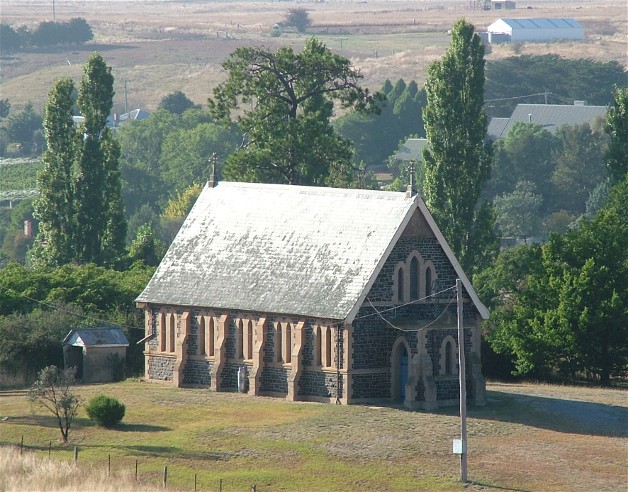
the Presbyterian Church being built in 1861, St. Ignatius Roman Catholic Church being built in 1864, St. Lukes Anglican
Church being built in 1866, and there was a Methodist Church that was built in 1868. The Methodist Church building is now
the Historical Society building). There were a number of stores, smiths and artisans' businesses and two hotels recorded
in 1866.
The original main street was Macarthur Street, not the present one, and some of the earliest buildings can be found
there.
The rapid expansion after the 1860s was partly due to the influx of migrants following the gold rushes, and the Land Acts
of 1861 which made it possible for people to take up small grants from the government at favourable rates.
Taralga differs from many towns in that a large proportion of its existing buildings date from the 1860s to 1890s (although
now subject to later uses) and because most of them are of stone construction - built from the vast number of stones and
rocks which litter the volcanic soils for miles around.
These two combined to produce an architectural style which is unique to Taralga - not quite Georgian, not quite Victorian
- with a tendency to larger windows and quite substantial construction even for modest dwellings. It also means that the
town retains a special heritage of particular interest to the traveller.
The population of Taralga has fluctuated over time. It was 100 or so in 1863 and then it climbed to over 700 thirty years
later. Following that surge in growth, the population decline to half the size immediately after the depression of the 1890s.
By the mid 1950s it had regained almost its largest size, but today houses just some 370.
Taralga has been, as might be expected a rural centre for most of its life, with businesses and small industries catering
to the needs of the farmer. First mooted in the 1880s, a rural railway branch line from Goulburn was finally built in 1926
(now closed), and an electricity plant set up in the 1930s.
Like most other rural areas it suffered a decline after the 1950s as the motor car brought the outside world closer,
and Crookwell then Goulburn became the centres for local business.
Today Taralga is sleepy but friendly town often visited by travellers to and from the Wombeyan Caves.
Its tree-lined main street presents an impressive spectacle, and the many interesting and historic buildings make a stop
and stroll around the streets most worthwhile.
Major Events & Festivals
January:
Taralga Australia Day Rodeo Plus
March:
Agricultural, Pastoral & Horticultural Association Show
October: Historical Society Open Day
What to See and Do For Visitors.
The whole of Taralga can be regarded as an unspoilt heritage town with many well preserved and restored buildings from
the mid to late 19th century with a distinct architectural style. The stone from which they were constructed was not
quarried, but cleared from the soil of the pastures from miles around.
It is best to park the car and get a guide map from one of the pubs or stores and take a stroll around its streets to
discover some of the interesting buildings and past of the town.
There are two good pubs with accommodation and restaurants and a warm welcome for visitors, plus a couple of good B&Bs
and a farmstay if you would like to linger a while. Also cafes and licensed club; picnic area in the park in the middle
of town.
The historical society's museum, which is in the old Methodist Church, can be opened on weekends for visitors. Visitors need
to enquire at the Taralga Inn.
On Australia Day weekends each year, Taralga is host to thousands of visitors who come for the Rodeo and a taste of country
life. Taralga is also developing as one of Australia's newest cool climate wine growing areas. Honeysuckle Cottage in the
main street offers lunch, wine tastings and group tours of Cushendall boutique winery and vineyard (by arrangement).
At other times of the year, the area offers beautiful rural scenery and country drives, the famous
Wombeyan Caves
to the north, and fishing and camping next to mountain streams nearby. For Kids,
Taralga is a place to get out of the car and go
for a stroll. There are many strange and interesting old buildings to look at. If you get the chance, look at the stuff in
the local museum, and the old farm machinery, sheds and 150 year old house that is on the main street. In town, there is
a good cafe and takeaway. At one of the pubs there is a kids' entertainment room. This pub also has a kids' menu if you
want to eat in style.
If you're lucky, you might get to visit or stay at one of the farms near town or camp out in January and visit the Rodeo.
Further north up the road is the magical and spooky Wombeyan Caves.


BACK to
SITE MAP

Hosted by:

Website designed by:
All Written Material unless specified is by Rev. John Clewer
No part may be reproduced without prior permission by John Clewer
(Main Graphics, Logos, Photos, and Text restricted use)
© 2008 - Present
|