Me | Diary | London | Books | Links | Home | Monty Clift

| |
|
Me | Diary | London | Books | Links | Home | Monty Clift |
|
|
 |
More books I've really enjoyed reading. Click on titles to buy...
The Great Olympic Swindle by Andrew Jennings.
The third book in Andrew Jennings' Olympic investigative trilogy. It reveals how crooked sports leaders, their sponsors, gangsters and dope peddlers conspired to dupe the public, concealing corruption, fraud and organised crime. There are horrific accounts in here of how amateur boxing is fixed and how the International Olympic Committee feathers its own nest at the expense of sport. In addition, there's more on how the so-called reform of the movement
has failed.
The New Lords of the Rings by Andrew Jennings.
The world of modern Olympic sport is a secretive domain where decisions are taken behind closed doors, where money is spent on creating a fabulous life-style for a tiny circle of officials and funds destined for sport are siphoned away. This is an updated version of a 1992 book which reveals the truth behind the
International Olympic Committee, the corruption involved in the bid process, how the IOC has covered up the problem of drugs in sport and so on. Read it and weep - the Olympic Games are not what you think they are. But is that any wonder when it's most recent president, Samaranch, was a key fascist in Franco's regime...
The Soul of Indiscretion: Tom Driberg by Francis Wheen.
Driberg was a strange man - leading Labour politician, gossip and
journalist, committed Christian and homosexual. With that in mind, it's no surprise that this political biography is a lot of fun. Born early in the 20th century, he was soon breaking free of his tedious and austere family life and enjoying the benefits of a decent middle class education. But it was on the Daily Express that he made his name, as the paper's first William Hickey columnist. An early supporter of the Communist Party, he entered Parliament during the war as an independent before joining Labour. He never attained high office, partly perhaps because his penchant for hanging around in public toilets with young men was all too well known. Wheen's biography
is often hilarious, sometimes disappointing but it's certainly one of the liveliest biographies of a politician I've read in years.
The Neandertal Enigma by James Shreeve. Penguin.
So why did the Neandertals die out, leaving the way clear for modern man to conquer the planet? In this book, Shreeve attempts to find an answer. He outlines the existing theories while exploring the evidence unearthed at the many archaeological sites around the world. In the end he comes up with his own explanation - and an intriguing one it is too. Clear and readable, this is one for the non-specialists like myself.
The Wildest Dream by Peter and Leni Gillman. Headline. A biography of George Mallory, the man who tried to climb Everest three times in the 1920s and who died on his final attempt. This is a fantastic read and the authors really get under the skin of their subject - a determined, liberal, sometimes arrogant man whose short life was packed full of incident, danger, tragedy and famous friends. Excellent.
A History of London by Stephen Inwood. Macmillan. A mammoth book - about 1,000 pages - but a fantastic read from beginning to end. Inwood tells the story of the city from the earliest Roman settlement up to the modern day but this isn't dry stuff. He breaks his chapters down into themes and concentrates on the human story - making it far more readable than many other books on the subject. It may take you an age to get to the end, but it's an enjoyable journey.
Alan Turing: The Enigma by Andrew Hodges. Vintage.
Turing was the mathematician who broke the wartime Enigma code - vital to allied success - and who went on to be the father of the modern computer. This is the story of his life, written with warmth and compassion. It's a vast and detailed book, describing his childhood, his work in maths, the secret code-breaking career and his efforts to pioneer computers. At times it gets horrendously technical with long discussions about mathematical theories and technology - all way above my head. What saves it is the story of the man himself - a loner, a gay man who suffered at the hands of the law and society and who went on to kill himself at a young age. It's a book best reserved for people with a good understanding of maths and computers. Buy in the US
The Arrogance of Power. The Secret World of Richard Nixon by Anthony Summers. Victor Gollancz.
If you thought Richard Nixon was innocent of the Watergate break-ins, the victim of the plotters around him, this book will change your mind. Veteran investigative journalist Summers digs deep into Nixon's past to reveal decades of wrong-doing and dubious activities, involving personal and political financing, links with the mob, unsavoury businessmen and political machinations. While some of the evidence Summers produces may be circumstantial, the whole leaves a nasty taste in the mouth and there must be little doubt the man was an out and out crook. Add to that Watergate, bizarre mental behaviour and his alleged drinking, pill-popping and wife-beating, and you have a gripping if sometimes heavygoing read. Not a conventional biography, this goes for the jugular.
Tallulah Bankhead: A Scandalous Life by David Bret. Robson Books.
The life and times of one of Broadway's most outrageous actresses. This is no great biography - and Bret is not my favourite writer - but this an adequate insight into the career and bisexual private life of one of the campest stars ever. Full of her great, witty quotes, this concentrates more on what went on behind closed doors and offers less about her work on stage and screen. Still, a fun read. Buy in the US
Burt Lancaster by Kate Buford. Aurum Press.
One of the Hollywood greats, Burt Lancaster was a man of many faces. The boy from New York grew up to become one of the leading circus acrobats of his generation before Hollywood knocked on his door. There followed a string of great - and sometimes average - movies; he fought the system by setting up his own production company; and he risked his own future by gambling on some often low budget, art house films - often European-based. What emerges is a picture of a complicated man - devoted to his family yet with a sexual appetite that threw him into the arms of both sexes; a desire to prove himself as an intellectual; a risk-taker who challenged the establishment with often dangerous radical views. It would appear that only in later life did he find real contentment. This is a good book about a fine actor.
RFK by C David Heymann. Arrow.
This biography of Robert Kennedy is a great introduction to the man born to America's royal family but destined to be assassinated in 1968. On the way he helped his brother JFK in his bid to become President and went on to serve as Attorney General and as a senator. Heymann's book is wonderfully readable and full of insight and scandals surrounding RFK's complicated sex life, his clashes with Hoffa and the mob and his run-in with Marilyn Monroe. For conspiracy theorists, there is little here to get your teeth into - there simply isn't room to cover all the evidence surrounding JFK's killing or his supposed role in Monroe's death - but as a biography it is great stuff. What emerges is a complicated, sometimes sensitive and at others ruthless individual. No wonder his family went bonkers.
The River by Edward Hooper. Penguin.
A massive 800-page examination of the source of HIV and AIDS, this is at times heavy going but full of fascinating information. The author claims that HIV was introduced into humans through contaminated oral polio vaccines given out in African trials during the late 50s - and has amassed a lot of evidence to back his claims. Widely condemned by the scientific community, the theory suffers from being based mostly on circumstantial evidence - but then most of the HIV origin theories are. Intriguing, dense, often technical and littered with examples of where science has gone wrong in the past, this is not a simple read but is ultimately rewarding.
I Claudius and Claudius the God by Robert Graves. Penguin.
Although written more than 50 years ago, these great historical novels tell the story of the famously lame and stuttering historian who found himself Emperor of Rome. The two works, available in the same volume, are packed with tales of intrigue, corruption, sex, murder, incest and general mayhem. Written as an autobiography on the part of Claudius, we learn about Rome under Augustus, Tiberius, the rather bonkers Caligula and Claudius himself. It's largely based on the remaining historical sources, with Graves' imagination filling in the blanks. Not exactly pure history, but hugely entertaining, bloodthirsty and dirty!
Bruce Chatwin by Nicholas Shakespeare. Vintage.
Bruce Chatwin was one of the UK's most extraordinary writers of the post-war years, and as the reviews have stated he was also something of an enigma. He had worked as an art expert and studied archaeology before turning his hand to journalism and both fiction and non-fiction works. But his books defied description - the lazy would call it travel writing but Chatwin was keen to explore much deeper themes in his publications. Shakespeare's wonderful biography paints a picture of a complex man, at times likeable and at others truly monstrous. He married but mostly had sex with men and was one of the UK's first high-profile AIDS casualties. He could be remarkably generous and at other times rude and selfish. It's a book that will need several readings before you can ever begin to understand the man. Buy in the US
|
|
Me | Diary | London | Books | Links | Home | Monty Clift |
 Virginia Woolf by Hermione Lee.
 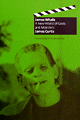 James
Whale: A New World of Gods and Monsters by James Curtis. Faber & Faber.
James
Whale: A New World of Gods and Monsters by James Curtis. Faber & Faber.